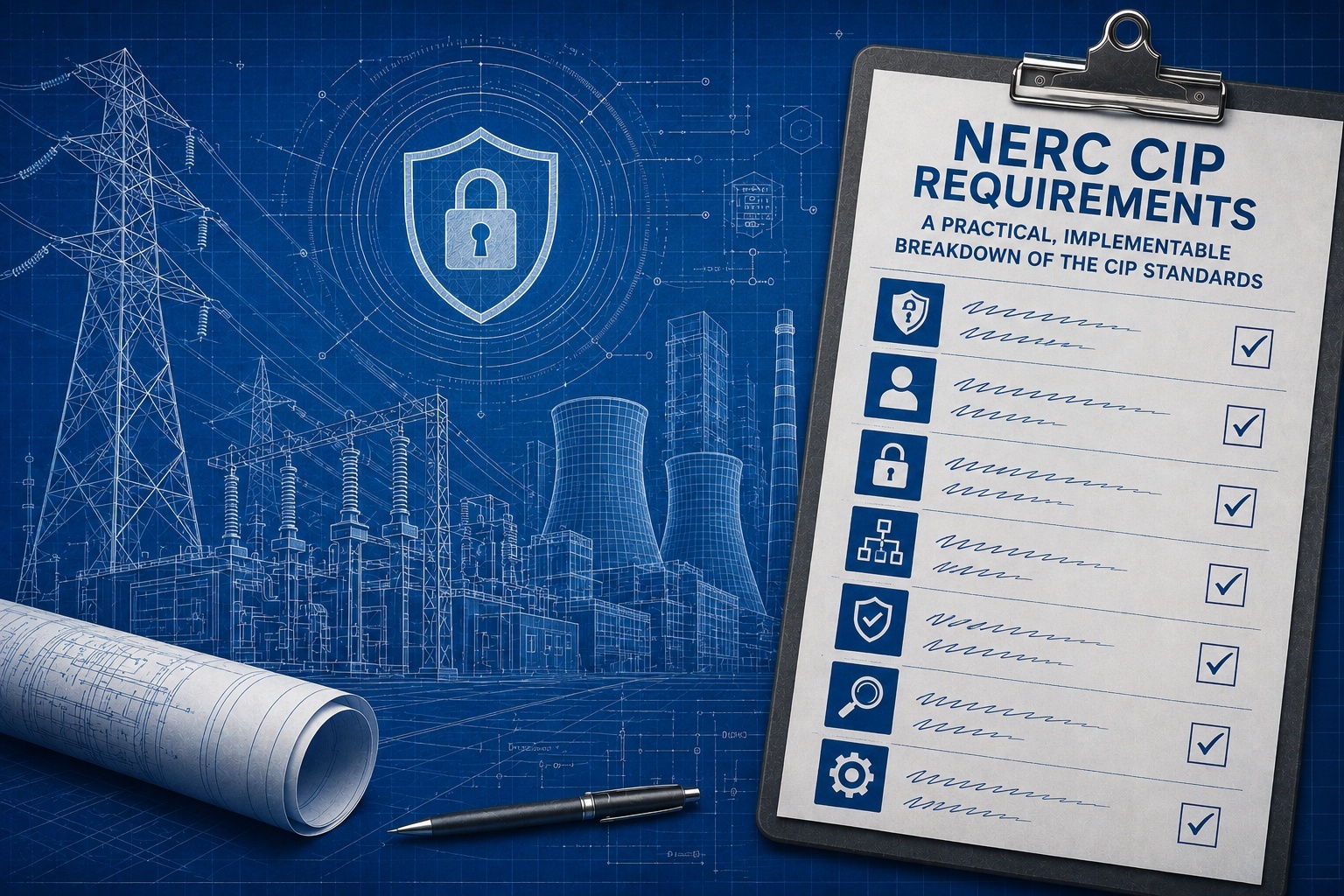
NERC CIP requirements can read like policy language, but operationally they translate into a repeatable security program for the assets that keep the grid running. For OT security architects and engineers, the challenge is not memorizing the standards. It is turning them into controls that hold up under audit and under real attack paths, without disrupting production.
This page breaks down the major CIP standards into what teams actually implement: scoping, access control, patch and vulnerability processes, configuration change control, logging, incident response, recovery, and supply chain. It also calls out where organizations commonly misinterpret requirements and accidentally create risk.
A second challenge is validation. Many teams default to live testing on operational networks, then have to trade realism for safety. Frenos is built for full-scope security testing of industrial environments without touching production systems, using digital twins to safely validate attack paths and control effectiveness. If you want context on why this matters, see Why Traditional OT Security Assessments Risk Production Downtime and How Digital Twins Are Transforming OT Security Testing. For teams evaluating testing approaches, Digital Twin vs Live OT Security Testing is a practical comparison.
Scope note: NERC CIP applicability and implementation details vary by registered entity, functional model, and asset criticality. This page is an implementation guide, not legal advice.
Quick definitions: what “NERC CIP requirements” typically mean
Most practitioners use “NERC CIP requirements” to mean the enforceable controls in the NERC Critical Infrastructure Protection (CIP) Reliability Standards that apply to Bulk Electric System (BES) Cyber Systems.
A few terms that drive everything:
- BES Cyber System (BCS): One or more cyber assets that, if compromised, could impact reliable operation of the BES within specified time horizons.
- BES Cyber Asset (BCA): A programmable electronic device (or grouping) that is part of a BCS.
- Electronic Security Perimeter (ESP): The logical boundary around BCS, typically enforced by firewalls, access controls, and routing.
- Protected Cyber Assets (PCA): Cyber assets that are within an ESP and support BCS.
- Transient Cyber Assets (TCA) and Removable Media (RM): Laptops, vendor tools, and media that are temporarily connected or used to transfer data into the ESP.
- Routable vs non-routable protocols: Important for CIP-005 scoping and access control decisions. Misclassifying traffic is a common audit and security pitfall.
If you get scoping wrong, everything downstream is either noncompliant or wasteful. If you scope correctly but do not validate controls, you are compliant on paper but exposed in practice.
How the CIP standards fit together (a working mental model)
A practical way to interpret the CIP family is as a lifecycle:
- Identify and classify what matters (CIP-002).
- Put boundaries and controlled access around it (CIP-005).
- Control physical access to systems and spaces (CIP-006).
- Baseline and harden systems, manage accounts, monitor and log (CIP-007).
- Keep threats out through portable tools, media, and vendors (CIP-010 and CIP-013).
- Detect and respond when something happens (CIP-008).
- Recover and rebuild reliably (CIP-009).
- Coordinate with other operators and entities (CIP-004 training and organizational controls; plus related requirements across standards).
Teams often treat these as separate compliance workstreams. The stronger approach is to design them as one integrated control set: classification drives perimeter design, perimeter design drives access paths, access paths drive monitoring and incident response, and configuration/change control drives recovery.
Where organizations misinterpret CIP requirements:
- Confusing “documented” with “implemented”: Auditors may accept documentation, but incidents exploit implementation gaps.
- Over-reliance on “air gap” assumptions: Many ESPs have routable paths through jump hosts, vendor access, or overlooked management interfaces.
- Treating patching as a checkbox: CIP focuses on process and risk-based timelines, but real exposure depends on exploitability and compensating controls.
- Assuming a traditional pentest equals validation: Live testing is frequently constrained in OT for safety reasons. If you cannot test realistically, you may not be validating the highest-risk paths. See Why Traditional OT Penetration Testing Puts OT Production at Risk for the operational trade-offs and what to do instead.
CIP-002 (BES Cyber System categorization): what you actually need to do
CIP-002 is the foundation: identify BES Cyber Systems and categorize them (High, Medium, Low impact). Practically, it is a defensible asset and function mapping exercise.
Implementation checklist (practical):
- Inventory what could affect BES reliability: not just control centers and primary SCADA, but supporting servers, gateways, engineering workstations, virtualization hosts, time sources, and remote access infrastructure.
- Map cyber assets to BES functions and time horizons: categorization is driven by the impact to reliable operation, not by how “important” the asset feels.
- Document rationale and boundaries: write down why each system is in or out, what the cyber system comprises, and where the functional boundary sits.
- Keep the inventory maintainable: the common failure is a one-time spreadsheet that becomes stale. Connect asset changes to change management (CIP-010) so categorization stays current.
Common misinterpretations and risk:
- Mistaking network zones for cyber systems: A VLAN or subnet is not automatically a BCS. Conversely, one BCS can span multiple network segments.
- Ignoring management plane dependencies: Hypervisors, backup systems, authentication services, and patch repositories can be in scope if they are required for operation.
- Categorizing “low” as “low risk”: Low impact does not mean low likelihood of exploitation. It often means fewer mandatory controls, which increases the need for smart, targeted compensating controls.
Validation idea:
Use a model of your environment to test whether a supposedly out-of-scope asset can still provide an attack path into an ESP or to a BCS. Digital twin based validation is well-suited here because it can map attack paths without touching production.
CIP-003 and CIP-004: governance and people controls that fail in practice
CIP-003 and CIP-004 are often treated as policy and training. That is a mistake. They determine whether technical controls are consistently operated.
What to implement:
- Roles and responsibilities: define who owns CIP evidence, who owns OT engineering exceptions, and who can approve changes that affect ESP boundaries.
- Access authorization process: ensure that access decisions for OT are tied to operational need, not IT role templates.
- Training that matches workflows: training should cover remote access, transient asset handling, incident escalation, and evidence expectations for operators, engineers, and vendors.
Where teams misinterpret requirements:
- Generic annual training: training that does not address high-risk OT tasks (firmware updates, engineering laptop use, vendor maintenance windows).
- No operational definition of “authorized”: if approvals happen in email without traceability, you will struggle under audit and during incident response.
Practical tip: tie training and authorization to the most common CIP-005 and CIP-010 exceptions. If exceptions repeat, the system design is misaligned with how work is actually done.
CIP-005 (Electronic Security Perimeter): reduce paths, then control them
CIP-005 is about defining ESPs and controlling all electronic access into them. In OT terms, it is your network architecture, remote access design, and rule management discipline.
What “good” looks like operationally:
- Clear ESP boundary: you can point to the enforcing devices and rule sets that define the boundary.
- Minimal inbound paths: remote access is brokered through managed jump infrastructure with strong authentication and session controls.
- No hidden management networks: out-of-band and vendor maintenance paths are inventoried, reviewed, and controlled.
- Documented interactive remote access controls: multi-factor authentication, encryption, and logging are not optional in real-world threat models.
Common misinterpretations:
- Assuming a firewall equals compliance: ESP is not only perimeter devices. It includes rules, services, and how access is provisioned and monitored.
- Overlooking “inside-out” paths: engineering workstations, historians, and update servers inside the ESP often initiate outbound sessions that can be abused for command and control.
- Treating vendor access as a special case: vendors are usually the most privileged remote users. If their path is not the most controlled path, your design is inverted.
Implementation guidance:
- Start with an access path diagram: human remote access, machine-to-machine flows, patch and AV update flows, time sync, historian data exports, backups.
- Define path parameters: For each path, define: protocol, authentication, encryption, allowed destinations, monitoring points, and break-glass procedure.
Validation idea:
Use controlled attack-path testing to confirm that an asset outside the ESP cannot reach protected services inside it, and that a compromised TCA cannot laterally move into sensitive segments. This is exactly where simulated OT penetration testing is valuable because you can test “what if an engineer laptop is compromised” without risking operations. For how Frenos approaches simulated testing, see Platform 3.0 Simulated OT Penetration Testing.
CIP-006 (Physical Security): align physical and cyber boundaries
CIP-006 addresses physical access controls for BES Cyber Systems. OT teams often underestimate how frequently physical access becomes a cyber control bypass.
What to implement:
- Physical security perimeters: match cyber reality: control centers, relay rooms, substation control houses, and any location housing in-scope cyber assets.
- Access logging and review: badge access logs, visitor logs, and camera coverage where required and practical.
- Procedures for maintenance and vendors: define how vendors gain physical access, how they are escorted, and how their tools are handled.
Common failure modes:
- Mismatch in categorization: mismatch between CIP-002 categorization and facility perimeters: assets move, cabinets get repurposed, and the physical scope is not updated.
- “Locked door” without evidence: if you cannot show who entered and when, it is hard to demonstrate control operation.
Practical tip: integrate physical access events into incident triage. If you investigate a suspicious configuration change, you should also check for corresponding physical presence.
CIP-007 (System Security Management): hardening, accounts, logging, and vulnerability processes
CIP-007 is where the daily work lives: account management, ports and services, malware defenses, patching and vulnerability assessments, and security event monitoring.
Implementation checklist (practical):
Account management
- Define account types: operator, engineer, service, vendor, break-glass.
- Control privileged access: separate admin accounts, limit group membership, and review regularly.
- Manage default accounts: Disable or remove default accounts on OT systems where feasible, and document exceptions with compensating controls.
Ports and services
- Baseline allowed services: per system class: HMI, historian, domain services, jump hosts, engineering workstations.
- Enforce allow-listing: at host and network layers when possible.
- Track deviations: through change control (CIP-010).
Security patching and vulnerability assessments
- Maintain a repeatable cycle: identify, evaluate applicability, test, deploy within risk-based timelines, and document.
- Use compensating controls: when patching is not feasible: network segmentation, application allow-listing, protocol restrictions, and monitored access paths.
Malware defenses
- Define malware prevention: traditional AV, application control, removable media scanning, and execution restrictions.
- Plan for updates: in constrained environments: offline update workflows and verification.
Logging and monitoring
- Centralize logs: where feasible: jump hosts, authentication, firewall events, key servers.
- Define alertable events: aligned to your incident response plan (CIP-008).
Common misinterpretations:
- Patching equals security: in OT, patch latency can be inevitable. Your exposure is determined by exploit paths and control coverage, not by patch status alone.
- Vulnerability scans as “proof”: many scanners are unsafe or incomplete in OT. Also, a list of CVEs does not tell you if a CVE is reachable from a realistic adversary foothold.
- Logging without use: collecting logs that nobody reviews does not reduce risk.
Practical framework: “reachability first” vulnerability management
- Step 1: Identify highest-consequence assets (from CIP-002).
- Step 2: Identify plausible initial access points: remote access, TCAs, vendor paths, IT-OT conduits.
- Step 3: Map attack paths from those entry points to high-consequence assets.
- Step 4: Prioritize vulnerabilities and misconfigurations that sit on those paths.
- Step 5: Validate that compensating controls break the path.
This is where Frenos’ approach is differentiated. Instead of forcing live testing that may be constrained or prohibited, teams can validate reachability and control effectiveness in a digital twin and keep assessment downtime near-zero (actual results depend on environment and scope; avoid assuming fixed outcomes).
FAQ
Which NERC CIP standards should I focus on first?
Start with CIP-002 to get scope and categorization defensible. Then prioritize CIP-005 (ESP and access paths), CIP-007 (system security management), and CIP-010 (configuration and change control). These three tend to drive the largest real-world risk reduction because they determine how an attacker could enter, move, and persist.
Will validating CIP controls disrupt production?
It can if you rely on intrusive live testing, broad vulnerability scanning, or uncoordinated exercises. A safer approach is to validate in a simulation environment or digital twin that mirrors OT access paths and key systems. That allows full-scope testing without touching production systems, and it is well-suited to environments where uptime and safety constraints limit live assessment depth.
Is this better than a traditional penetration test?
They answer different questions. A traditional pentest often prioritizes finding exploitable issues quickly, but OT constraints can limit realism and coverage. Control validation focuses on whether your CIP-aligned controls actually prevent and detect the attack paths that matter to BES reliability. Many mature programs use both, with simulation-based validation filling the gaps where live testing is too risky or incomplete.
How long does an OT-focused CIP validation assessment take?
Timing depends on scope, data availability, and how many access paths and ESPs are in play. A practical approach is to start with one high-impact or medium-impact area, validate the highest-risk paths first, then expand iteratively. If you pursue a digital twin based approach, time is often spent on modeling and scenario design rather than negotiating production testing windows.
Do we need complete datasets to create a digital twin for CIP validation?
No. You typically can start with network segmentation and firewall rules, remote access design, identity and authentication flows, asset classes (not every endpoint), and representative configurations for critical systems. The model can be refined as you discover gaps, and the early value usually comes from validating the most important access paths rather than modeling everything at once.
Call to Action
If you want to move from “CIP controls documented” to “CIP controls proven,” request an OT Security Assessment. We will help you map the highest-risk attack paths to your BES Cyber Systems and validate control effectiveness safely through simulation and digital twins, without touching production systems.


.jpg)