
Digital Twin vs Live OT Security Testing: Which Is Safer & More Effective?


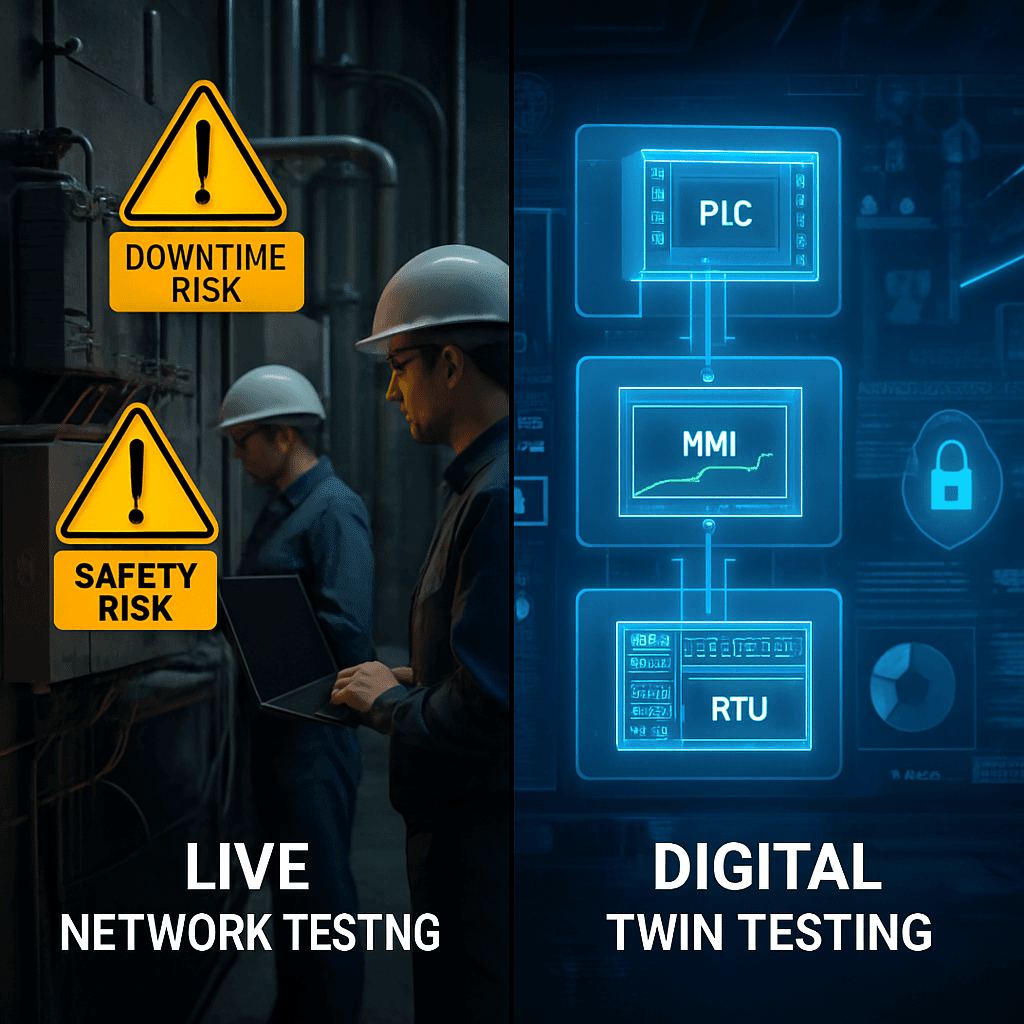
OT security teams face a difficult tradeoff: they need to validate real-world cyber risk, but testing directly on live industrial networks can introduce production downtime, safety issues, and operational instability that cost millions in lost output.
According to Gartner's research on OT security, organizations are increasingly adopting simulation-based testing approaches, with the OT security market expected to reach $26 billion by 2028. That growth is being driven by the need for safer, more comprehensive security validation methods.
This has led organizations to compare two fundamentally different approaches:
- Live network testing - Direct assessment of production or near-production systems
- Digital twin-based testing - Virtualized replica testing in consequence-free environments
Understanding the strengths, limitations, and appropriate use cases for each approach is critical for building an effective OT security strategy. For comprehensive context on testing methodologies, see our OT Penetration Testing guide.
What Is Live Network Testing in OT Security?
Live network testing evaluates security controls by interacting directly with production or near-production OT environments. This traditional approach has been the standard in cybersecurity for decades but was developed primarily for resilient IT infrastructure.
Typical activities include:
- Active scanning of PLCs, RTUs, HMIs, and other OT assets
- Segmentation validation by attempting lateral movement between zones
- Access control testing to verify firewall rules and authentication
- Limited exploitation under strict supervision to prove vulnerabilities
- Protocol testing to validate industrial protocol security (Modbus, DNP3, OPC)
The inherent constraints:
Live testing in OT operates under severe restrictions:
- Narrow testing windows during planned maintenance outages
- Restricted scope excluding critical or fragile systems
- High operational risk where even passive scanning can crash devices
- Typically covers only 5-8% of the total attack surface
According to SANS ICS Security Survey, 47% of organizations report experiencing unintended operational disruptions during live OT security assessments—a risk many industrial operators can no longer accept.
What Is Digital Twin-Based Testing in OT Security?
Digital twin-based testing uses a high-fidelity virtual replica of an OT environment to evaluate security posture without any interaction with production systems. This approach enables comprehensive security validation in a consequence-free simulation environment.
A production-grade digital twin includes:
- Network topology modeling - Complete representation of architecture, segmentation, firewall rules, and access controls
- Asset and protocol simulation - Virtual representations of PLCs, RTUs, HMIs, historians with industrial protocol implementations
- Security control representation - Existing security tools, compensating controls, authentication mechanisms
- Attack path simulation - AI-powered adversary modeling testing millions of scenarios and exploitation chains
The assessment process:
- Data ingestion - Import existing asset inventories, vulnerability scans, network configurations
- Model creation - Build high-fidelity virtual environment matching production
- Adversary simulation - AI agent tests attack scenarios continuously
- Prioritization - Rank findings by actual exploitability in your specific environment
- Continuous assessment - Automatically incorporate changes and retest regularly
Because testing occurs entirely outside the live environment, digital twins enable repeatable, production-safe security validation that can run continuously rather than annually.
Digital Twin vs Live Network Testing: Direct Comparison
The primary distinction between these approaches isn't accuracy—modern digital twins built from actual configuration data are highly accurate. The fundamental difference is risk exposure and coverage capabilities.
| Area | Live Network Testing | Digital Twin Testing |
|---|---|---|
| Production Impact | Possible downtime, system crashes | Zero production impact |
| Safety Risk | Elevated - can trigger fail-safe behaviors | Minimal - isolated from physical processes |
| Test Coverage | 5-8% typical due to safety constraints | 100% - no assets excluded |
| Testing Frequency | Annual or semi-annual | Continuous - daily, weekly, or on-demand |
| Time to Results | 3-5 months from planning to report | Hours to days |
| Cost per Assessment | $50K-$100K per site | 70-80% lower after initial setup |
| Destructive Testing | Impossible - too dangerous | Enabled - test ransomware, DoS safely |
| Audit Evidence | Point-in-time snapshot | Ongoing validation with trends |
Both approaches can uncover vulnerabilities and validate security controls, but they do so under dramatically different operational constraints.
Where Live Network Testing Falls Short
Despite being the traditional standard, live testing struggles with the unique characteristics of operational technology.
Technical limitations:
- Legacy PLCs from the 1990s-2000s can't handle modern scanning tools
- Single points of failure mean one crashed device stops production
- Limited logging makes root cause analysis impossible after incidents
- Recovery procedures measured in hours or days, not minutes
Strategic disadvantages:
- Critical systems excluded from testing are often the highest risk targets
- Annual testing cycles mean findings are stale within months
- No ability to quickly validate security control effectiveness
- False confidence from testing only "safe" portions of the environment
Research from Dragos World ICS/OT Cybersecurity Year in Review shows that recovery from unplanned OT incidents averages 23 hours, with costs ranging from $100,000 to $5 million depending on industry and facility size.
Why Digital Twins Are Gaining Traction
Digital twin-based testing aligns more naturally with how OT environments actually operate—valuing stability, safety, and uptime while still providing comprehensive security validation.
Key strategic advantages:
Production-safe comprehensive testing:
- Test 100% of assets including critical systems too fragile for live testing
- No possibility of unintended disruptions or safety incidents
- Validate destructive attack scenarios (ransomware, DoS, safety system manipulation)
Continuous security validation:
- Assessments run daily, weekly, or on-demand rather than annually
- Immediate validation of security improvements and control effectiveness
- Track security posture trends over time with quantifiable metrics
Realistic scenario planning:
- Test impact of specific threat actor techniques (Sandworm, Volt Typhoon)
- Model security architecture changes in virtual environment first
- Evaluate compensating controls when patching isn't feasible
Superior compliance evidence:
- Continuous assessment provides current evidence versus stale annual reports
- Comprehensive documentation across all assets
- Trend analysis showing measurable improvement for auditors and boards
Scalability:
- Assess hundreds of sites as easily as one
- Standardized methodology ensures consistency
- Dramatically lower cost per assessment at scale
Organizations across critical infrastructure are adopting digital twin approaches to meet regulatory requirements like NERC CIP, TSA Pipeline Security Directives, and IEC 62443 without risking operational disruption.
When Live Network Testing Still Makes Sense
Despite the advantages of digital twin testing, live network assessment isn't obsolete. Specific circumstances justify traditional approaches.
Appropriate use cases:
- Newly commissioned systems before production integration
- Fully isolated test environments that perfectly mirror production
- Targeted validation of specific digital twin findings for audit purposes
- Highly controlled testing during extended planned outages with operations supervision
- Regulatory requirements specifically mandating live testing evidence (increasingly rare)
The declining window:
These appropriate use cases are becoming increasingly rare:
- Continuous operation demands eliminate testing windows
- Interconnected systems make true isolation nearly impossible
- Organizations less willing to accept testing-related incidents
- Legacy equipment becomes more fragile as it ages
For most organizations, live testing transitions from "primary assessment method" to "occasional validation tool" as digital twin capabilities mature.
Hybrid Approach: Combining Both Methods Strategically
For mature OT security programs, the decision is not "digital twin OR live testing" but rather how to combine them strategically for optimal security insight with minimal operational risk.
Recommended hybrid strategy:
- Establish digital twin as primary assessment method - Deploy platform covering all OT environments with continuous assessment
- Prioritize findings through simulation - Validate which vulnerabilities are actually exploitable in your environment
- Selective live validation only when necessary - Reserve live testing for specific high-value validation needs
- Continuous improvement cycle - Update digital twin as environment changes and reduce live testing frequency
Practical example:
Manufacturing organization with 50 plants:
- Digital twin coverage: All 50 plants assessed monthly
- Annual findings: 12,000+ vulnerabilities identified
- After prioritization: 450 exploitable issues requiring remediation
- Live validation: 15 highest-risk findings validated at 3 representative plants
- Result: 100% coverage with 0.02% exposure to live testing risk
Many organizations following this model:
- Use digital twins for continuous validation (90-95% of testing)
- Reserve live testing for targeted confirmation (5-10% of testing)
- Achieve superior security outcomes with lower operational risk
How This Supports OT Penetration Testing
Digital twin-based testing is increasingly becoming the foundation for effective OT penetration testing programs, enabling capabilities that traditional approaches cannot safely provide.
Enhanced penetration testing capabilities:
- Safe attack path validation - Test complete kill chains from initial access to impact without risk
- Threat actor simulation - Model specific threat groups' techniques and ICS-specific malware safely
- Remediation validation - Test proposed fixes before touching production
- Continuous penetration testing - Shift from annual assessments to ongoing validation
This inverts the risk model—comprehensive testing occurs safely, with targeted production validation only when absolutely necessary.
For detailed guidance on safe testing methodologies, see our article Why Your Next OT Penetration Test Should Be Simulated.
Making the Decision: Which Approach Is Right for You?
Choose digital twin as your primary approach if:
✓ You operate critical infrastructure where downtime has severe consequences
✓ Your environment includes legacy systems that can't tolerate aggressive testing
✓ You need to assess security posture more frequently than annual cycles
✓ You require comprehensive coverage including systems too fragile for live testing
✓ You want quantifiable security improvement metrics for executives and boards
Maintain targeted live testing capability if:
✓ You have regulatory requirements specifically mandating live assessment evidence
✓ You maintain isolated test environments that perfectly mirror production
✓ You need to validate specific digital twin findings for audit purposes
Most organizations benefit from hybrid approaches that:
✓ Use digital twins for continuous comprehensive assessment (90-95% of testing)
✓ Reserve live testing for targeted validation (5-10% of testing)
✓ Progressively reduce live testing scope as digital twin confidence grows
Final Takeaway
Live network testing offers realism and direct evidence, but it also introduces operational risk that many OT environments cannot afford. The 5-8% coverage, high costs, and potential for disruption make it increasingly difficult to justify as a primary assessment approach.
Digital twin-based testing provides a safer, more scalable, and more comprehensive way to assess cyber risk without compromising production. The ability to test continuously, validate destructive scenarios safely, and cover 100% of the attack surface represents a fundamental evolution in OT security methodology.
As OT security programs mature, digital twins are becoming a foundational component of production-safe security testing strategies—not replacing live testing entirely, but dramatically reducing reliance on approaches that introduce unacceptable operational risk.
The question isn't whether to adopt digital twin testing, but how quickly you can implement it and what role targeted live validation will play in your hybrid strategy.
Related Resources

1-Day Simulated OT Pentest
Take a deep dive into understanding how Frenos' simulated OT penetration testing platform allows you to understand and improve your OT security posture at scale.
Read more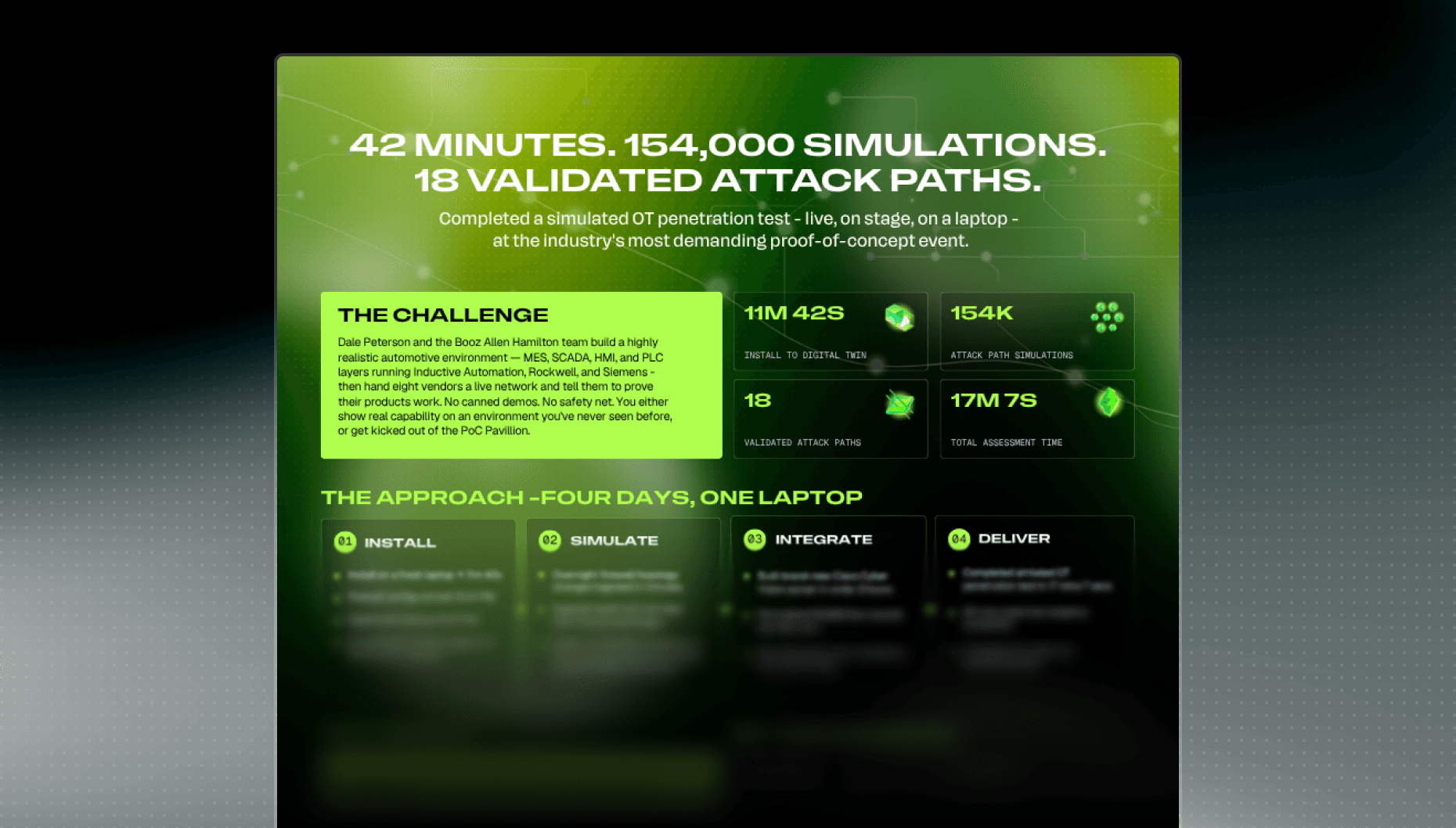
S4x26 Case Study
At the S4x26 POC Pavilion, Frenos completed 154,000 OT attack path simulations in 17 minutes and 7 seconds in a documented engagement. From three assumed-breach starting points (iDMZ, Plant Operations, Enterprise), the platform validated 18 attack paths into the critical Rockwell and Siemens zone. Those paths are exploitable given the actual controls, firewall rules, routing, and configurations modeled in the digital twin.
Read more
Threat Intelligence
Transform static threat intelligence into dynamic attack simulations. Reveal exactly how specific threat actors could compromise your OT environment before they try.
Read more