It has been nearly three years since Microsoft and CISA first disclosed Volt Typhoon, and almost two years since the joint advisory (AA24-038A) confirmed that this PRC state-sponsored group had maintained persistent access to U.S. critical infrastructure for at least five years. By now, that number is closer to seven.
The advisories have been published. The TTPs have been mapped. The industry has had time to read, digest, and act. The uncomfortable question is whether most organizations actually have.
Volt Typhoon was not a one-time breach that got cleaned up. It is a sustained, pre-positioned presence inside energy, water, transportation, and communications networks, designed to enable disruption of OT operations if a geopolitical trigger occurs. The intelligence community has been clear about this. The question for OT defenders is no longer about awareness. It is about whether your internal controls, segmentation, and response plans would actually hold against an adversary who has had years to study your environment from the inside.
What Makes Volt Typhoon Different — And Why OT Cybersecurity Teams Struggle to Detect It
Most threat actors leave artifacts. Volt Typhoon does not.
The group operates almost exclusively through living-off-the-land (LOTL) techniques, relying on PowerShell, WMIC, certutil, netsh, and other native Windows tools that exist in every enterprise environment by design. They do not deploy custom malware. They do not trigger endpoint detection signatures. They blend into normal administrative activity and stay there.
Their credential access follows a well-documented playbook: LSASS memory dumps, Mimikatz for credential harvesting, and NTDS.dit extraction via Volume Shadow Copy to crack domain hashes offline. Once they have valid domain credentials, they move laterally using RDP and PSExec, standard tools that most security monitoring treats as legitimate traffic.
This is the core challenge. Every tactic they use looks like something your own administrators would do.
The IT-to-OT Pivot Is the Real Threat to SCADA Security
Volt Typhoon’s initial access typically targets public-facing edge devices, including Fortinet, Ivanti, Citrix, and Cisco appliances with known or zero-day vulnerabilities. Once inside the IT network, they conduct extensive reconnaissance of network topology, security architecture, and operational protocols.
But the endgame is OT.
In confirmed compromises, CISA observed Volt Typhoon moving to vCenter servers, a strategic position for pivoting to domain-joined OT assets. They were found enumerating stored PuTTY sessions that contained connection profiles for water treatment plants, water wells, and electrical substations.
They have tested access to OT systems using default vendor credentials. They have exfiltrated SCADA documentation, network diagrams, and operations manuals, the exact intelligence needed to plan targeted service disruptions.
This is not opportunistic. It is methodical preparation for operational impact.
Why Traditional OT Security Falls Short
Most OT security programs are built around three pillars: asset visibility, network monitoring, and vulnerability management. These are necessary. They are not sufficient against this threat.
Volt Typhoon’s LOTL approach means there are no malware signatures to detect. Their use of valid credentials means authentication logs show legitimate access. Their patience, maintaining footholds for what is now potentially seven years, means anomaly detection baselines have long since normalized their presence.
Network monitoring will show traffic between IT and OT segments. But it cannot tell you whether your segmentation would survive a coordinated lateral movement campaign using stolen domain admin credentials. Vulnerability scanning identifies missing patches. But it cannot tell you whether an attacker who already has valid credentials could chain together misconfigurations, weak authentication, and trusted communication paths to reach your most critical control systems.
The gap is not in detection. It is in validation.
AI for SCADA Vulnerability Assessment: Simulation Closes the Gap
The only way to know whether your defenses would actually stop a Volt Typhoon-style attack is to test them against one.
Traditional penetration testing rarely addresses this. Most OT pen tests are constrained by the risk of disrupting production systems, which means they stop short of the exact attack paths an adversary would use. Red team exercises are valuable but episodic, expensive, and limited in scope.
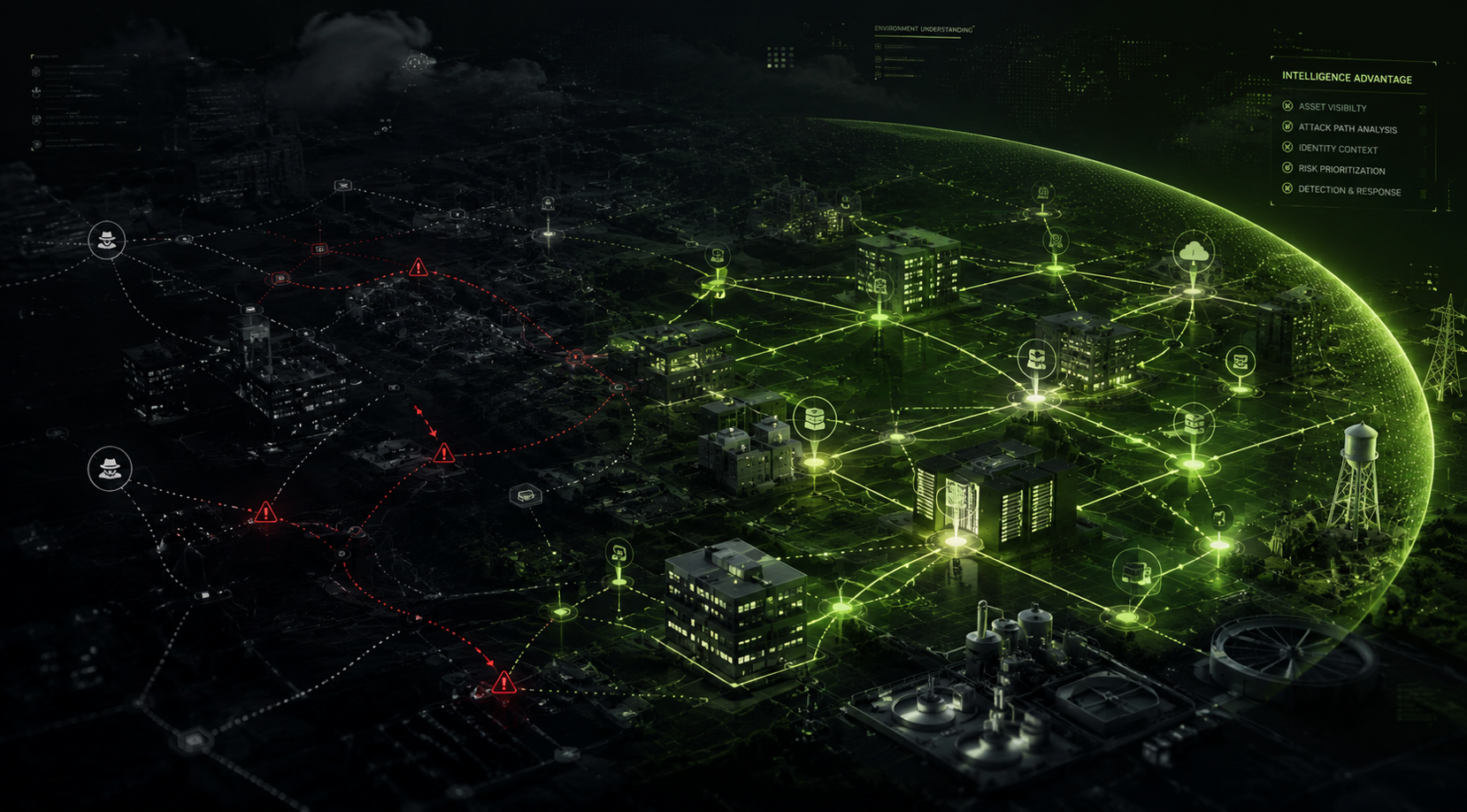
Simulated OT penetration testing built on a cyber digital twin changes the equation. By modeling your OT environment, its network architecture, routing behavior, access controls, firewall zoning, and vulnerabilities, you can safely execute the full Volt Typhoon attack chain without touching production:
- Initial access through compromised edge devices, with vulnerability reachability analysis that evaluates your actual architecture against the ports, protocols, and technical requirements needed to exploit the Fortinet, Ivanti, and Citrix CVEs that Volt Typhoon targets
- Credential harvesting via LSASS and NTDS.dit extraction
- Lateral movement using RDP and PSExec with valid credentials, with multi-path exploitation modeling that reflects how real adversaries adapt when controls block their preferred route
- Living-off-the-land activity modeled through endpoint telemetry, including sysmon data that gives visibility into the exact LOTL techniques Volt Typhoon relies on
- Pivot from IT to OT through domain-joined assets and default vendor credentials
- Segmentation validation through network exposure visualization that clusters networks by firewall zoning, revealing where attack paths cross zone boundaries
This is not a checkbox exercise. It is continuous, evidence-based simulated penetration testing that answers the same questions a red team would ask: what can an attacker reach, how would they get there, and where does the attack chain break. No operational risk. No maintenance window.
What AI-Driven OT Cybersecurity Simulation Reveals
When you model Volt Typhoon’s TTPs against your actual architecture, the results are often uncomfortable, but actionable.
Common findings include segmentation gaps where IT-to-OT firewall rules allow more traffic than security teams realize. Default credentials on domain-joined OT assets that have never been rotated. Stored session profiles like SSH, RDP, and PuTTY configurations that provide direct paths to control systems. Monitoring blind spots where LOTL techniques generate no alerts. And incident response plans that assume detection will happen at the perimeter, not after an attacker has been inside for months.
Each of these is a validated, prioritized finding, not a hypothetical risk score. The Frenos Adversary Intelligence Engine maps over 2,000 discrete adversary actions against MITRE ATT&CK and D3FEND frameworks, enriched with vulnerability intelligence that goes far beyond CVSS scores to evaluate actual exploitability based on your network’s specific architecture. You know exactly which attack paths exist, which controls stop them, and where to invest for the greatest reduction in exposure.
And with comparative threat resilience metrics, you can benchmark your posture against industry peers, answering not just whether your defenses hold, but how your resilience to threats like Volt Typhoon measures against organizations facing the same risk profile.
Three Years of Advisories. Now What for OT Security Leaders?
The industry has had nearly three years to absorb the Volt Typhoon disclosures. CISA, NSA, FBI, and Five Eyes partners have published detailed advisories mapping their TTPs to MITRE ATT&CK for Enterprise and ICS frameworks. The intelligence is thorough, public, and well-understood. That was never the hard part.
The hard part is translating what we know about this adversary into proof that our defenses would actually stop them. Most organizations invested in visibility after the initial disclosures, and that was the right first step. But visibility answers the question of what is in your environment. It does not answer whether your architecture would survive the specific attack chains Volt Typhoon has been refining for the better part of a decade.
Reading an advisory tells you what the adversary does. Simulation tells you whether your defenses would stop them. After three years of knowing exactly how this group operates, that is the only remaining gap worth closing.
Frequently Asked Questions
1. What is Volt Typhoon and why does it matter for OT security?
Volt Typhoon is a state-sponsored threat actor that has maintained persistent access to U.S. critical infrastructure networks using living-off-the-land techniques and valid credentials. For OT security leaders, it matters because the group demonstrates how attackers can move from IT environments into OT and SCADA systems without deploying malware, making traditional detection methods ineffective.
2. Why is Volt Typhoon difficult for OT cybersecurity teams to detect?
Volt Typhoon relies on native administrative tools such as PowerShell, WMIC, and RDP rather than custom malware. Because these tools are legitimate and commonly used in enterprise environments, their activity blends into normal operations. This makes detection based on signatures or anomaly baselines unreliable, particularly in mature OT cybersecurity environments.
3. How does Volt Typhoon threaten SCADA security?
The group has been observed exfiltrating SCADA documentation, network diagrams, and operational manuals while testing default credentials on OT systems. This indicates preparation for potential service disruption. The primary SCADA security risk is not opportunistic access but methodical reconnaissance and pre-positioning for operational impact.
4. Why isn’t traditional OT security enough to stop Volt Typhoon-style attacks?
Traditional OT security programs focus on asset visibility, monitoring, and vulnerability scanning. While necessary, these controls do not validate whether segmentation would survive lateral movement using stolen credentials. Visibility shows what exists. It does not prove whether an attacker could reach critical control systems.
5. What is AI for SCADA vulnerability assessment?
AI for SCADA vulnerability assessment uses adversarial modeling and digital twin simulation to evaluate how real-world attack chains could move through OT and SCADA architectures. Instead of assigning theoretical risk scores, it analyzes exploitability based on actual network topology, firewall rules, authentication controls, and system interdependencies.
6. How is simulated OT penetration testing different from traditional pen testing?
Traditional OT penetration testing is often constrained to avoid disrupting production systems and may stop short of full attack path validation. Simulated OT penetration testing, built on a cyber digital twin, allows organizations to model complete adversary campaigns safely, including credential theft, lateral movement, and IT-to-OT pivots, without operational risk.
7. What is the IT-to-OT pivot in OT cybersecurity?
The IT-to-OT pivot refers to an attacker moving from a compromised enterprise IT network into operational technology environments. This is a critical concern in OT cybersecurity because many SCADA and industrial control systems are domain-joined or indirectly reachable through trusted connections, creating exploitable pathways if segmentation is weak.
8. How can organizations validate their OT security posture?
Organizations can validate OT security by simulating real adversary attack chains against a digital twin of their environment. This approach tests segmentation integrity, credential controls, and exposure pathways to determine whether critical systems are reachable. Validation shifts the focus from detection to measurable resilience.
Frenos Platform 3.0 delivers simulated OT penetration testing built on a cyber digital twin. Our adversarial reasoning agent, SAIRA, models how threats like Volt Typhoon would move through your architecture, with multi-path exploitation, living-off-the-land modeling, and vulnerability reachability analysis that goes beyond CVSS to evaluate actual exploitability in your environment. No operational risk. No maintenance windows. Request a Briefing.



.jpg)