
OT Security: Complete Guide to Protecting Operational Technology & Industrial Control Systems


What Is OT Security?
Operational Technology (OT) security refers to the practices, tools, and processes used to protect industrial control systems that control physical operations. This includes systems such as Programmable Logic Controllers (PLCs), Distributed Control Systems (DCS), Supervisory Control and Data Acquisition (SCADA), Human-Machine Interfaces (HMIs), industrial networks, and the devices that run manufacturing plants, utilities, power generation, water treatment, transportation systems, and other critical infrastructure.
Unlike traditional IT security, OT security focuses on availability, safety, and reliability first. A security incident in an OT environment doesn't just result in data loss—it can cause production downtime costing millions per hour, equipment damage requiring months to repair, safety incidents threatening personnel, or environmental harm with regulatory consequences.
According to IBM's Cost of a Data Breach Report, the average cost of an OT security incident in critical infrastructure is $5.04 million, with recovery times extending weeks or months due to specialized equipment dependencies and safety validation requirements.
The Scope of OT Security
Industrial Control Systems (ICS) protected by OT security include:
- Manufacturing operations - Assembly lines, robotics, CNC machines, material handling systems
- Energy generation and distribution - Power plants, substations, grid management systems
- Oil and gas operations - Refineries, pipelines, offshore platforms, storage facilities
- Water and wastewater - Treatment plants, pumping stations, distribution networks
- Chemical processing - Reactors, distillation columns, batch processing systems
- Building automation - HVAC, elevators, access control, fire suppression
- Transportation - Rail switching, traffic management, airport systems
Each sector faces unique challenges, but all share the fundamental requirement: security cannot compromise operational safety or availability.
Why OT Security Matters More Than Ever
OT environments were historically isolated and designed to run for decades with minimal change. Air-gapped networks, proprietary protocols, and physical security provided effective protection when these systems operated in isolation.
Today, that reality has fundamentally shifted.
Drivers Increasing OT Security Risk
IT/OT network convergence:
- Cloud connectivity for remote monitoring and analytics
- Shared corporate networks and authentication systems
- Industrial IoT devices bridging previously isolated environments
- Business intelligence systems requiring real-time production data
Remote access proliferation:
- Vendor maintenance connections from around the globe
- Engineering workstations accessible from corporate networks
- Pandemic-driven remote work requirements that never reversed
- Supply chain partners requiring system access
Legacy systems vulnerable by design:
- Equipment running Windows XP, NT, or even older operating systems
- Industrial protocols (Modbus, DNP3) never designed with security features
- Decades-old PLCs with no authentication or encryption capabilities
- Systems that cannot be patched without extended production outages
Ransomware targeting operational disruption:
- Colonial Pipeline attack (2021) - 6-day shutdown, $4.4M ransom
- JBS Foods attack (2021) - Global meat processing disruption
- Norsk Hydro attack (2019) - $75M in recovery costs
- Attackers increasingly recognize OT downtime forces payment faster than data theft
Regulatory and insurance pressure:
- TSA Pipeline Security Directives mandating specific controls
- NERC CIP requirements for bulk electric system
- IEC 62443 industrial cybersecurity standards
- Cyber insurance requiring proof of security controls and testing
Sophisticated nation-state threats:
- Sandworm targeting energy infrastructure
- Volt Typhoon pre-positioning in critical infrastructure
- ICS-specific malware (TRITON, Industroyer, Pipedream) demonstrating advanced capabilities
- Geopolitical tensions increasing targeting of industrial systems
As a result, adversaries increasingly view OT environments as high-impact, low-visibility targets where successful attacks achieve strategic objectives—economic disruption, geopolitical leverage, or demonstration of capability.
OT Security vs IT Security: Critical Differences
While IT and OT security share some foundational concepts like defense-in-depth and least privilege, their priorities and constraints are fundamentally different. Understanding these distinctions is essential for effective industrial cybersecurity.
Priority Differences
OT Security Prioritizes:
- System availability and uptime - Production cannot stop for security activities
- Safety of people and equipment - Human safety and physical damage prevention paramount
- Deterministic and real-time operations - Control loops require predictable, low-latency responses
- Operational stability - Changes must be carefully planned and tested
- Long system lifecycles - Equipment runs for 20-30 years with minimal updates
IT Security Prioritizes:
- Data confidentiality - Protecting sensitive information from theft or exposure
- User access control - Managing authentication and authorization
- Frequent patching and updates - Rapid response to emerging vulnerabilities
- Data integrity - Ensuring information hasn't been tampered with
- Compliance with data protection regulations - GDPR, CCPA, HIPAA
Practical Implications
Patching:
- IT: Monthly or emergency patches deployed quickly
- OT: Patches delayed months or years, requiring extended outages and safety validation
Testing:
- IT: Aggressive vulnerability scanning and penetration testing acceptable
- OT: Testing constrained to prevent production disruption; traditional penetration testing creates unacceptable operational risk
Change management:
- IT: Rapid iteration with frequent updates
- OT: Minimal changes requiring extensive validation and coordination
Downtime tolerance:
- IT: Minutes to hours typically acceptable
- OT: Seconds can be catastrophic; hours cost millions
Network architecture:
- IT: Emphasis on segmentation for data protection
- OT: Segmentation critical for safety and operational stability
Applying IT security tools or testing methods directly to OT environments can introduce risk, disrupt operations, or cause outages—which is why OT security requires specialized approaches, methodologies, and expertise.
Common OT Security Risks & Vulnerabilities
Despite differences across industries, most OT environments share a similar risk profile that creates predictable attack surfaces for adversaries.
1. Legacy Infrastructure & Unpatched Systems
The challenge: Many industrial systems run outdated operating systems and firmware that cannot be easily patched or replaced without significant operational impact.
Specific vulnerabilities:
- Windows XP, NT, or embedded systems with end-of-life operating systems
- PLCs and RTUs with decades-old firmware containing known exploits
- Applications dependent on legacy libraries or protocols
- Equipment where patching requires multi-day outages or FDA revalidation
Exploitation examples: WannaCry ransomware in 2017 exploited unpatched Windows systems, impacting manufacturing facilities worldwide including automotive plants that couldn't patch production systems during the vulnerability window.
2. Flat Networks & Inadequate Segmentation
The challenge: Lack of proper network segmentation allows threats to move laterally from IT networks into OT environments, or between OT zones, with minimal barriers.
Specific vulnerabilities:
- Missing or misconfigured firewalls between Purdue Model zones
- Shared VLANs spanning IT and OT networks
- Engineering workstations with connectivity to both domains
- No isolation between production lines or facilities
Exploitation examples: NotPetya malware in 2017 spread from IT into OT networks at pharmaceutical and manufacturing companies, causing production shutdowns and hundreds of millions in losses due to flat network architectures.
3. Remote Access Exposure & Vendor Connections
The challenge: Vendor VPNs, unmanaged credentials, and shared accounts create persistent entry points that attackers exploit to gain initial access to OT networks.
Specific vulnerabilities:
- Third-party remote access without proper monitoring or time restrictions
- Vendor credentials shared across multiple customer sites
- VPN configurations allowing direct access to OT zones
- Remote desktop services exposed to the internet
- No logging or session recording of remote access activities
Exploitation examples: The Target breach originated through compromised HVAC vendor credentials, demonstrating how third-party access creates attack paths into operational systems.
4. Limited Visibility & Asset Management
The challenge: Organizations often lack accurate, real-time insight into what devices exist, how they communicate, where vulnerabilities are present, and where risk actually lives.
Specific gaps:
- Incomplete asset inventories missing 20-40% of devices
- No documentation of communication patterns or dependencies
- Unknown or undocumented remote access points
- Shadow IT/OT devices deployed without security review
- No vulnerability management programs for OT assets
Impact: Without comprehensive visibility, organizations cannot effectively prioritize risks, validate security controls, or detect anomalous behavior that indicates compromise.
5. Infrequent Security Assessments
The challenge: Security assessments are often annual or ad hoc, leaving long gaps where risk evolves unnoticed as environments change.
Specific issues:
- Point-in-time assessments quickly become outdated
- New devices and connections added between formal assessments
- Configuration drift reducing security posture over time
- No validation of remediation effectiveness
- Reactive rather than proactive security posture
According to the SANS ICS Security Survey, 68% of organizations conduct OT security assessments annually or less frequently, while environments change continuously through equipment upgrades, network modifications, and access changes.
How OT Security Is Traditionally Assessed
Understanding traditional assessment approaches helps organizations recognize their limitations and identify opportunities for improvement.
Traditional OT Security Assessment Methods
Architecture reviews and documentation analysis:
- Review of network diagrams and system architectures
- Evaluation of security policies and procedures
- Analysis of firewall rules and access control lists
- Assessment against compliance frameworks (IEC 62443, NERC CIP)
Stakeholder interviews:
- Discussions with engineering and operations teams
- Understanding operational constraints and priorities
- Identifying security concerns and past incidents
- Gathering institutional knowledge about system behavior
Manual configuration reviews:
- Examination of device configurations and hardening
- Review of authentication mechanisms and access controls
- Analysis of logging and monitoring capabilities
- Identification of misconfigurations and weaknesses
Live network or device testing:
- Limited vulnerability scanning when operational windows permit
- Passive network traffic analysis
- Targeted testing of specific systems with operations approval
- Validation of specific security controls
Limitations of Traditional Approaches
While these methods provide value, they also have significant constraints:
Production impact concerns:
- Testing may be severely constrained to avoid operational disruption
- Critical systems often excluded entirely from assessment scope
- Limited testing windows during maintenance outages
- Risk of unintended consequences from assessment activities
Rapid obsolescence:
- Findings quickly become outdated as environments evolve
- Annual assessment cycles miss 11 months of changes
- No validation that remediation efforts actually reduce risk
- Static reports don't reflect current security posture
Subjective prioritization:
- Risk prioritization often based on CVSS scores without operational context
- Limited understanding of actual exploitability in specific environments
- Difficulty quantifying business impact of identified vulnerabilities
- No testing of complete attack paths from initial access to impact
Cost and scalability challenges:
- Repeating comprehensive assessments is expensive and disruptive
- Difficult to scale across dozens or hundreds of sites
- Heavy reliance on specialized consultant availability
- Extensive internal resources required for coordination and support
For detailed analysis of traditional testing limitations, see Why Traditional IT Penetration Testing Puts OT Production at Risk.
Modern Approaches to OT Security
As OT environments grow more complex and threats more sophisticated, security approaches are evolving from periodic manual assessments to continuous, intelligence-driven risk management.
Simulation-Based OT Security Testing
Instead of testing live systems with inherent operational risk, organizations use digital replicas of OT environments to safely simulate attacks, misconfigurations, and failure scenarios.
Key capabilities:
Safe attack path validation:
- Test complete adversary campaigns from initial access to operational impact
- Validate which vulnerabilities are actually exploitable in your environment
- Model ransomware, sabotage, and other destructive scenarios
- Zero risk to production systems or safety equipment
"What-if" scenario testing:
- Evaluate security architecture changes before implementation
- Test effectiveness of proposed security investments
- Model impact of specific threat actor techniques
- Validate remediation strategies before production deployment
Continuous validation:
- Run assessments daily, weekly, or on-demand
- Automatically incorporate environmental changes
- Track security posture improvement over time
- Validate controls continuously, not annually
For comprehensive details on simulation methodologies, see our guide on OT Penetration Testing and Digital Twin implementation.
Continuous OT Security Posture Management
Rather than point-in-time assessments, modern OT security focuses on continuous risk visibility, tracking how changes in architecture, access, or configuration affect security posture over time.
Core capabilities:
Real-time risk monitoring:
- Continuous assessment of attack surface and exploitable vulnerabilities
- Automated detection of new devices or configuration changes
- Immediate identification of security control failures
- Trending analysis showing improvement or degradation
Dynamic prioritization:
- Context-aware risk scoring based on actual exploitability
- Consideration of compensating controls and network segmentation
- Business impact alignment for remediation prioritization
- Integration with threat intelligence for realistic threat modeling
Validation and verification:
- Automated testing that remediation efforts close attack paths
- Continuous validation of security control effectiveness
- Proof of security posture improvement for executives and auditors
- Quantifiable metrics demonstrating risk reduction
Autonomous and AI-Driven Analysis
AI-driven agents can analyze OT environments at scale, continuously reassessing risk, prioritizing findings, and surfacing actionable insights without relying solely on human review cycles.
Advanced capabilities:
Automated attack path discovery:
- AI agents explore millions of potential attack scenarios
- Identification of novel attack chains human analysts might miss
- Prioritization based on likelihood and operational impact
- Continuous adaptation as environments change
Intelligent threat modeling:
- Mapping of MITRE ATT&CK for ICS techniques to your environment
- Simulation of specific threat actor TTPs (Sandworm, Volt Typhoon, etc.)
- Predictive analysis of emerging vulnerability impact
- Integration of threat intelligence for proactive defense
Scalable analysis:
- Consistent methodology across hundreds of sites
- Standardized risk metrics for portfolio management
- Automated report generation and trend analysis
- Reduced dependency on scarce ICS security expertise
This shift mirrors the evolution that occurred in IT security—but adapted for the unique realities, constraints, and priorities of operational technology environments.
Organizations implementing modern OT security approaches achieve 60-70% reduction in exploitable attack paths while simultaneously reducing assessment costs by 70-80% compared to traditional manual methods.
OT Security Standards & Frameworks
Most OT security programs align to established frameworks that provide structure and demonstrate compliance with regulatory requirements.
Key Standards
IEC 62443 - Industrial Automation and Control Systems Security:
- Comprehensive framework covering policies, procedures, and technical controls
- Security levels (SL 1-4) defining protection requirements
- Lifecycle approach from design through decommissioning
- Widely adopted across manufacturing and process industries
NIST SP 800-82 - Guide to ICS Security:
- Risk management framework adapted for industrial environments
- Technical guidance on securing ICS components
- Incident response and recovery procedures
- Reference architecture and deployment guidance
NERC CIP - Critical Infrastructure Protection:
- Mandatory standards for bulk electric system
- Asset identification and categorization requirements
- Electronic security perimeter controls
- Security testing and vulnerability assessment mandates
Industry-specific regulatory guidance:
- TSA Security Directives for pipelines and rail
- FDA cybersecurity guidance for medical devices
- Nuclear Regulatory Commission requirements for nuclear facilities
- State public utility commission cybersecurity mandates
The Implementation Challenge
The challenge is not understanding the frameworks—it's operationalizing them in complex, legacy environments without disrupting production.
Common obstacles:
- Frameworks assume modern, well-documented systems; reality is often decades-old legacy equipment
- Compliance requirements conflict with operational constraints (can't patch during production)
- Documentation requirements exceed reality (systems aren't documented as they actually operate)
- Testing requirements create unacceptable operational risk with traditional methods
Effective approach:
Effective OT security programs map controls to real system behavior and actual risk, not just documentation and theoretical compliance. They use simulation-based testing to validate control effectiveness without production impact, and maintain continuous visibility rather than annual compliance checkboxes.
Organizations need approaches that achieve genuine risk reduction while demonstrating regulatory compliance—not one or the other.
Building an Effective OT Security Program
A mature, operationally-aligned OT security program includes multiple interconnected capabilities that work together to reduce cyber risk without compromising availability or safety.
1. Accurate Asset & Network Visibility
Foundation for all other security activities:
- Comprehensive inventory of all OT devices (PLCs, RTUs, HMIs, historians, workstations)
- Network topology mapping showing communication paths and dependencies
- Vulnerability identification matched to specific assets
- Configuration management tracking changes over time
Implementation approaches:
- Passive network monitoring for discovery without disruption
- Integration with existing asset management systems
- Active scanning during planned outages when safe
- Continuous discovery to identify new or changed assets
2. Network Segmentation & Access Control
Purdue Model implementation:
- Proper zoning between IT and OT networks
- Firewalls between control zones (Level 0-3)
- DMZ for data exchange without direct connectivity
- Unidirectional gateways where appropriate
Access management:
- Least privilege access principles
- Multi-factor authentication for remote access
- Time-limited vendor access with session monitoring
- Regular access reviews and credential rotation
3. Safe, Repeatable Security Testing
Continuous validation without operational risk:
- Simulation-based penetration testing using digital twins
- Adversary simulation testing complete attack chains
- Remediation validation before production deployment
- Regular testing cadence (monthly/quarterly vs annually)
Operational safety:
- Zero production impact from security assessments
- Comprehensive coverage including critical systems
- Destructive scenario testing (ransomware, sabotage)
- Repeatable exercises for continuous improvement
4. Continuous Risk Monitoring & Prioritization
Real-time security posture visibility:
- Dashboard showing current exploitable attack paths
- Trending metrics demonstrating improvement or degradation
- Automated alerts for new vulnerabilities or configuration changes
- Integration with threat intelligence for context
Context-aware prioritization:
- Risk scoring based on actual exploitability, not just CVSS
- Consideration of operational impact and safety implications
- Accounting for compensating controls and segmentation
- Clear remediation guidance aligned to operational constraints
5. Incident Response & Recovery Planning
OT-specific incident response:
- Procedures accounting for operational continuity requirements
- Communication protocols between IT, OT, and operations teams
- Decision frameworks for isolation vs containment tradeoffs
- Regular exercises using realistic OT attack scenarios
Recovery capabilities:
- Backup and restore procedures tested regularly
- Configuration baselines for rapid recovery
- Vendor relationships for emergency support
- Business continuity planning accounting for extended recovery times
6. Security Awareness & Training
OT-specific training programs:
- Engineering teams understanding cyber risk to operations
- Operations teams recognizing security incidents
- IT teams understanding OT constraints and priorities
- Executive awareness of OT cyber risk and investment needs
Program Success Metrics
The goal is not perfection—it's measurable risk reduction without downtime.
Key performance indicators:
- Reduction in exploitable attack paths over time
- Mean time to detect and respond to security incidents
- Percentage of attack surface assessed regularly
- Number of critical systems with validated security controls
- Compliance with regulatory requirements without operational disruption
The Future of OT Security: From Reactive to Predictive
OT security is undergoing fundamental transformation from manual, episodic testing toward continuous, intelligence-driven risk management that enables proactive defense.
Emerging Capabilities
Predictive threat modeling:
- AI-powered prediction of how new vulnerabilities will impact your specific systems
- Proactive testing of emerging threat actor techniques before they're widely deployed
- Automated security architecture optimization recommendations
- Forecasting of future risk based on planned environmental changes
Autonomous security operations:
- Self-healing security controls that automatically adapt to threats
- Automated remediation of low-risk issues without human intervention
- Continuous optimization of detection rules and response procedures
- AI agents that learn from adversary techniques and defensive responses
Integration with operational technology:
- Security data incorporated into maintenance and reliability programs
- Cyber risk factors in production scheduling and capacity planning
- Unified operational and security dashboards for holistic risk management
- Security metrics that speak the language of operations (uptime, safety, quality)
Industry Trajectory
According to Gartner's forecast, OT security spending will reach $26 billion by 2028, driven by increasing threats, regulatory requirements, and recognition that OT security is essential to operational resilience.
Key trends:
- Simulation-based security becoming standard practice for ICS environments
- Continuous validation replacing annual assessment cycles
- AI-powered analysis enabling scale and consistency across enterprises
- Operational integration where security is embedded in reliability and safety programs
- Threat-informed defense based on realistic adversary capabilities, not just vulnerabilities
Organizations leading this evolution achieve superior security outcomes while reducing costs, improving operational relationships, and demonstrating quantifiable risk reduction to executives, boards, and regulators.
Platforms like Frenos reflect this evolution by using simulation, digital twins, and autonomous analysis to make OT security safer, more comprehensive, and operationally aligned with the realities of industrial environments.
Frequently Asked Questions About OT Security
OT security protects industrial control systems and the physical processes they manage, including manufacturing operations, power generation and distribution, water and wastewater treatment, oil and gas facilities, chemical processing, transportation systems, and other critical infrastructure. The focus is on preventing cyber attacks that could cause production downtime, equipment damage, safety incidents, or environmental harm.
OT systems prioritize availability, safety, and reliability over data confidentiality. Many IT security practices—such as aggressive vulnerability scanning, frequent patching, or rapid incident response that isolates systems—can disrupt OT operations or create safety hazards if applied incorrectly. OT security requires specialized approaches, methodologies, and expertise that account for operational constraints and safety requirements.
Traditional assessments occur annually due to operational constraints and costs, but modern OT environments benefit from continuous or simulation-based assessment models that reflect real-world changes as they happen. Leading organizations maintain ongoing security validation through digital twin simulation, with periodic deep-dive assessments quarterly or semi-annually rather than relying solely on annual point-in-time audits.
Yes. Simulation-based and digital twin approaches allow organizations to test security controls comprehensively without touching live production systems. This enables testing of destructive scenarios (ransomware, sabotage, safety system manipulation) that would be impossible to validate safely on operational equipment. Organizations can achieve 100% attack surface coverage with zero operational risk.
Continuous OT security focuses on ongoing visibility and risk evaluation rather than point-in-time audits, enabling faster detection and response to emerging risks. This approach includes real-time monitoring of attack surfaces, automated validation of security controls, continuous testing through simulation, and trending analysis that demonstrates security posture improvement over time.
OT vulnerabilities should be prioritized based on actual exploitability in your specific environment, operational impact if exploited, safety implications, and whether compensating controls effectively mitigate risk—not just generic CVSS scores. Effective prioritization requires understanding complete attack paths, accounting for network segmentation, considering operational constraints for remediation, and aligning with business priorities for availability and safety.
The most significant challenges include legacy systems that cannot be easily patched or upgraded, flat networks lacking proper segmentation, limited visibility into assets and vulnerabilities, remote access exposure from vendors and third parties, infrequent security assessments that miss environmental changes, and difficulty balancing security improvements with operational stability requirements.
Take Action: Modernize Your OT Security Program
Traditional OT security approaches—annual assessments, manual testing, reactive vulnerability management—are insufficient for the threats modern industrial environments face. Organizations need comprehensive, continuous security validation that reduces cyber risk without compromising the availability and safety that operations demand.
Ready to transform your OT security program?
Learn more about modern OT security approaches:
- OT Penetration Testing: Complete Guide - Comprehensive overview of assessment methodologies and simulation-based testing
- OT Red Teaming Guide - Adversary simulation for industrial control systems
- Digital Twin Roadmap - Implementation guide for simulation-based security
- Why Traditional Testing Puts Production at Risk - Understanding the limitations of conventional approaches
Related Resources
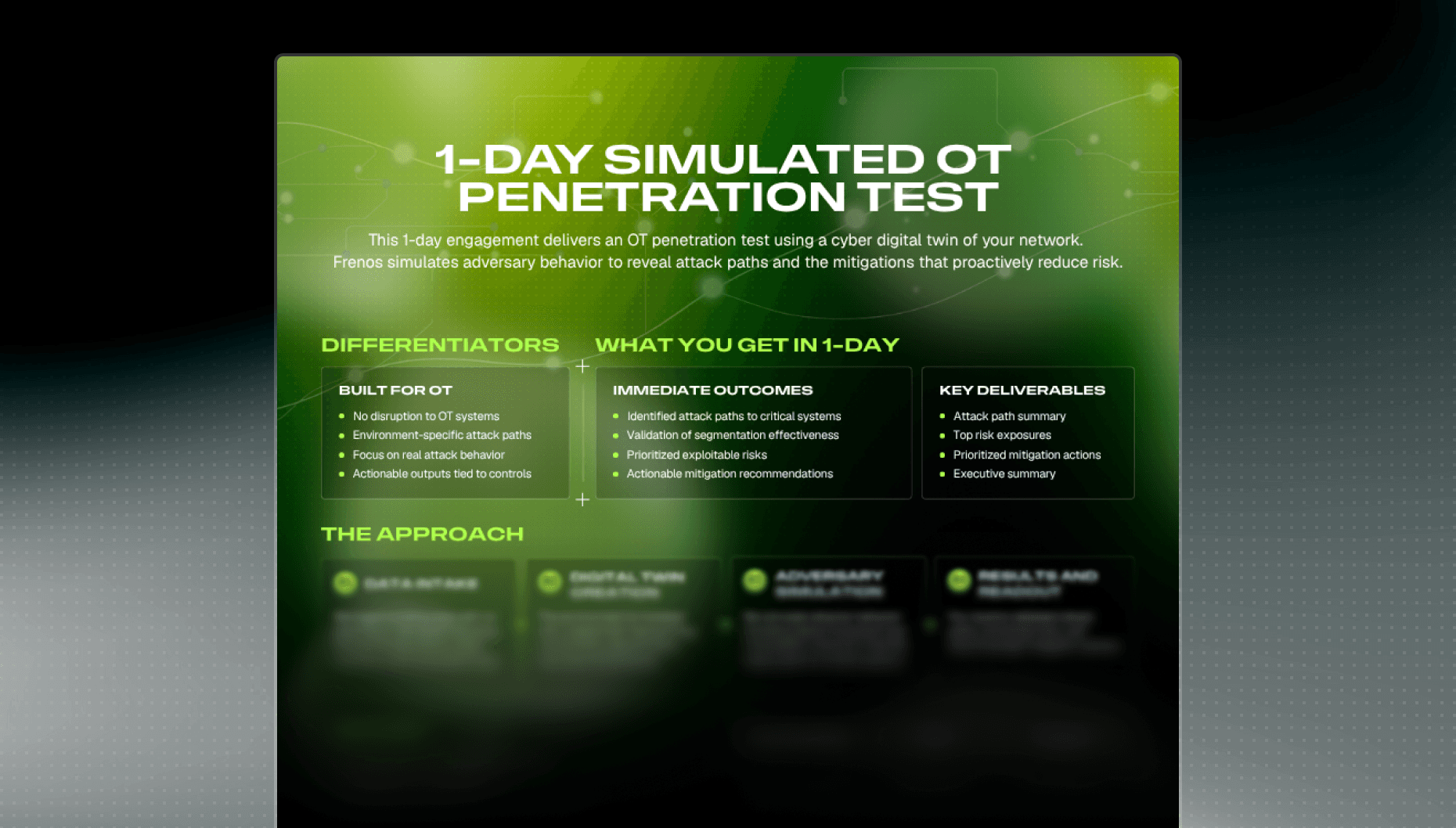

1-Day Simulated OT Pentest
Take a deep dive into understanding how Frenos' simulated OT penetration testing platform allows you to understand and improve your OT security posture at scale.
Read more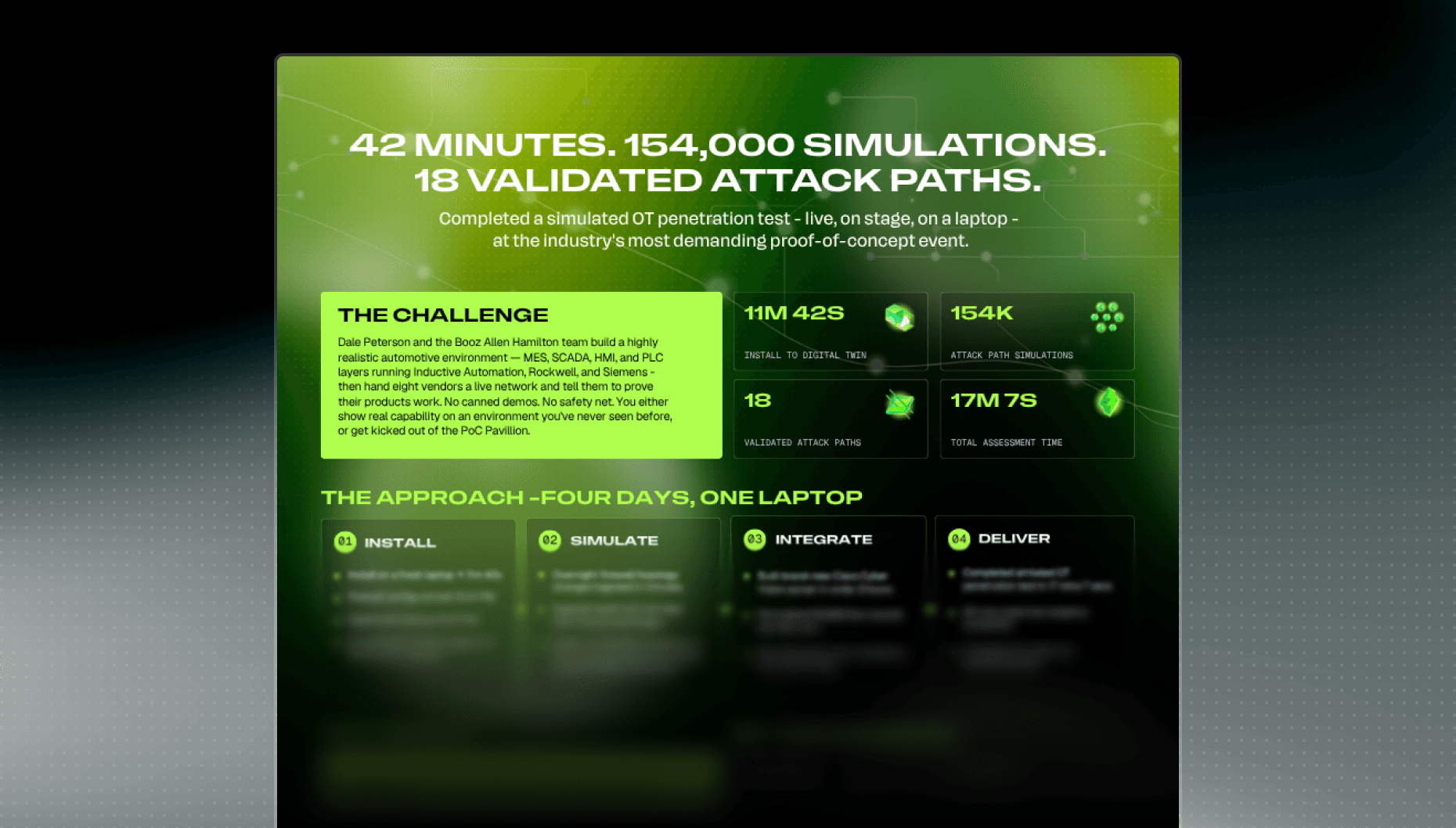
S4x26 Case Study
At the S4x26 POC Pavilion, Frenos completed 154,000 OT attack path simulations in 17 minutes and 7 seconds in a documented engagement. From three assumed-breach starting points (iDMZ, Plant Operations, Enterprise), the platform validated 18 attack paths into the critical Rockwell and Siemens zone. Those paths are exploitable given the actual controls, firewall rules, routing, and configurations modeled in the digital twin.
Read more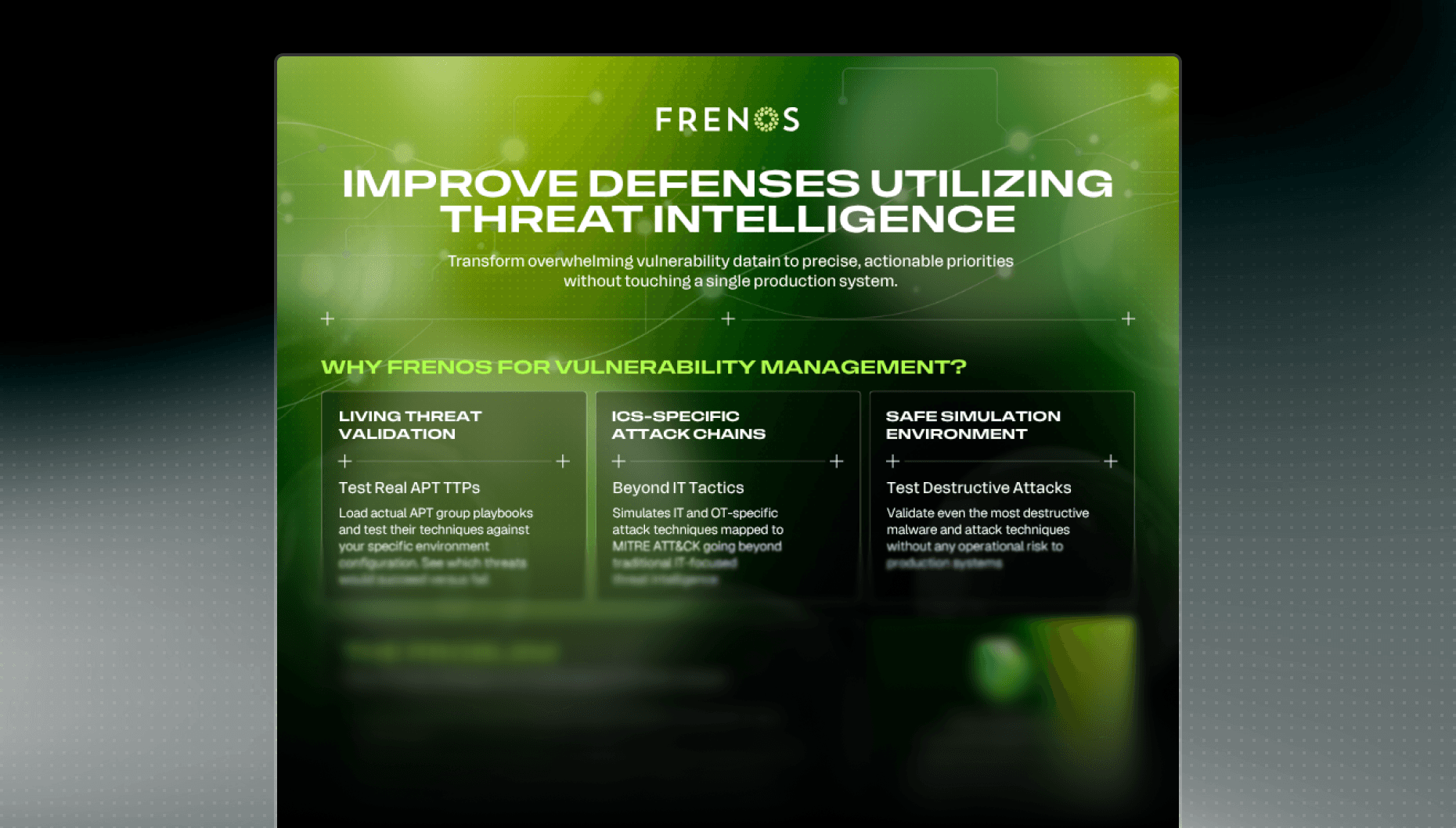
Threat Intelligence
Transform static threat intelligence into dynamic attack simulations. Reveal exactly how specific threat actors could compromise your OT environment before they try.
Read more