
Why Traditional OT Security Assessments Risk Production Downtime



For many industrial organizations, OT security assessments feel like playing with fire. You know you need them, but every assessment carries the nagging fear that something could go wrong. A misplaced scan might crash a controller. An unexpected packet could trigger a fault. That maintenance window you thought was safe? Maybe not safe enough.
This isn't paranoia. It's experience talking.
Traditional security assessment methods were borrowed from IT security, where the worst-case scenario is usually a server reboot. Apply those same techniques to a live production environment controlling physical processes, and you're rolling the dice on downtime, safety incidents, and revenue loss.
The real question isn't whether traditional assessments carry risk. They do. The question is whether there's a better way.
Why OT Systems Don't Tolerate Security Testing the Way IT Systems Do
Anyone who's worked in operational technology knows these environments weren't built for experimentation. They were built to run. Most OT installations include legacy PLCs and controllers that were never designed to handle unexpected traffic. These devices operate on real-time communication requirements where milliseconds matter. Many run proprietary protocols that behave unpredictably when probed. And unlike redundant IT infrastructure, production-critical systems often have minimal backup options.
When something goes wrong in these environments, the consequences cascade quickly. Production stops. Equipment gets damaged. Safety systems might fail. Revenue evaporates by the minute. This is exactly why so many OT teams approach security testing with extreme caution or put it off indefinitely.
How Most Organizations Conduct OT Security Assessments Today
Walk into most industrial facilities, and you'll find security assessments falling into a few familiar patterns.
The Live Scanning Approach
Security teams run discovery or vulnerability scans directly against operational networks to identify devices, open ports, and known vulnerabilities. The logic makes sense from an IT perspective. You can't secure what you can't see, right? Except many OT devices simply weren't designed to handle this kind of interrogation. Scans can overload controllers, cause communication timeouts, or trigger device faults that require manual resets. Sometimes those resets happen during production runs.
The Documentation Review Method
Engineers review firewall rules, PLC logic, access controls, and whatever documentation exists to identify security gaps. This approach feels safer because you're not touching anything live. The limitation? It's completely static. Documentation reviews rarely reflect actual system behavior, undocumented changes made over the years, or the attack paths that exist across interconnected systems. You're basically hoping your paperwork matches reality.
The Narrowly Scoped Penetration Test
Some organizations allow limited penetration testing during carefully scheduled maintenance windows or planned downtime. There's a trade-off here that everyone understands but nobody likes to talk about. To avoid operational risk, testing gets restricted to a small subset of systems. Critical production equipment often stays off-limits. The result? Large portions of the environment never get tested, leaving blind spots exactly where you can't afford them.
What Actually Happens When You Test Live OT Systems
Traditional assessments aim to improve security, which makes sense. But in practice, they often create new problems while trying to solve old ones.
Even activities marketed as "read-only" can affect fragile systems in unexpected ways. Traffic patterns that look innocuous to the scanner can disrupt OT protocols. Malformed packets intended for one device can impact others. Controllers that have been running flawlessly for years suddenly misbehave when subjected to scanning traffic they were never designed to handle.
To manage this risk, testing gets constrained. But constraints mean incomplete findings. Critical attack paths go undiscovered because testing them would be too risky. This creates a dangerous illusion. A clean assessment doesn't necessarily mean the environment is secure. Often, it just means the test wasn't allowed to go deep enough to find the real problems.
There's also an assessment fatigue issue that doesn't get discussed enough. Because live testing is disruptive and risky, assessments happen infrequently. Maybe once a year if you're disciplined about it. Meanwhile, your environment keeps changing. New connections get added. Configurations drift. Attack techniques evolve. Those long gaps between assessments? That's when real risk develops unnoticed.
The False Choice Between Security and Uptime
Here's where many organizations get stuck. They believe they have to choose between thorough security testing or protecting production uptime. Pick one.
That's not actually true, but it feels true because traditional assessment methods force that trade-off. Avoiding testing doesn't reduce your risk though. It just makes risk invisible. On the other hand, testing live systems too aggressively can introduce exactly the disruptions everyone's trying to avoid.
The real challenge isn't choosing between security and uptime. It's finding ways to test OT security realistically without touching production systems. That requires rethinking assessment methods entirely rather than just being more careful with traditional approaches.
Modern Approaches That Don't Gamble with Production
The good news? OT security assessment practices are evolving beyond the old point-in-time, cross-your-fingers-and-hope model toward approaches that eliminate production risk entirely.
Simulation-based testing represents one of the most significant shifts in how organizations approach OT security assessments. Instead of testing production systems directly, you can now simulate entire OT environments to identify real attack paths, validate segmentation and access controls, and test adversary behavior safely. This removes operational impact while enabling much deeper analysis than you could ever perform on live systems.
There's also a fundamental change happening in how frequently organizations assess their security posture. Rather than relying on annual snapshots, continuous posture management approaches track how changes in architecture, access, or configuration affect security over time. This reduces blind spots and keeps your understanding of risk aligned with reality rather than with last year's assessment results.
The goal has shifted from "passing an assessment" to maintaining ongoing visibility into OT security risk without disrupting operations. Platforms like Frenos reflect this evolution by using digital twin technology and autonomous analysis to evaluate OT security safely, repeatedly, and at enterprise scale.
Making Better Decisions About OT Security Assessments
Traditional OT security assessments served an important purpose. They raised awareness and helped organizations take their first steps toward securing industrial environments. But those methods were never designed for today's connected, high-risk operational technology landscape.
Organizations looking to mature their security programs should be asking themselves different questions now. Can we test realistically without risking downtime? How often can we reassess our environment without disruption? Are we discovering actual attack paths, or just checking compliance boxes?
When you start asking those questions seriously, you often end up exploring simulation-based assessment models and continuous security validation approaches. These aren't just incremental improvements over traditional methods. They're fundamentally different ways of thinking about OT security that align better with operational realities.
Taking the Next Step
If you're evaluating safer approaches to protecting industrial environments, the best starting point is understanding how modern OT penetration testing and security assessment practices have evolved. When simulation removes production risk from the equation, testing can become more thorough, more frequent, and more valuable without the trade-offs that have historically limited OT security programs.
OT security doesn't have to come at the expense of uptime. But it does require rethinking how assessments are performed, moving away from adapted IT security practices toward approaches purpose-built for operational technology environments.
Further Reading:
- What Is an OT Security Assessment? Understanding modern approaches to evaluating industrial cybersecurity risk.
- OT Penetration Testing Guide How testing OT security safely has evolved with digital twin technology.
- AI-Powered OT Assessment Guide The complete guide to autonomous security validation for critical infrastructure.
External Resources:
- NIST SP 800-82 Rev 3 - NIST guidance for industrial control systems security
- IEC 62443 Standard - International industrial cybersecurity standards
- CISA ICS Resources - Critical infrastructure cybersecurity guidance and resources
Related Resources
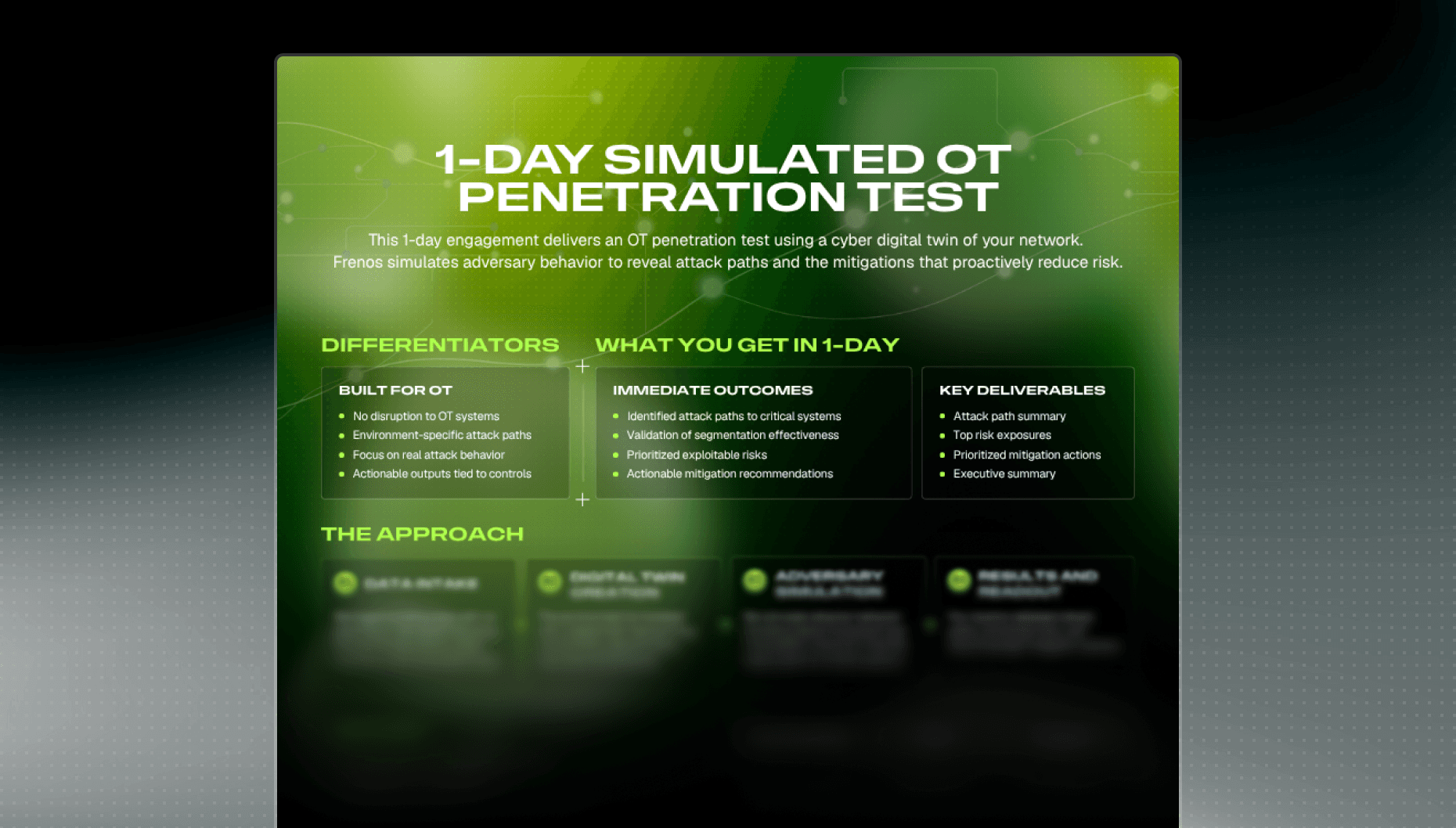

1-Day Simulated OT Pentest
Take a deep dive into understanding how Frenos' simulated OT penetration testing platform allows you to understand and improve your OT security posture at scale.
Read more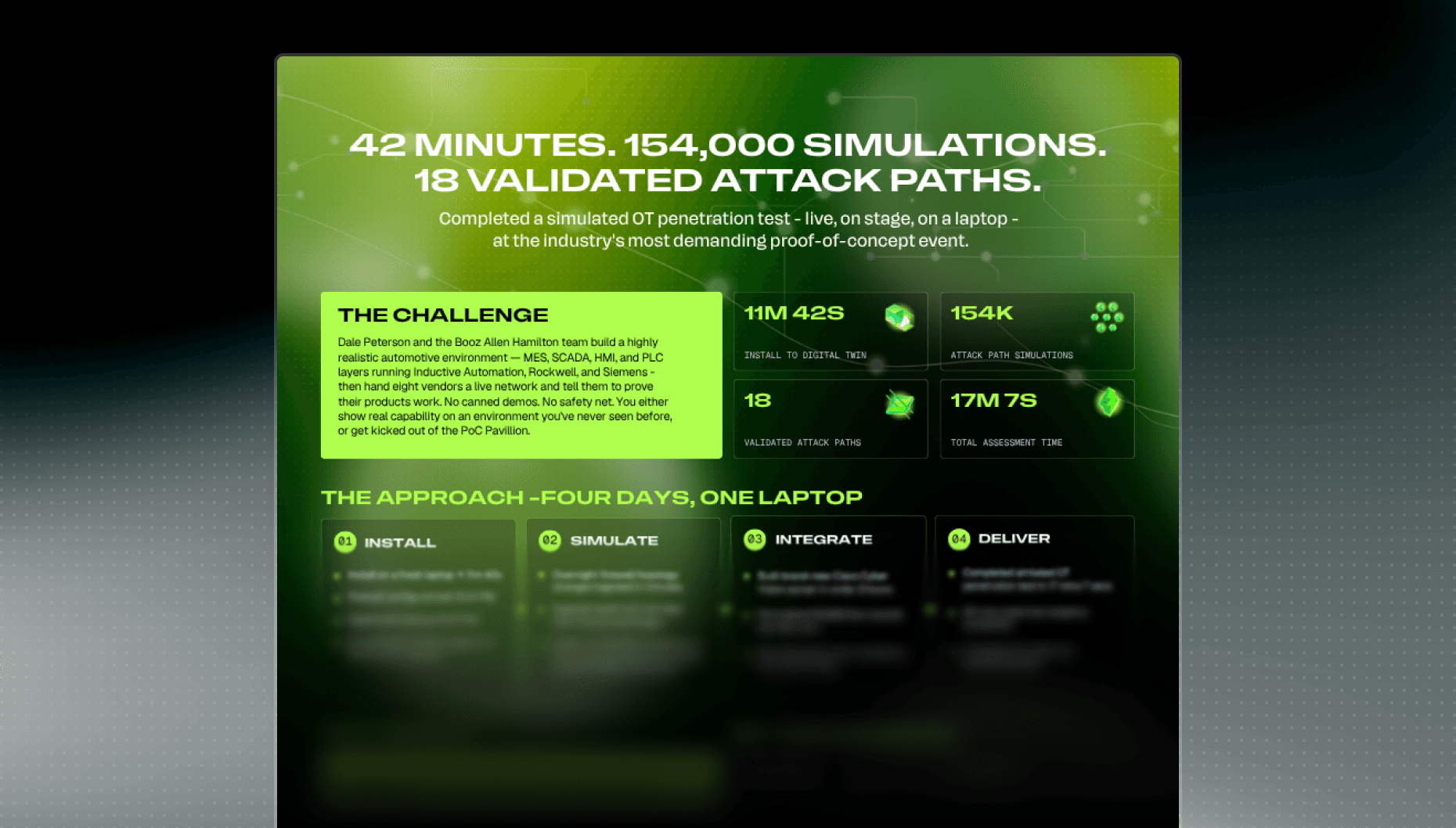
S4x26 Case Study
At the S4x26 POC Pavilion, Frenos completed 154,000 OT attack path simulations in 17 minutes and 7 seconds in a documented engagement. From three assumed-breach starting points (iDMZ, Plant Operations, Enterprise), the platform validated 18 attack paths into the critical Rockwell and Siemens zone. Those paths are exploitable given the actual controls, firewall rules, routing, and configurations modeled in the digital twin.
Read more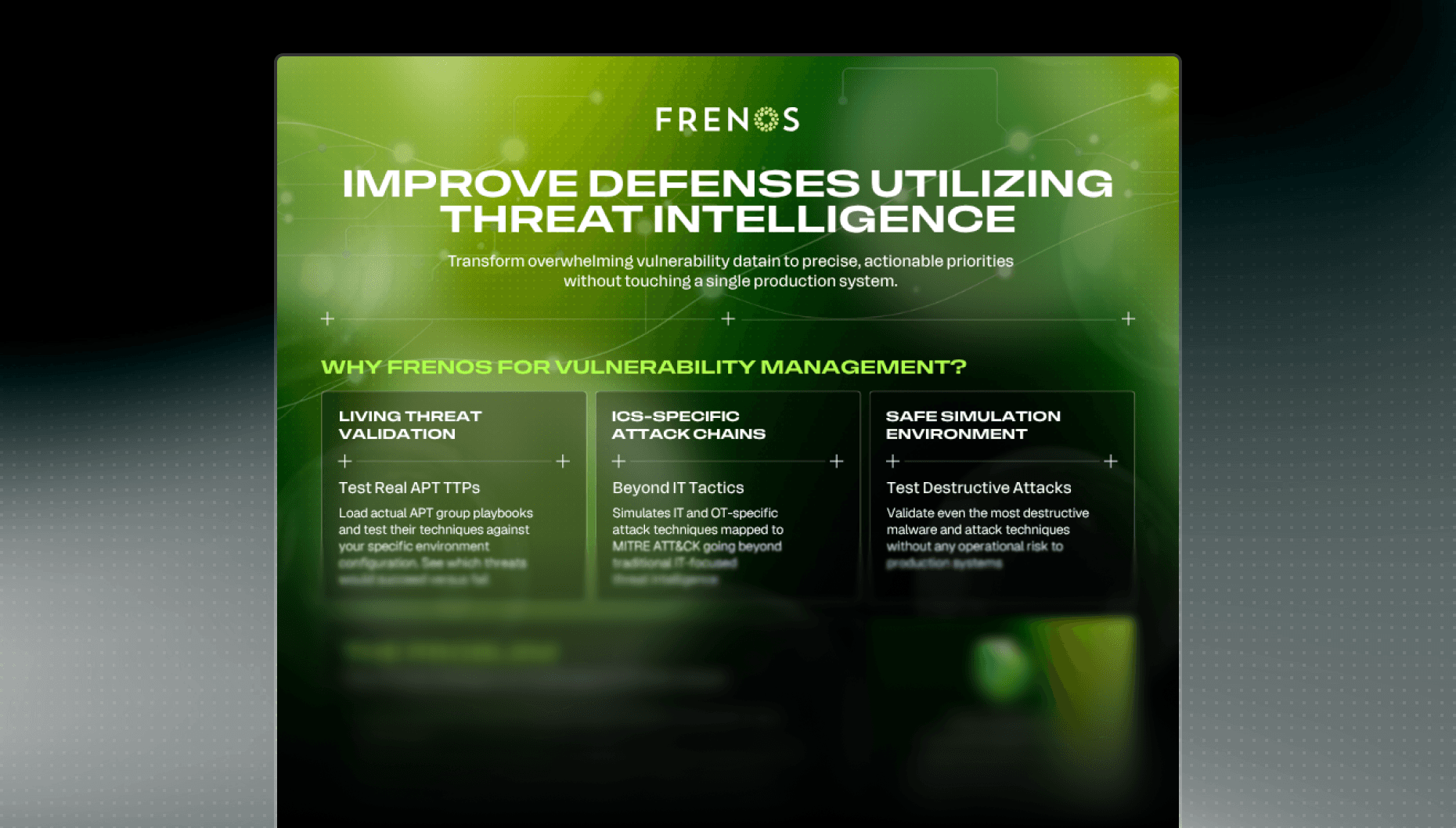
Threat Intelligence
Transform static threat intelligence into dynamic attack simulations. Reveal exactly how specific threat actors could compromise your OT environment before they try.
Read more