
How Digital Twins Are Transforming OT Security Testing


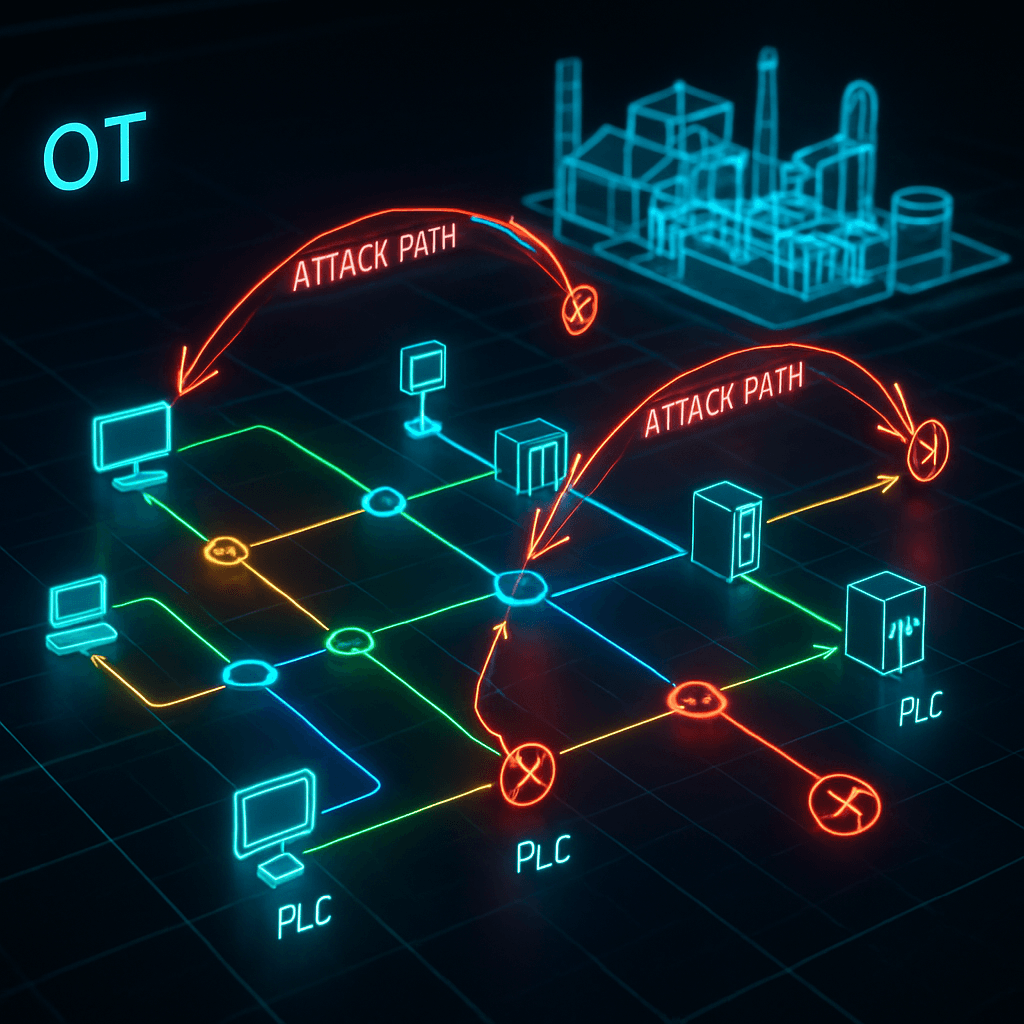
For years, OT security teams have lived with an uncomfortable reality. The most realistic security tests are often the most dangerous to run.
Test live systems thoroughly, and you risk disrupting production. Limit your testing to stay safe, and you create blind spots everywhere. Avoid testing altogether, and you're just guessing about actual risk.
Digital twins are fundamentally changing that trade-off by enabling realistic, repeatable OT security testing without touching production systems at all.
Why Traditional Security Testing Runs Into Walls
Operational technology environments were never built for the kind of aggressive testing that IT security teams take for granted. These systems run legacy PLCs and controllers that can't handle unexpected traffic. They operate on real-time process requirements where milliseconds matter. They use proprietary protocols that behave unpredictably when probed. And the consequences for getting it wrong aren't just inconvenient server reboots.
Given these constraints, most OT security testing ends up narrowly scoped to a handful of systems, infrequent because scheduling is so complicated, and highly conservative because nobody wants to be the person who crashed production during a security test.
This cautious approach makes sense from a risk management perspective. But it severely limits how deeply teams can explore actual attack paths, discover misconfigurations that span multiple systems, or understand how failures cascade through interconnected environments.
What Digital Twins Actually Mean for Security Testing
When people hear "digital twin" in OT contexts, they often think of CAD models or simple asset inventories. That's not what we're talking about here.
A digital twin for OT security testing is a behavioral replica of your environment that models network topology and segmentation, device roles and communication patterns, trust relationships and access paths, plus control logic interactions. This behavioral modeling allows security teams to test how an OT environment responds under attack without sending a single packet to production systems.
The difference between an asset inventory and a behavioral digital twin is like the difference between having a map of a building and understanding how people actually move through it under different conditions. One tells you what exists. The other lets you predict what happens when things go wrong.
Testing Scenarios That Live Systems Can't Safely Handle
Digital twins unlock testing approaches that are simply too risky to attempt on live operational technology. Consider realistic attack path modeling, where teams can simulate exactly how an attacker moves from IT networks into OT environments, pivots between zones, and targets high-impact assets. Try running that test on production and see how quickly the operations team shows up at your desk.
Misconfiguration and segmentation testing becomes practical when you can validate firewall rules, trust boundaries, and segmentation effectiveness across the full environment rather than sampling a few systems and hoping the rest work the same way. Adversary behavior simulation lets you model attack techniques step by step, including lateral movement tactics, credential misuse scenarios, and control disruption attempts that would be insane to test on live systems.
Perhaps most valuable is the ability to run "what-if" scenario analysis. What happens if this specific system gets compromised? How does this proposed architecture change affect our risk? Which of our defensive controls actually stops an attack versus just detecting it after the damage is done? These questions are nearly impossible to answer with confidence using traditional testing methods because the tests themselves are too dangerous to run.
Removing Production Risk From the Testing Equation
The biggest shift digital twins enable isn't just better testing. It's removing operational risk entirely from the testing process.
Because all testing occurs in a simulated environment, there's no risk of downtime affecting production schedules. No impact on safety systems or operational processes. No need to wait weeks or months for maintenance windows. No pressure to artificially limit scope because you're worried about consequences.
This fundamentally changes OT security testing from occasional and constrained to repeatable and comprehensive. Tests that would take months to plan, coordinate, and execute in production environments can run in hours in a digital twin. Tests too risky to even propose on live systems become routine validation exercises.
Moving Beyond Annual Snapshots
Traditional OT security testing provides a snapshot. It tells you whether your environment was secure at the exact moment the test was performed, assuming the test was thorough enough to find the issues that mattered, which given the typical constraints is often a generous assumption.
Digital twins support a completely different operational model. You can retest environments as they change rather than waiting for the next annual assessment. Track how security posture evolves over time instead of comparing disconnected snapshots. Validate controls continuously as configurations drift. Reduce blind spots caused by the months between formal assessments.
The question shifts from "Did we pass last year's assessment?" to "What is our actual risk today given current configurations and known threat actor techniques?" That's a much more useful question when you're trying to allocate limited security resources.
Enhancing Rather Than Replacing Traditional Testing
Digital twins don't replace OT penetration testing or red teaming. They make both approaches safer and more effective.
Penetration testing can go much deeper without increasing operational risk. Testers can attempt techniques that would never be approved on live systems. Red teaming becomes repeatable instead of a disruptive once-per-year exercise that requires months of planning. You can run the same attack scenarios after making changes to see whether your improvements actually reduced risk.
Most importantly, findings get prioritized based on real attack paths rather than just vulnerability severity scores. Understanding which vulnerabilities could actually be chained together to compromise critical systems is far more valuable than having a sorted list of every flaw in your environment.
This enables organizations to apply the right testing approach at the right maturity level without the usual trade-offs between thoroughness and operational safety.
Where Digital Twin Testing Delivers Maximum Value
Digital twins prove especially valuable in high-availability manufacturing environments where even short disruptions cost thousands of dollars per minute. Critical infrastructure operators can't afford to experiment with security testing on systems that keep the lights on or water flowing. Regulated industries face limited testing windows where even approved tests must stay carefully scoped. Organizations running complex or distributed OT networks struggle to understand security posture across dozens or hundreds of sites.
Beyond security testing specifically, digital twins increasingly support incident response planning by letting teams practice response procedures safely. Architecture changes and upgrades can be security-validated before implementation. M&A risk evaluation can assess acquired environments without touching newly acquired production systems. And continuous security posture management becomes practical when you can validate defenses repeatedly without operational impact.
The Direction OT Security Is Heading
OT security is moving away from static compliance checklists and annual assessments toward continuous, intelligence-driven risk management. Organizations are shifting from asking "Did we check all the boxes?" to "Do we understand how our environment would actually fail under current threat actor techniques?"
Digital twins enable that shift by providing the realism organizations need without introducing operational risk. Platforms like Frenos use simulation and autonomous analysis to help organizations understand how their OT environments would behave under real-world attack scenarios, safely and repeatably.
The technology doesn't just make testing safer. It makes testing more meaningful by removing the artificial constraints that have historically limited how thoroughly organizations could validate their operational technology security.
Understanding What This Means Practically
Digital twin technology represents a fundamental change in what's possible for OT security testing. For the first time, organizations can test thoroughly without risking operations. They can repeat tests as environments evolve rather than accepting increasingly outdated assessment results. They can validate that architectural changes actually improve security before implementing them in production.
This doesn't eliminate the need for traditional security practices. But it removes many of the constraints that have forced organizations to choose between operational safety and security thoroughness. That choice always felt false because you need both. Digital twins let you have both.
If you're evaluating modern approaches to securing operational technology, understanding how simulation-based testing fits into your program is becoming essential. The gap between what you can safely test and what you need to understand is closing. That changes the conversation about OT security maturity in practical ways.
Related Resources
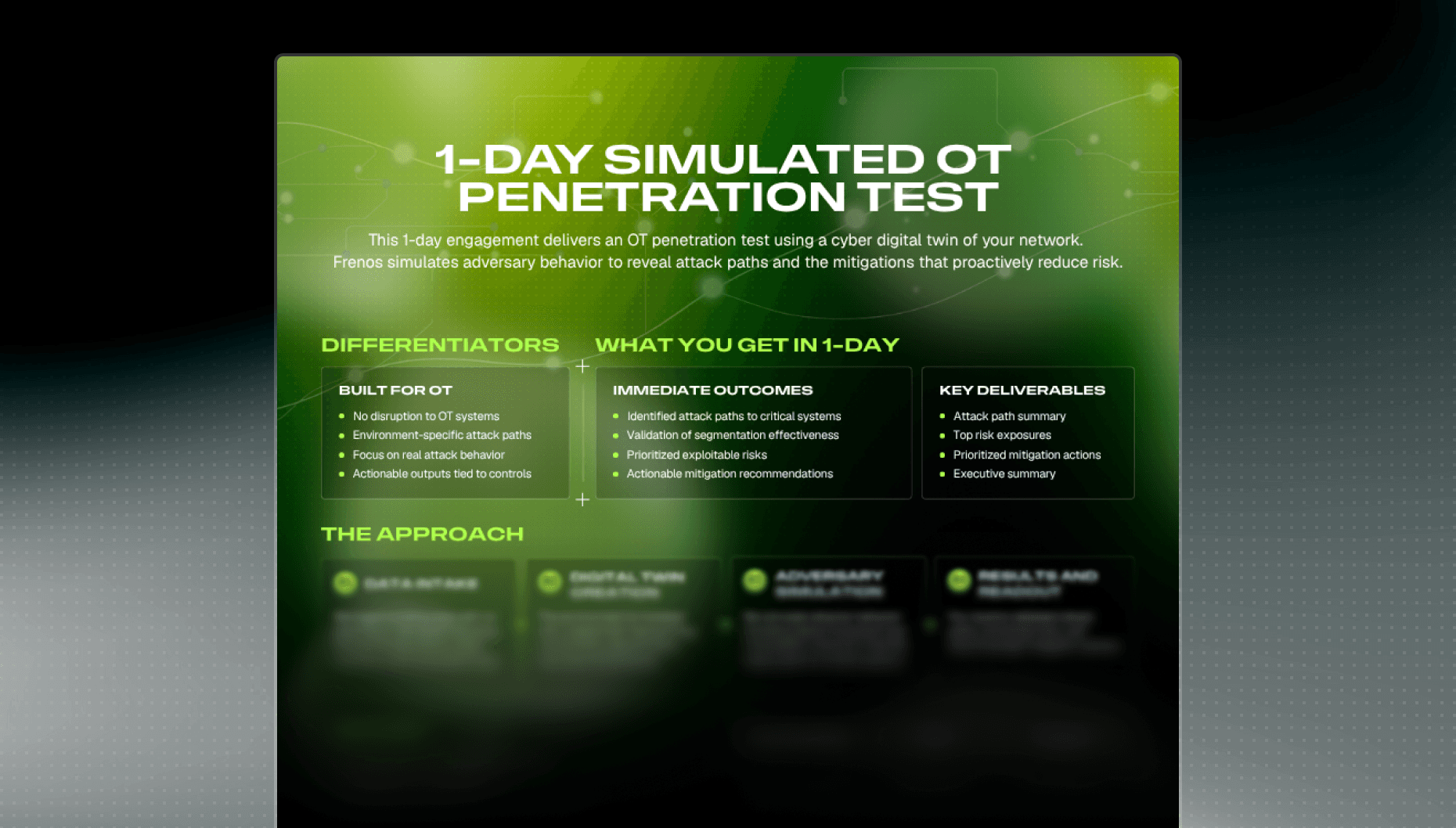

1-Day Simulated OT Pentest
Take a deep dive into understanding how Frenos' simulated OT penetration testing platform allows you to understand and improve your OT security posture at scale.
Read more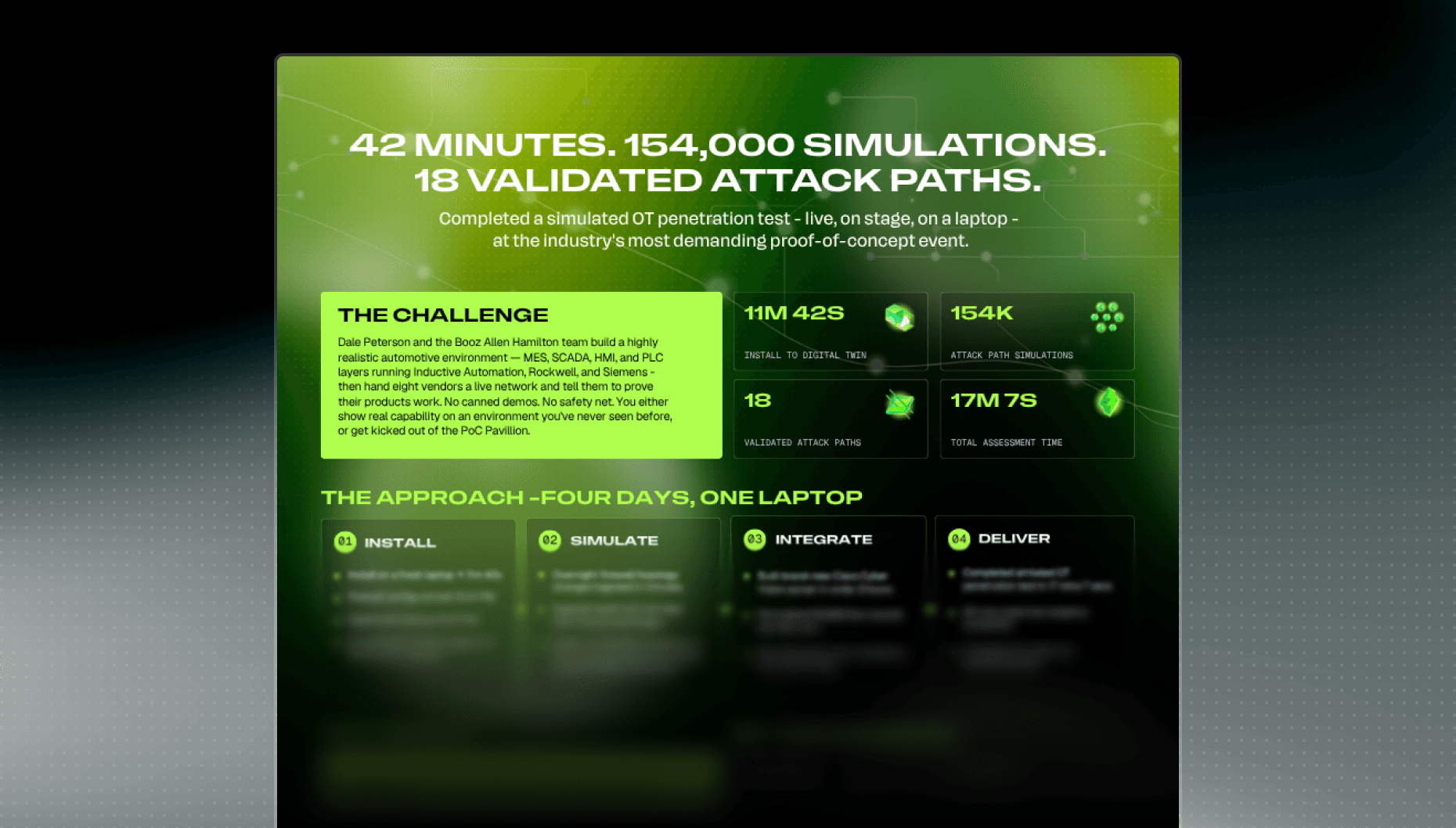
S4x26 Case Study
At the S4x26 POC Pavilion, Frenos completed 154,000 OT attack path simulations in 17 minutes and 7 seconds in a documented engagement. From three assumed-breach starting points (iDMZ, Plant Operations, Enterprise), the platform validated 18 attack paths into the critical Rockwell and Siemens zone. Those paths are exploitable given the actual controls, firewall rules, routing, and configurations modeled in the digital twin.
Read more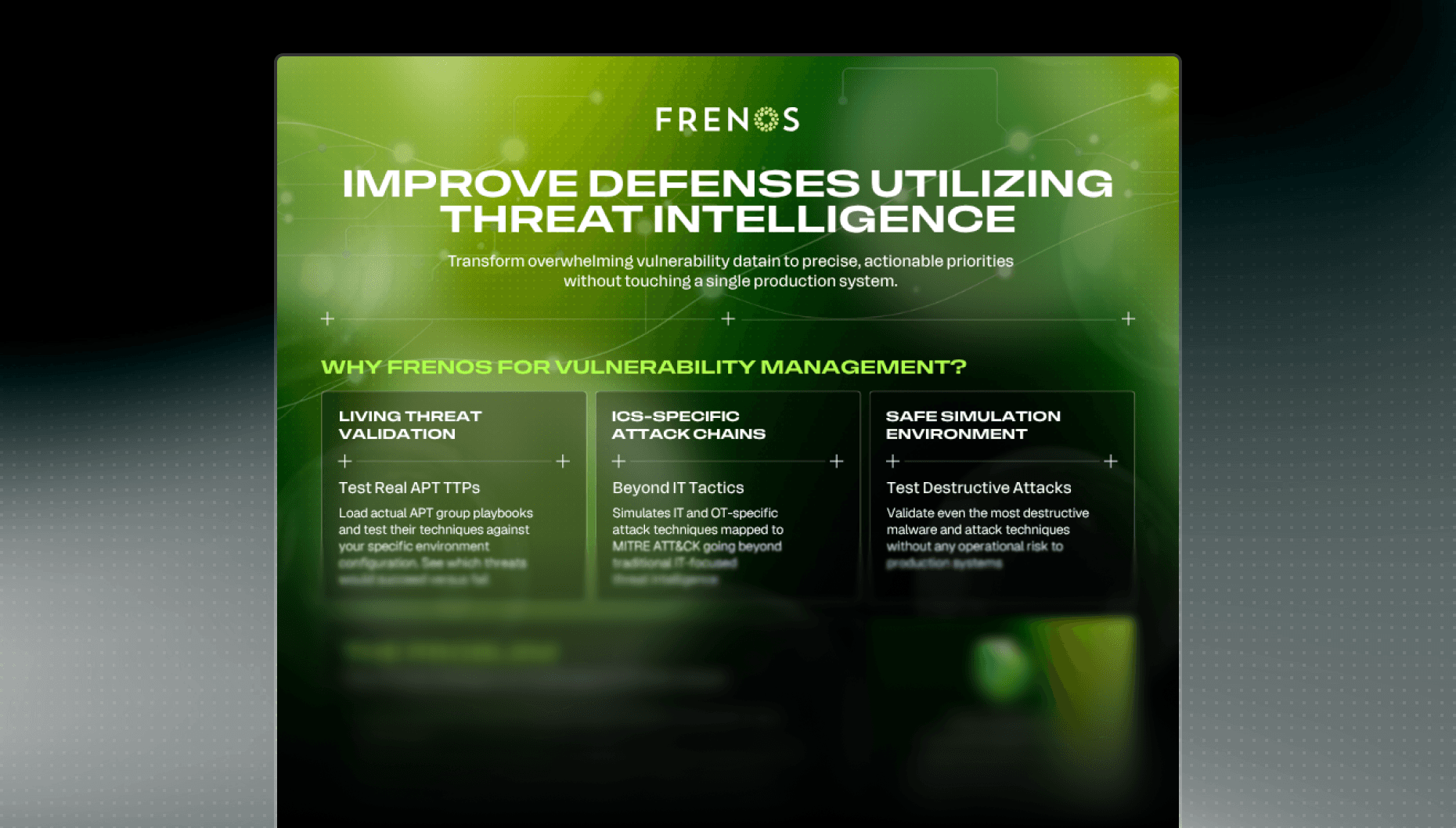
Threat Intelligence
Transform static threat intelligence into dynamic attack simulations. Reveal exactly how specific threat actors could compromise your OT environment before they try.
Read more