
NIST vs IEC 62443: Which OT Security Framework Should You Use?


If you operate critical infrastructure, “nist vs iec 62443” is rarely an academic debate. It is a decision about how you will scope risk, organize security work across plants and sites, prove due diligence to regulators and auditors, and reduce the likelihood of safety and downtime events.
In practice, most teams end up using both, but in different ways. NIST helps you structure a program and communicate posture to leadership. IEC 62443 helps you define what “good” looks like at the system and component level, especially when you buy, integrate, or certify industrial solutions.
This guide breaks each framework down into what it actually asks you to do, where it fits best (manufacturing, energy, water, pharma, oil and gas), and the common gap both share: neither framework provides a built-in way to validate security controls against realistic attack paths without risking production. If you need background first, start with the Complete Guide to Protecting Operational Technology and Industrial Control Systems. For why assessment methods are changing, see Why OT Cybersecurity Assessments Need to Evolve: From Manual to Automated to Continuous.
Quick definitions: NIST CSF, NIST SP 800-82, and IEC 62443
NIST Cybersecurity Framework (CSF) is a risk-based framework organized around core functions (Identify, Protect, Detect, Respond, Recover). It is widely used to communicate cybersecurity posture and program maturity across business units.
NIST SP 800-82 is NIST’s guidance for Industrial Control Systems (ICS) security. It is not a certification standard. It provides OT-specific architecture patterns, compensating controls, and implementation guidance that maps well to CSF outcomes.
IEC 62443 is a family of standards focused on industrial automation and control systems. It defines security requirements for asset owners, system integrators, and product suppliers. It includes formal security levels (SL) and detailed technical requirements for systems and components, and it supports certification pathways.
If your search is “nist 800-82 vs iec 62443,” it helps to remember: 800-82 is guidance; 62443 is a structured requirement set with clearer expectations for suppliers and integrated systems.
NIST vs IEC 62443: what each framework is optimized for
NIST CSF strengths (program and communication)
- Executive visibility: CSF profiles and tiers make it easier to explain current vs target state and prioritize investment.
- Risk management: aligns well with enterprise risk workflows and governance models.
- Broad applicability: works across IT and OT, which matters for convergence, shared SOC services, and incident response.
Where NIST is less specific for OT
- It does not prescribe detailed technical requirements for PLCs, safety systems, or control network zones.
- It can leave teams debating “what good looks like” at the control layer unless you supplement it with OT-specific guidance (often SP 800-82) and internal standards.
IEC 62443 strengths (engineering requirements and assurance)
- Detailed requirements: particularly valuable for segmentation (zones and conduits), authentication, patching constraints, secure remote access, and component hardening.
- Supply chain alignment: gives procurement and engineering a common language for vendor requirements, including roles (asset owner, integrator, supplier).
- Security levels: supports target SL decisions tied to threat assumptions.
Where IEC 62443 is harder in real operations
- Implementing it can become documentation-heavy unless you scope carefully.
- Translating requirements into day-to-day operations and measurable outcomes can be challenging without a parallel program framework.
Practical takeaway for “iec 62443 vs nist csf”: NIST CSF is typically the better front door for building and communicating a program; IEC 62443 is typically the better backbone for defining technical OT requirements and supplier expectations.
Decision criteria: which framework to lead with by use case
- You need an enterprise-wide cybersecurity operating model that includes OT.
- Leadership wants maturity reporting, a roadmap, and measurable outcomes.
- You have multiple sites with different architectures and need a consistent prioritization method.
Use NIST CSF (and SP 800-82 guidance) as your lead when:
- You are building or modernizing a plant, line, or control system and need engineering-grade requirements.
- You rely heavily on system integrators and need contract language for security responsibilities.
- You have procurement-driven needs, including IEC 62443 certification requirements for products or solutions.
Use IEC 62443 as your lead when:
Sector examples
- Manufacturing: Use NIST CSF to align plants and corporate security, then use IEC 62443-3-3 requirements to drive segmentation and hardening on high-value lines.
- Energy and utilities: NIST CSF supports governance and risk reporting; IEC 62443 helps define security requirements for substations, generation sites, and vendor-delivered control systems.
- Pharma: NIST CSF helps reconcile cybersecurity and quality objectives; IEC 62443 supports consistent requirements for automation systems and validated environments.
- Oil and gas: NIST CSF supports multi-asset risk management; IEC 62443 supports integrator accountability and consistent remote access and segmentation requirements.
If you are asking “which OT security framework is best,” the most workable answer is usually: lead with NIST for program structure, enforce IEC 62443 for technical and supplier controls, and add a validation layer to prove the design works in your environment.
How NIST CSF and IEC 62443 map in practice (a working crosswalk)
A useful way to compare “nist vs iec cybersecurity differences” is to map NIST CSF functions to common IEC 62443 activities.
Identify
- NIST: asset inventory, business environment, risk assessment.
- IEC 62443: define zones and conduits, identify critical functions, establish security level targets.
Protect
- NIST: access control, awareness, data security, maintenance.
- IEC 62443: system requirements (62443-3-3) and component requirements (62443-4-2) such as authentication, least privilege, secure remote access, hardening, and malware protection constraints.
Detect
- NIST: anomalies, continuous monitoring.
- IEC 62443: monitoring expectations exist, but implementation is typically left to the asset owner and integrator. This is where many teams struggle with visibility in segmented or vendor-managed environments.
Respond / Recover
- NIST: response planning, communications, improvements.
- IEC 62443: touches incident response requirements but is not a full operating model. Many organizations keep NIST as the umbrella for response and recovery.
Practical note: this crosswalk works best when you treat NIST as the “management system” for outcomes and IEC 62443 as the “engineering specification” for OT controls. It also helps prevent control duplication when OT and IT teams share responsibilities.
Where both frameworks fall short: validation without risking production
Both NIST and IEC 62443 are strong at defining what should exist (outcomes, requirements, roles). Neither inherently proves that your control design will hold under real attacker behavior in your specific environment.
Common examples teams run into:
- A zone and conduit model looks correct on paper, but real traffic flows include maintenance paths, vendor tunnels, or shadow connectivity.
- Remote access controls meet a policy requirement, but a misconfiguration creates a pivot from an IT jump host into an engineering workstation subnet.
- Asset inventories are “complete enough” for audit, but not accurate enough to model exploit paths to the highest-risk assets.
Why traditional testing is not enough in OT
Live pentesting and vulnerability scanning can create unacceptable operational risk, especially around fragile protocols, safety constraints, and change management rules. Many critical infrastructure teams end up testing less, not more, because the safety and uptime trade-offs are real.
A practical approach is to add a validation layer that does not touch production systems. Frenos’ approach is to enable full-scope security testing through digital twins and attack-path validation, so you can evaluate segmentation, identity paths, and compensating controls without creating production risk. For more detail, see How Digital Twins are Transforming OT Security Testing and Digital Twin vs Live OT Security Testing: Which is Safer and More Effective.
A step-by-step method to choose and operationalize NIST and IEC 62443
Step 1: Choose your organizing layer
- If your main problem is inconsistent priorities and unclear posture, use NIST CSF as the top-level organizing layer.
- If your main problem is inconsistent technical security across plants and vendors, use IEC 62443 requirements as the driver.
Step 2: Define the OT scope and crown jewels
- Identify the processes where loss of view, loss of control, or loss of safety has the highest impact.
- Define “highest-risk assets” in operational terms: safety controllers, historians, batch management, SIS interfaces, remote access gateways, engineering workstations.
Step 3: Create a pragmatic target architecture
- Use IEC 62443 zoning and conduits to document intended trust boundaries.
- Translate target security levels into a small set of enforceable requirements (identity, remote access, segmentation, logging, backups).
Step 4: Build a control backlog mapped to outcomes
- Map each initiative to NIST CSF outcomes for governance reporting.
- Map each initiative to specific IEC 62443 requirements for engineering clarity.
Step 5: Validate against attack paths before touching production
- Use safe methods to test whether an attacker can pivot from common entry points (vendor access, IT to OT, wireless, portable media) to the highest-risk assets.
- Confirm that compensating controls actually stop the path, not just satisfy a checklist.
Step 6: Operationalize continuous improvement
- Treat validation as a recurring activity tied to change events: new line commissioning, remote access changes, firewall rule updates, vendor upgrades.
This approach supports “nist csf implementation in industrial environments” without turning IEC 62443 into a documentation exercise. It also gives engineering and security a shared way to measure whether the environment is becoming harder to compromise over time.
FAQs
No. Many critical infrastructure operators use NIST CSF to run the overall cybersecurity program and reporting, then use IEC 62443 to specify technical requirements for OT systems, integrators, and suppliers. The key is to define how they map so teams do not duplicate work.
Not usually. NIST SP 800-82 is OT-specific guidance that complements NIST CSF. IEC 62443 is a structured requirement set with security levels and clearer supplier and integrator expectations. They are often used together: 800-82 for implementation guidance, 62443 for requirements and assurance.
It can if you rely only on live scanning or intrusive testing in operational networks. A safer approach is to validate controls and attack paths in a high-fidelity digital twin so you can test segmentation and access paths without touching production systems.
A traditional pentest can be valuable, but it is often scoped narrowly to reduce operational risk and may not be repeatable at the pace of OT change. A safe validation approach focuses on full attack-path testing and can be run repeatedly, helping you confirm that the controls required by NIST and IEC 62443 actually prevent realistic compromise paths.
You do not need perfect data to start. Most environments begin with partial inventories and incomplete diagrams. The practical goal is to build enough fidelity to validate the highest-risk attack paths first, then improve coverage iteratively as you learn where visibility gaps exist.
Call to Action
If you are deciding between NIST and IEC 62443, the decision should not stop at “which framework.” The bigger question is how you will prove your controls work against realistic attacker movement without creating operational risk. Request an OT Security Assessment to map your highest-risk assets, align NIST and IEC 62443 to your environment, and validate attack paths safely without touching production systems.
Related Resources
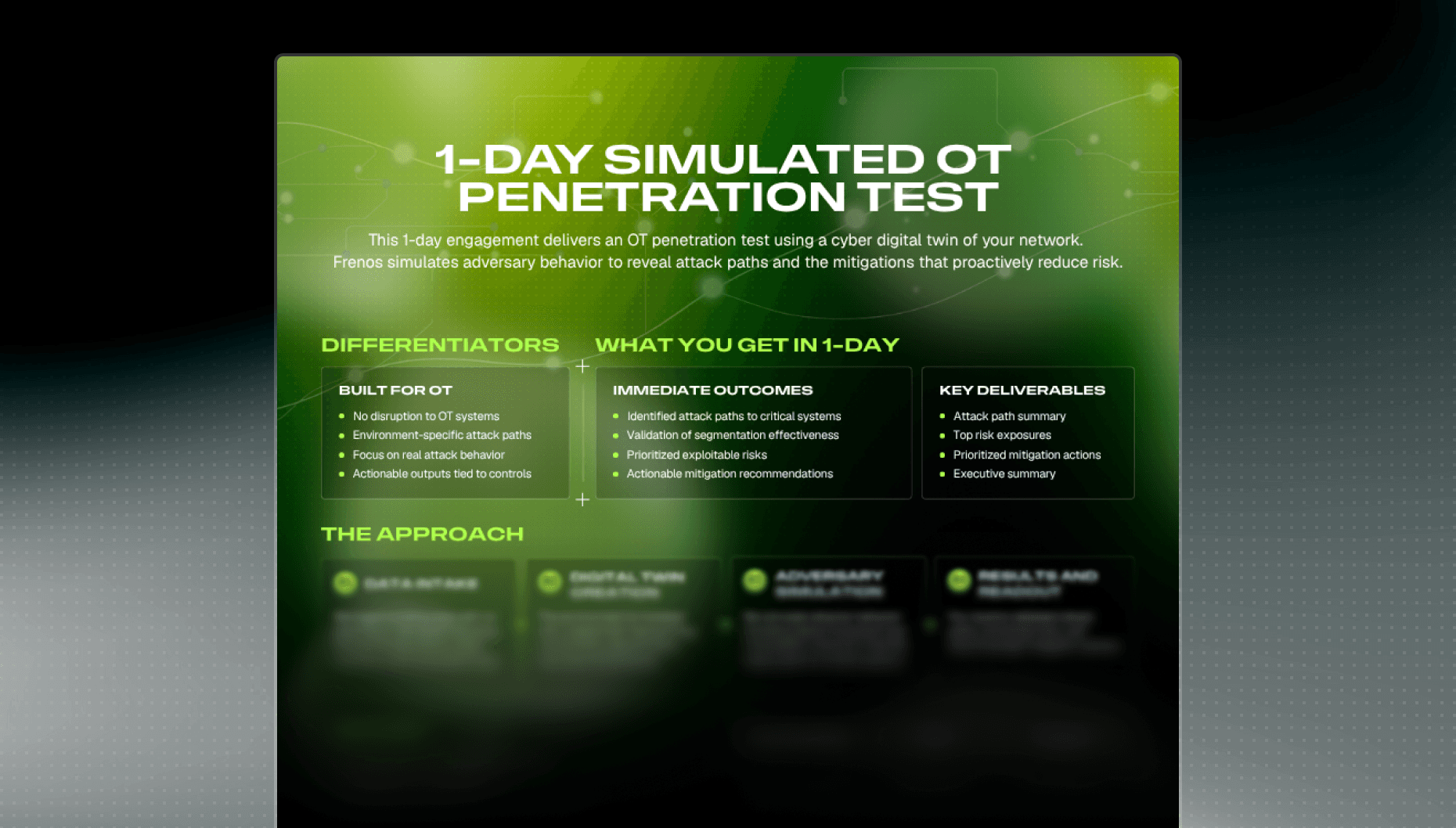

1-Day Simulated OT Pentest
Take a deep dive into understanding how Frenos' simulated OT penetration testing platform allows you to understand and improve your OT security posture at scale.
Read more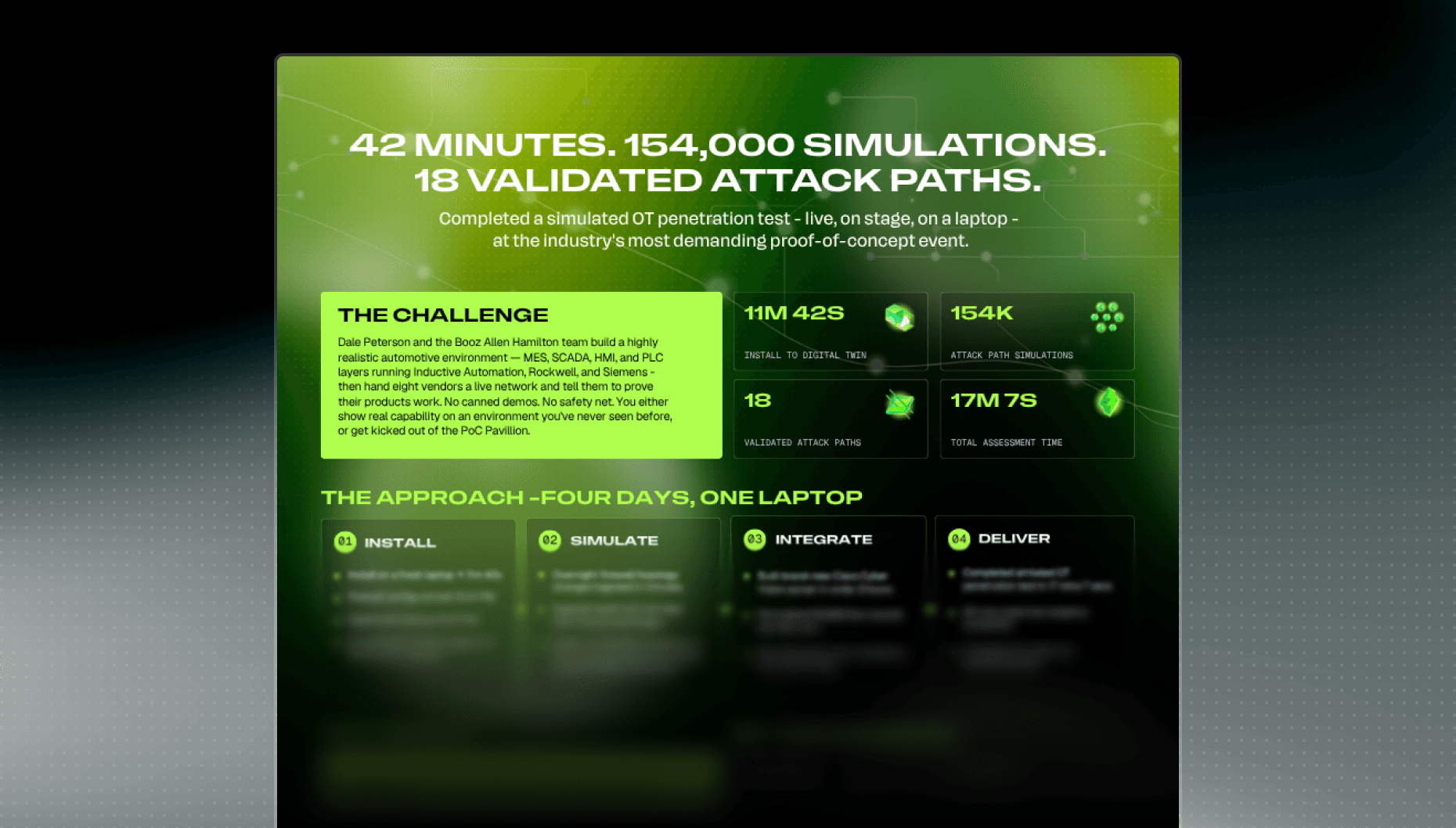
S4x26 Case Study
At the S4x26 POC Pavilion, Frenos completed 154,000 OT attack path simulations in 17 minutes and 7 seconds in a documented engagement. From three assumed-breach starting points (iDMZ, Plant Operations, Enterprise), the platform validated 18 attack paths into the critical Rockwell and Siemens zone. Those paths are exploitable given the actual controls, firewall rules, routing, and configurations modeled in the digital twin.
Read more
Threat Intelligence
Transform static threat intelligence into dynamic attack simulations. Reveal exactly how specific threat actors could compromise your OT environment before they try.
Read more