
Can You Safely Do OT Penetration Testing on SCADA and ICS Systems?



OT penetration testing is often requested for the same reason as IT testing: prove real-world exploitability and prioritize remediation. The problem is that OT and SCADA systems are engineered for availability and safety first, not for aggressive scanning or frequent change. A “normal” pentest method can unintentionally cause downtime, process instability, nuisance trips, or unsafe states.
This article explains why traditional penetration testing is risky in OT, what common failure modes look like, and how to close the “safe testing gap” with a digital twin approach that validates attack paths without touching production. If you want background fundamentals, see OT Penetration Testing for ICS & SCADA. For an example of how simulated testing works in practice, see Platform 3.0 Simulated OT Penetration Testing for Industrial Environments.
Definition: What is OT penetration testing (and how it differs from IT pentesting)?
OT penetration testing is a controlled security assessment of operational technology environments such as ICS, SCADA, DCS, PLC networks, safety systems, engineering workstations, historians, and the supporting Windows and network infrastructure. The goal is to validate whether an attacker can achieve realistic outcomes such as unauthorized logic changes, unsafe setpoint manipulation, loss of view, loss of control, or lateral movement from IT to OT.
Key differences from IT pentesting:
- Availability and safety constraints: Many OT assets have fragile stacks, limited compute, long patch cycles, and tight real-time requirements. “It rebooted” is not a benign outcome.
- Protocol and dependency complexity: OT communications often rely on broadcast, polling, proprietary drivers, serial gateways, or timing-sensitive protocols. A scan that is safe for enterprise networks can overwhelm a control device.
- Impact criteria: In IT, impact is often data exposure or account compromise. In OT, impact includes process deviation, quality loss, equipment damage, and safety risk.
- Scope realism: Testing needs to include paths like historian to control network, remote access tooling, vendor VPN patterns, engineering workstation privilege, and trust relationships. That is why many teams combine scada vulnerability assessment with adversarial techniques to validate exploit chains, not just single CVEs.
If you are deciding between approaches, the distinctions in objectives and constraints are covered in OT Penetration Testing vs Red Teaming: Key Differences Explained.
Why traditional OT and SCADA penetration testing is risky
The core issue is mismatch: many industrial penetration testing playbooks assume you can scan broadly, enumerate aggressively, and run exploit validation directly against live targets. In OT, that assumption can be expensive.
Common failure modes include:
- Device overload and watchdog resets Many PLCs, RTUs, and embedded gateways respond poorly to high-rate discovery, banner grabbing, or vulnerability scanners tuned for IT. Even “read-only” polling can saturate a device or link, triggering watchdog resets or communication faults.
- Network storms and timing disruptions Misconfigured scanning, ARP storms, multicast amplification, or poorly targeted Nmap scripts can cause latency spikes. In deterministic or tightly scheduled environments, latency and jitter become operational problems.
- Unsafe or unintended control actions Tools or manual tests that write to registers, toggle coils, or send crafted messages can create real process changes. Even if your intent is validation, the boundary between “test packet” and “control command” can be thin.
- Cascading impact across shared services Engineering workstations, OPC servers, domain services, and historians are central points of dependency. If a test disrupts authentication, name resolution, or an OPC service, multiple control applications can fail simultaneously.
- Irrecoverable states and slow recovery OT recovery can require vendor support, maintenance windows, or on-site reimaging. Restoring operations is not always a simple rollback.
This is why many operators ask some version of “can you pentest SCADA systems without disruption?” The honest answer is that live testing always carries residual risk, even with experienced testers and tight rules of engagement. Frenos details the production risk mechanics in Why Traditional OT Penetration Testing Puts Production at Risk.
The “safe testing gap”: why most OT security testing methods force a trade-off
Most OT security programs rely on a mix of:
- Passive monitoring and asset discovery
- Configuration reviews and architecture analysis
- Vulnerability identification (CVE matching, firmware review)
- Limited active validation (carefully scoped)
These methods are valuable, but they leave a gap between “this looks risky on paper” and “we proved the full attack path to a real process impact.” Teams often face an undesirable choice:
Option A: High realism (active validation in production)
- Pros: Strong evidence, clear prioritization
- Cons: Operational risk, limited time windows, incomplete scope due to safety constraints
Option B: High safety (paper assessment, passive-only)
- Pros: Minimal disruption
- Cons: Lower confidence in exploitability, missed chained paths, hard to demonstrate blast radius
This trade-off becomes acute in scada penetration testing because the most consequential outcomes typically involve multi-step chains: IT foothold to jump host, to engineering workstation, to PLC programming access, to logic change. Verifying those chains without touching production is the safe testing gap.
A safer approach: digital twin based OT penetration testing
A digital twin for OT security testing is a simulated environment that mirrors the relevant parts of your industrial environment closely enough to validate attacker workflows end-to-end. The purpose is not to create a perfect physics simulation of the process. It is to replicate the systems, identities, communications, and trust relationships that attackers abuse.
With a digital twin approach:
- You can execute full attack chains without sending disruptive traffic to production devices.
- You can validate exploitability and lateral movement paths under controlled conditions.
- You can test “what if” scenarios such as segmentation changes, new remote access controls, or hardening measures.
- You can run continuous security validation rather than waiting for annual windows.
Frenos’ differentiator is enabling full-scope security testing of industrial environments without touching production systems, removing the usual trade-off between safety and realism. In practice, that means simulating key assets and paths so you can test like a red team while keeping operations stable.
For a deeper product-level walkthrough, see Platform 3.0 Simulated OT Penetration Testing for Industrial Environments.
Methodology: a practical framework for safe OT penetration testing
Below is a pragmatic framework that aligns with industrial cybersecurity testing constraints while still producing proof of exploitability and prioritized remediation.
- Define “no-go” impact boundaries Agree on what cannot happen: unplanned downtime, loss of view/control, SIS interaction, changes to controller logic, bandwidth thresholds, or any writing to control registers. Also define allowable validation methods in production (often minimal) versus in the twin (full scope).
- Build an attack-path focused asset model Instead of cataloging everything equally, map the paths attackers would use:
- IT to OT conduits, jump hosts, remote access gateways
- Identity systems and trust relationships (AD, local accounts, shared credentials)
- Engineering workstations and tooling
- Historian and OPC layers
- Network segmentation controls and firewall rule reality
- Create the digital twin from available data sets A common objection is “we do not have the data to build a twin.” In many environments, you can start with: Start with the minimum viable twin that covers the highest-risk paths, then iterate.
- Network diagrams and firewall rules (even if imperfect)
- Passive traffic captures or flow summaries
- Host inventories from EDR or CMDB where applicable
- Backup configurations for key servers and VMs
- PLC project access patterns (without pulling logic from production unless approved)
- Execute test scenarios as chained objectives Run scenarios that mirror real adversary behavior. Example objectives: The output should be evidence of the chain, not just a list of issues.
- Prove credential access to an engineering workstation
- Prove ability to reach programming interfaces or management ports through segmentation
- Prove ability to move from historian or OPC to control network assets
- Prove impact paths such as unauthorized project download capability in the simulated environment
- Validate compensating controls and proposed fixes Use the twin to test fixes before change windows:
- Firewall rule adjustments and conduit tightening
- Privilege reduction on engineering workstations
- Remote access hardening (MFA, session recording, time-bound access)
- Network monitoring detections mapped to tactics
- Operationalize as continuous security validation Industrial environments change slowly, but exposure changes quickly: new vendor access, a temporary route, a new Windows host, a process expansion. Continuous validation means re-running scenarios after meaningful changes, without waiting for the next outage window.
If you want a structured pre-during-post plan, align this framework with OT Penetration Testing Checklist: Complete 2026 Guide.
What you get at the end (deliverables that matter to OT teams)
A useful OT penetration test deliverable should help engineering, operations, and security make decisions quickly. Look for:
- Attack path maps to highest-risk assets, showing step-by-step reachability and prerequisites
- Evidence packages for each validated chain (commands, logs, screenshots, packet captures as appropriate)
- A prioritized remediation plan that distinguishes between:
- “Theoretical” exposure (present but unproven)
- “Validated” exposure (proven in the twin or safely validated in production)
- Control recommendations that respect operational constraints (maintenance windows, vendor dependencies)
- A retest plan for verifying fixes without disrupting production
If your leadership needs risk translation, the most credible story in OT is “this is the path to loss of control and here is the minimum set of changes to break it.”
Where limited production testing still fits
A digital twin approach does not eliminate the need for all production activity. It reduces it to the smallest, safest set required for confidence.
Examples of low-risk production activities (subject to local approval):
- Passive discovery and traffic observation
- Configuration reviews and backups
- Validation of segmentation rules via controlled, low-rate connectivity checks
- Targeted authentication checks on non-critical systems, during approved windows
Full exploit validation, aggressive enumeration, and “what if we run this scanner” experiments belong in the twin whenever possible. This balance is often the most defensible answer to “is it better than a traditional pentest?” It is better for OT when it increases scope and evidence while decreasing operational risk.
FAQs
It can, if you run traditional active scanning or exploit validation against live PLCs, RTUs, or fragile OT services. A safer model is to keep production interaction minimal (primarily passive and controlled checks) and move full attack-path validation into a digital twin so testing does not touch production systems.
Timelines depend on scope and data availability. Many teams start with a narrow, high-risk attack-path scope (for example remote access to engineering workstations) and expand iteratively. Digital twin based testing can shorten or remove the need for outage windows, which is often the schedule bottleneck.
No. You need enough fidelity to replicate the identities, communications paths, and key systems involved in likely attack chains. Network diagrams, firewall rules, traffic observations, and server inventories are often sufficient to start, then you refine the twin as you learn more.
If the twin is built around real architecture and trust relationships, it can be more useful than a production-constrained pentest because it enables full-scope chained validation. The objective is realistic attacker workflow and reachability, not stressing production controllers to see what breaks.
Ask for validated attack paths to critical assets, clear evidence for each step, a prioritized remediation plan that breaks the chain with minimal operational impact, and a retest plan. Pure CVE lists without exploit-chain context are rarely sufficient for OT risk decisions.
Call to Action
If you need to prove real OT attack paths without risking downtime, Frenos can help you close the safe testing gap with digital twin based OT penetration testing and continuous security validation. Request an OT Security Assessment to scope the highest-risk paths and define a testing plan that keeps production stable.
Related Resources
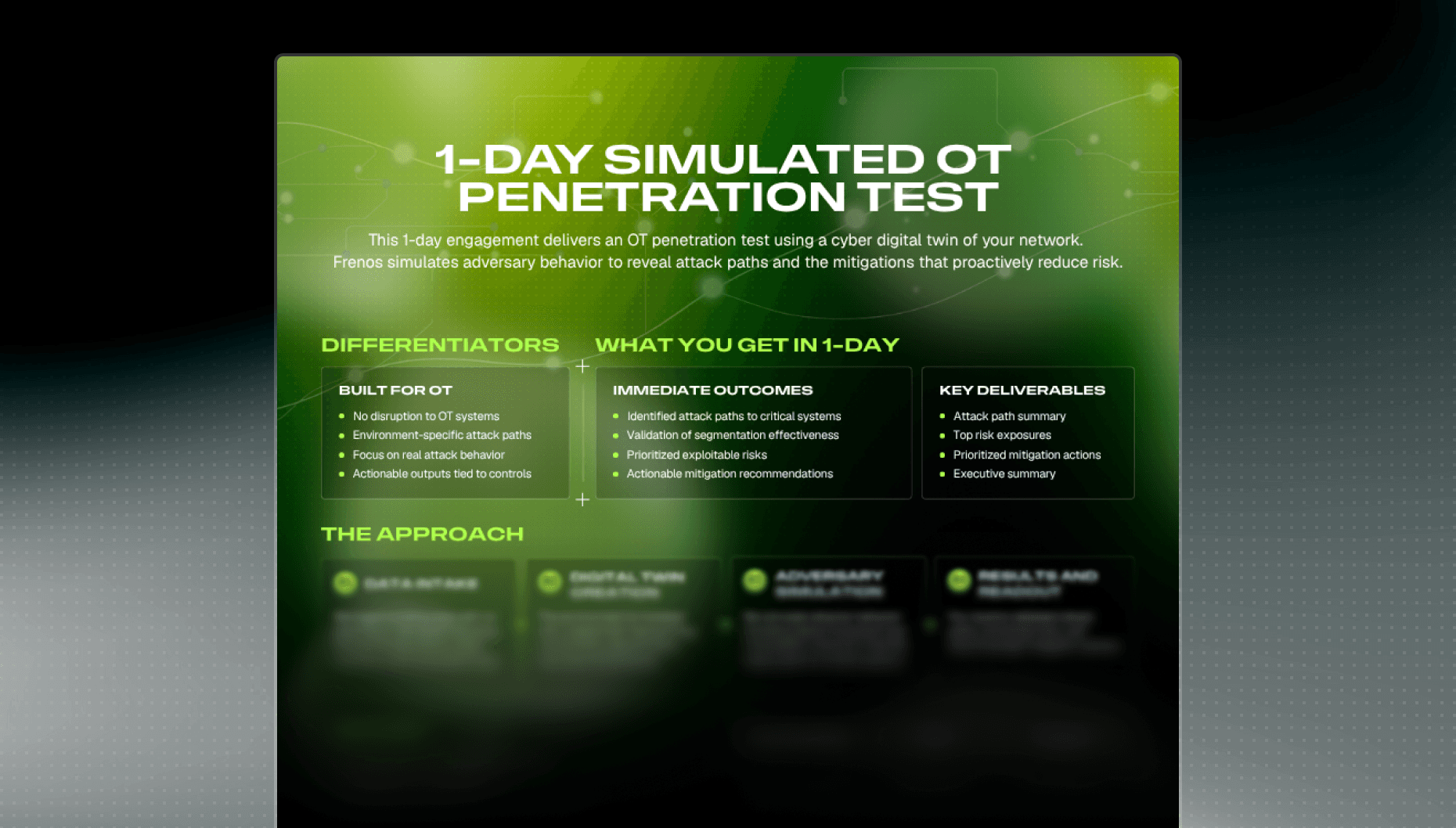

1-Day Simulated OT Pentest
Take a deep dive into understanding how Frenos' simulated OT penetration testing platform allows you to understand and improve your OT security posture at scale.
Read more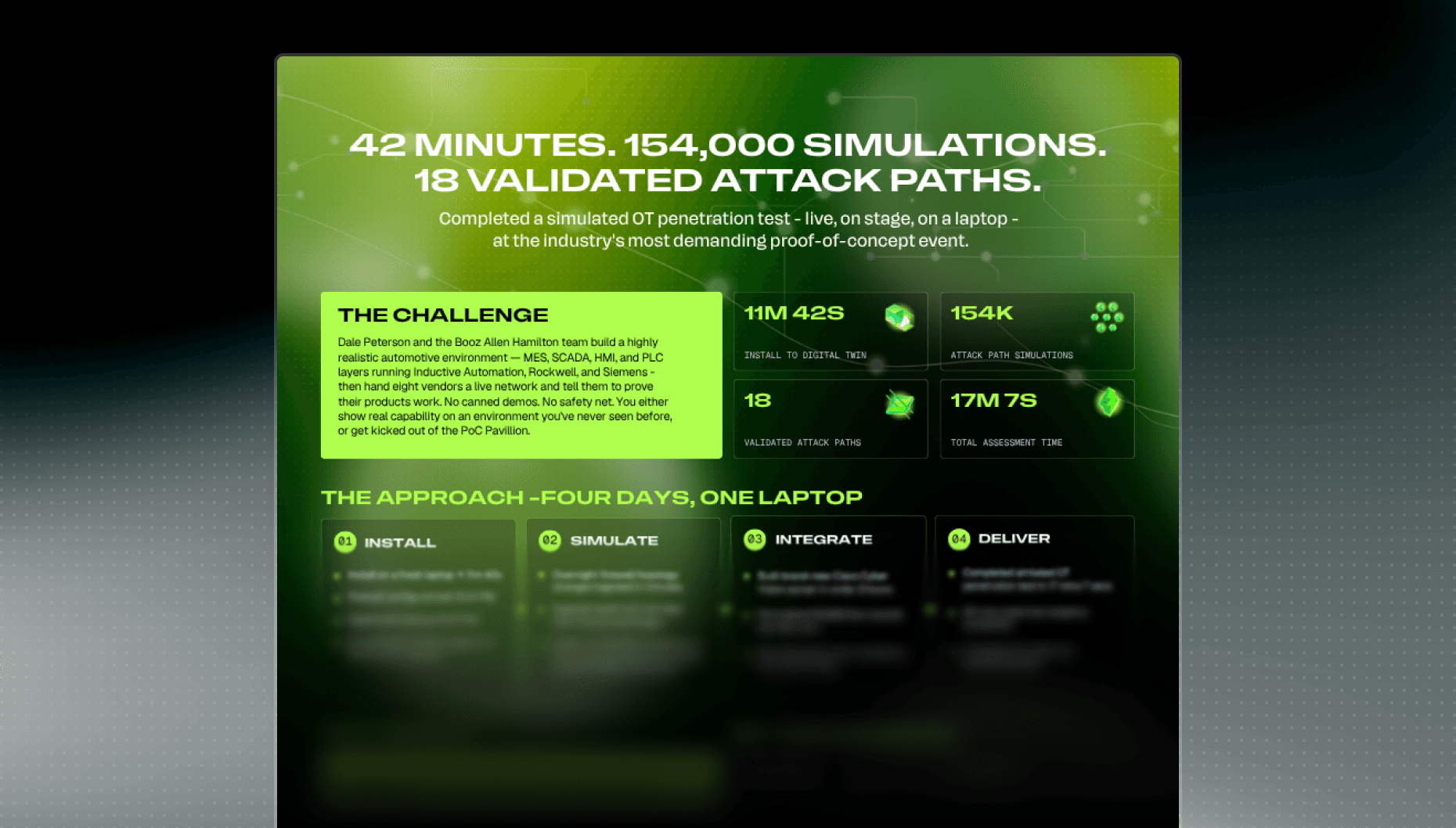
S4x26 Case Study
At the S4x26 POC Pavilion, Frenos completed 154,000 OT attack path simulations in 17 minutes and 7 seconds in a documented engagement. From three assumed-breach starting points (iDMZ, Plant Operations, Enterprise), the platform validated 18 attack paths into the critical Rockwell and Siemens zone. Those paths are exploitable given the actual controls, firewall rules, routing, and configurations modeled in the digital twin.
Read more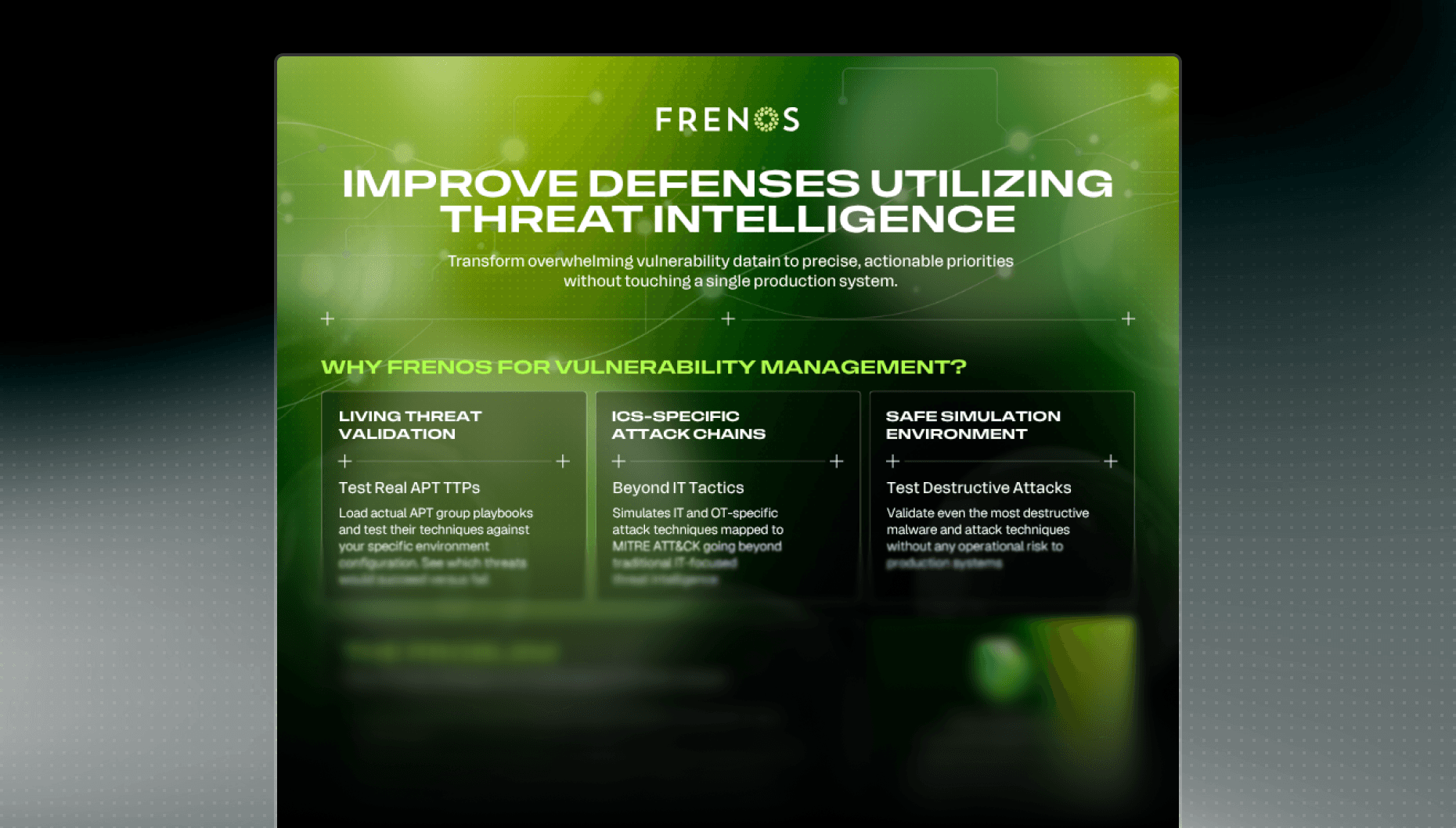
Threat Intelligence
Transform static threat intelligence into dynamic attack simulations. Reveal exactly how specific threat actors could compromise your OT environment before they try.
Read more