
OT Penetration Testing vs Red Teaming: What's the Difference?


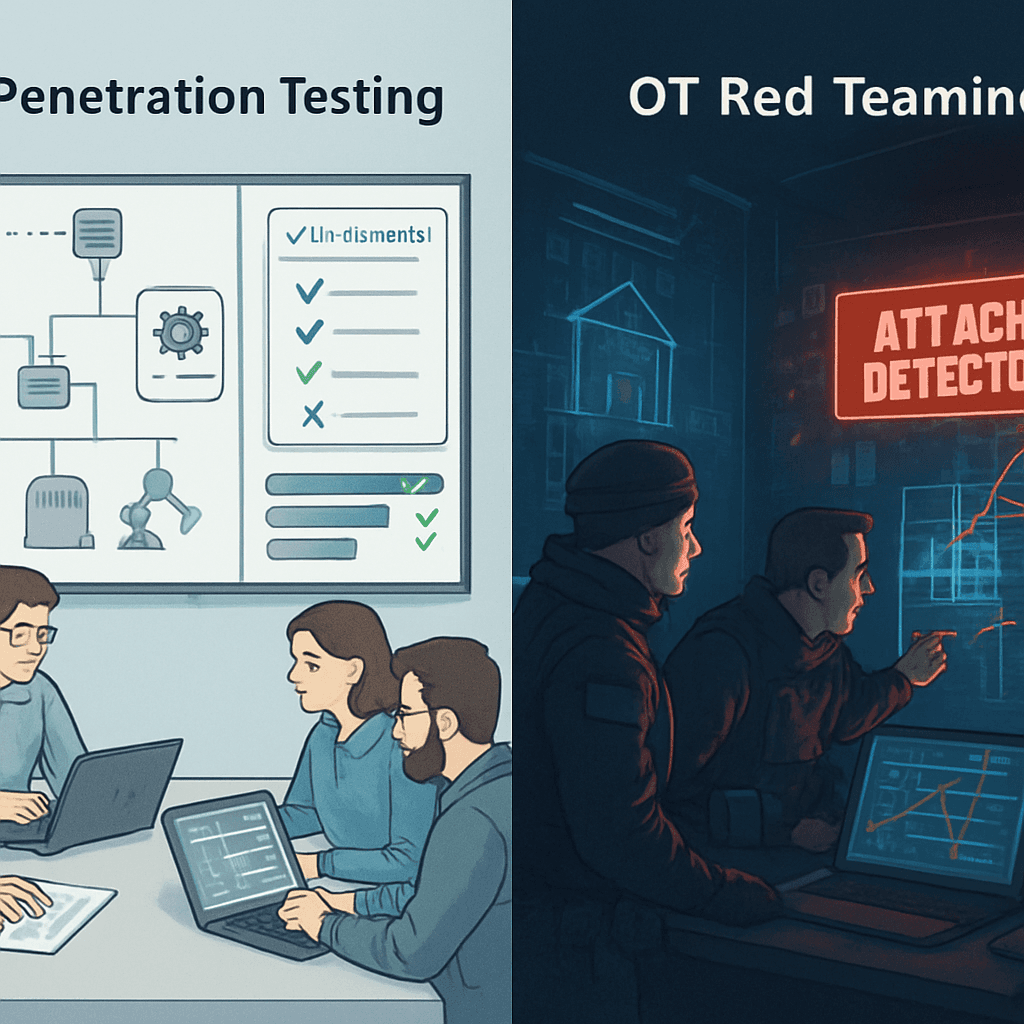
As organizations build out their OT security programs, the same question keeps coming up in planning meetings: Should we be doing penetration testing or red teaming?
These terms get thrown around interchangeably, which causes real confusion. In operational technology environments where the wrong test could halt production, understanding the difference matters more than semantic precision. Choosing the wrong approach or misunderstanding what you're actually buying can lead to false confidence, wasted budget, or unnecessary risk to systems that can't afford downtime.
This isn't about which one is "better." It's about which one actually answers the questions you need answered right now.
Why Testing OT Systems Requires a Different Playbook
If you come from an IT security background, you're probably used to aggressive testing. Automated scanners running 24/7. Continuous testing cycles. Tools that poke and prod systems without much concern for consequences because the worst case is usually a service restart.
That entire approach breaks down in operational technology. OT systems exist to maintain availability and uptime above everything else. They control physical equipment where unexpected behavior can mean safety incidents. They operate on deterministic behavior where timing matters down to the millisecond.
This changes how testing must be conducted. Everything needs careful scoping. Tests must be operationally aware of production schedules and system dependencies. The whole approach is designed to avoid unintended consequences rather than just discovering them.
That fundamental difference shapes how you should think about penetration testing versus red teaming in these environments.
What Penetration Testing Actually Means in OT Environments
OT penetration testing is a structured, scope-driven exercise designed to find specific vulnerabilities and misconfigurations within your environment. Think of it as a focused security audit with a defined target list and clear boundaries.
Most penetration tests in operational technology share common characteristics. They operate with defined scope and objectives that everyone agrees to upfront. The focus stays on known assets and controls rather than attempting to discover everything. Testing typically validates specific security measures like segmentation, access controls, and exposure points. And there's usually some compliance or audit requirement driving the whole effort.
Given the sensitivity of production systems, OT penetration testing tends to be limited and carefully controlled compared to its IT equivalent. Organizations deliberately constrain the scope to manage risk, which is the right call even if it means accepting incomplete coverage.
Penetration testing works particularly well when you're establishing a baseline security posture for the first time, validating that specific controls like firewalls or remote access work as intended, supporting regulatory requirements or insurance assessments, and operating at early or mid-stage security maturity where foundational controls still need verification.
What Red Teaming Brings That Penetration Testing Doesn't
OT red teaming takes a completely different approach. Instead of checking whether individual controls work, red teaming simulates how a real attacker would attempt to compromise your environment from initial access all the way through to impact.
The goal shifts from finding vulnerabilities to understanding how your defenses perform under realistic attack scenarios. Red teaming uses adversary emulation and attack path modeling based on known threat actor behavior. The focus expands to detection, response, and overall resilience rather than just identifying gaps. Testing deliberately crosses domain boundaries from IT networks into OT systems. And evaluation extends beyond technology to include people and processes.
Red teaming isn't about cataloging every vulnerability in your environment. That would be impossible and also misses the point. It's about understanding which attack paths actually matter given how real adversaries operate and which of your defenses would stop them versus which ones look good on paper but fail under pressure.
This approach makes the most sense for mature OT security programs that have moved past baseline controls, high-risk or regulated environments where the consequences of compromise justify the investment, organizations specifically concerned with real-world attack scenarios rather than theoretical vulnerabilities, and situations where you need to test whether your detection and response capabilities actually work.
A Quick Comparison That Clarifies the Distinction
Looking at these approaches side by side helps clarify when each makes sense:
Primary Goal
Penetration testing aims to find vulnerabilities. Red teaming simulates real attacks.
Scope Definition
Penetration testing uses narrow, defined boundaries. Red teaming operates with broad, scenario-driven parameters.
Focus Area
Penetration testing examines controls and exposure. Red teaming analyzes attack paths and potential impact.
Realism Level
Penetration testing provides moderate realism. Red teaming delivers high realism.
Risk Tolerance
Penetration testing requires low risk tolerance. Red teaming accepts managed, higher risk.
Best Application
Penetration testing suits baselines and compliance needs. Red teaming addresses resilience and readiness concerns.
Both approaches deliver value, but they answer fundamentally different questions about your security posture.
Common Mistakes Organizations Make
There are a few patterns that keep showing up when organizations choose between these approaches without fully understanding the implications.
Treating Pen Tests as Proof of Security
A successful OT penetration test doesn't mean your environment would withstand a real attack. Often, it just means the test stayed within its safe, limited scope. Passing a constrained test proves the tested controls work, not that untested areas are secure or that an adversary couldn't find alternative paths.
Jumping Into Red Teaming Too Early
Red teaming without basic controls in place generates a lot of findings but limited actionable insight. If attackers can walk through open doors, you don't need an expensive red team exercise to tell you that. You need to close the obvious gaps first through more focused testing and remediation.
Assuming One Replaces the Other
Penetration testing and red teaming are complementary, not interchangeable. Most mature programs use both at different stages. Penetration testing validates controls you've implemented. Red teaming evaluates whether those controls actually stop realistic attacks. You need both perspectives.
How Simulation Technology Changes the Equation
Historically, the biggest constraint on both OT penetration testing and red teaming has been production risk. How do you test thoroughly without risking operational disruption?
Simulation-based approaches using digital twins of OT environments fundamentally change that constraint. With simulation, organizations can test attack paths extensively without touching live systems at all. They can safely emulate adversary behavior including techniques too dangerous to attempt in production. Tests become repeatable as environments change rather than one-time events. And realism increases dramatically without increasing operational risk.
This allows penetration testing to go much deeper than was previously safe. Red teaming can happen more frequently without the lengthy planning and narrow windows that traditional approaches require. The production-risk constraint that has historically limited both approaches largely disappears.
From One-Time Events to Continuous Understanding
Modern OT security assessment programs are moving away from treating testing as occasional events toward maintaining continuous understanding of security risk.
The question shifts from "Did we pass the test?" to "Do we understand how this environment would fail under attack today given current configurations and threat actor capabilities?"
This requires different technology and different thinking. Platforms like Frenos support this shift by enabling simulated, repeatable security testing that combines the strengths of penetration testing (finding specific weaknesses) and red teaming (understanding realistic attack scenarios) in a way that's safe for operational environments.
Making the Right Choice for Your Situation
A simple maturity-based guideline helps frame the decision:
Early Stage Programs
Start with OT penetration testing to establish visibility into assets and validate baseline controls. You need to understand what you have and whether basic security measures work before worrying about sophisticated attack scenarios.
Mid-Stage Programs
Progress to deeper, repeatable penetration testing using simulation. This allows more thorough validation without the operational constraints that limited initial testing efforts.
Advanced Programs
Incorporate OT red teaming to evaluate real-world resilience. At this point, you've validated that controls exist and work individually. Red teaming tells you whether they work together against realistic adversary behavior.
In practice, most organizations benefit from both approaches applied at the right time with appropriate levels of realism for their environment and maturity.
Understanding What You're Actually Getting
The distinction between OT penetration testing and red teaming matters because they serve different purposes at different stages of security program maturity. Penetration testing validates whether specific controls work as designed. Red teaming evaluates whether your overall defensive posture would withstand realistic attack scenarios.
Neither approach alone tells the complete story about OT security risk. Both have limitations, particularly around production impact, though simulation technology is rapidly changing those constraints.
What matters most is understanding which questions you need answered right now and choosing the approach that delivers those answers without creating unnecessary risk to operational systems. That requires looking past the terminology to understand what you're actually testing and why.
Related Resources


1-Day Simulated OT Pentest
Take a deep dive into understanding how Frenos' simulated OT penetration testing platform allows you to understand and improve your OT security posture at scale.
Read more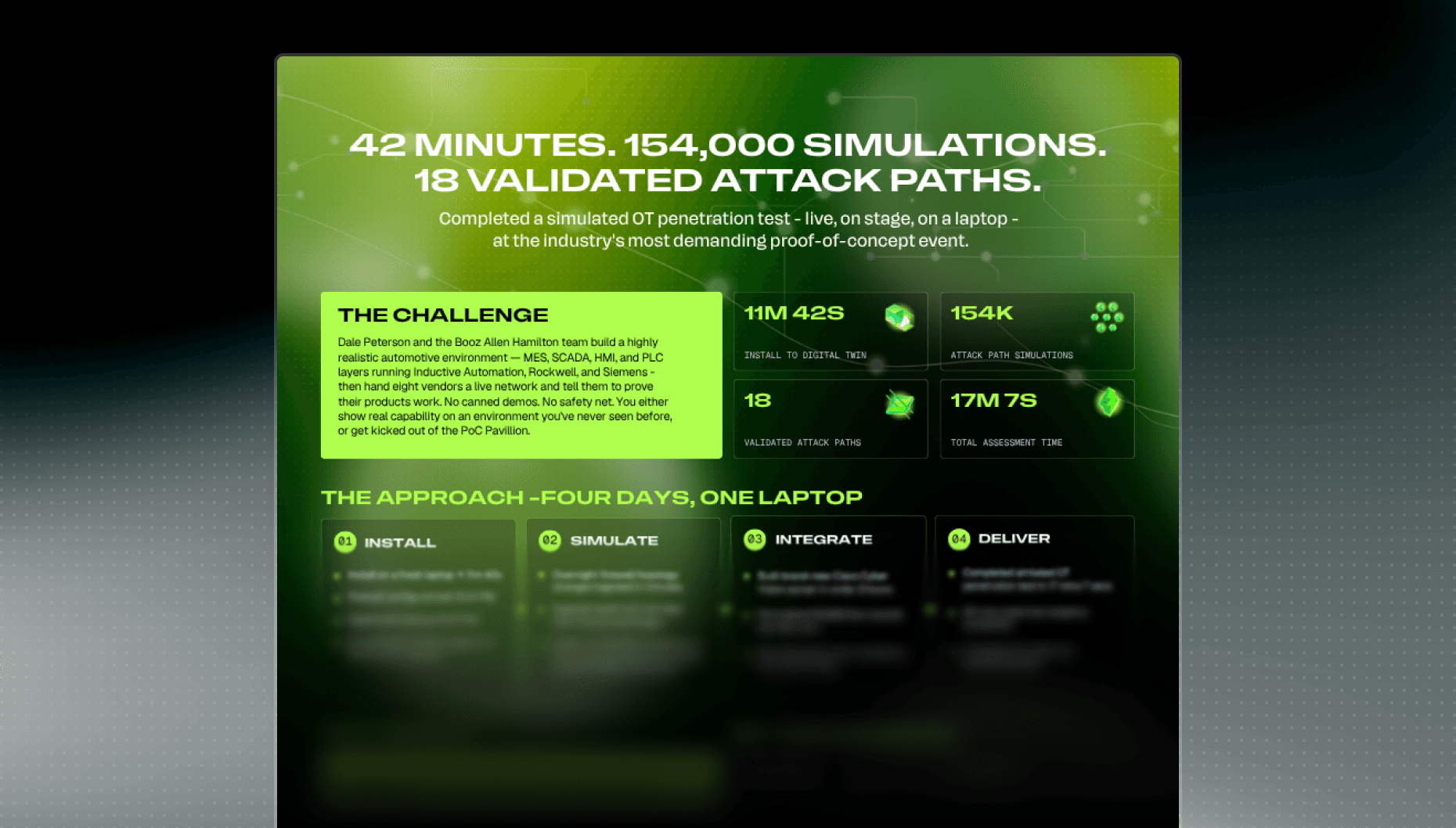
S4x26 Case Study
At the S4x26 POC Pavilion, Frenos completed 154,000 OT attack path simulations in 17 minutes and 7 seconds in a documented engagement. From three assumed-breach starting points (iDMZ, Plant Operations, Enterprise), the platform validated 18 attack paths into the critical Rockwell and Siemens zone. Those paths are exploitable given the actual controls, firewall rules, routing, and configurations modeled in the digital twin.
Read more
Threat Intelligence
Transform static threat intelligence into dynamic attack simulations. Reveal exactly how specific threat actors could compromise your OT environment before they try.
Read more