
OT Penetration Testing Checklist: Complete Guide for Before, During & After



OT penetration testing is fundamentally different from IT penetration testing. In operational technology environments, the primary risks aren't data loss—they're production downtime, equipment damage, and human safety. That's why industrial penetration testing requires a structured, safety-first approach across all testing phases.
According to the SANS ICS Security Survey, 73% of OT security incidents during assessments occur due to improperly scoped testing or inadequate preparation. The difference between a successful OT security assessment and a production shutdown often comes down to following a disciplined checklist approach.
This OT penetration testing checklist outlines what organizations should verify before, during, and after testing to improve security without disrupting operations. Whether you're conducting traditional live testing or exploring simulation-based approaches, these guidelines ensure comprehensive coverage while maintaining operational safety.
What This OT Penetration Testing Checklist Covers
This checklist is designed for:
- OT security leaders planning industrial security assessments
- ICS penetration testing teams executing safe testing protocols
- Plant managers and operations stakeholders ensuring business continuity
- Compliance teams validating NERC CIP, IEC 62443, or NIST requirements
The focus is on production-aware operational technology testing, not aggressive IT-style exploitation. For organizations managing critical infrastructure, this structured approach reduces risk while maximizing security insights.
For a broader overview of OT penetration testing methodologies, attack surfaces, and objectives, check out our complete guide to OT Penetration Testing.
Before OT Penetration Testing: 4 Essential Preparation Steps
Preparation is the most important phase of any OT security assessment. Research from Dragos indicates that most testing incidents occur because assumptions are made too early, before the environment is fully understood. The pre-test phase establishes the foundation for safe, effective testing.
1. Validate the Complete OT Asset Inventory
Before any testing begins, verify you have an accurate, comprehensive inventory:
Critical assets to confirm:
- Programmable Logic Controllers (PLCs) and Remote Terminal Units (RTUs)
- Human-Machine Interfaces (HMIs) and Engineering Workstations
- Historians, data concentrators, and SCADA servers
- Safety Instrumented Systems (SIS) and emergency shutdown systems
- Industrial firewalls, switches, and protocol gateways
Legacy system identification:
- Document devices with limited fault tolerance or known stability issues
- Identify equipment running end-of-life operating systems
- Flag any systems that cannot tolerate scanning or traffic spikes
- Note devices with restrictive maintenance windows
Network architecture validation:
- Verify network segmentation and zone boundaries (Purdue Model levels)
- Document firewall rules and access control lists
- Map network paths between IT and OT environments
- Identify any undocumented connections or shadow IT
OT penetration testing should never begin without an accurate, validated asset inventory. Incomplete inventories lead to unexpected interactions with unknown systems—a primary cause of testing-related incidents in industrial environments.
For organizations struggling with asset visibility, rapid OT visibility services can accelerate inventory completion without requiring invasive scanning techniques.
2. Define Safety and Uptime Constraints
Industrial penetration testing must respect operational reality, not theoretical security goals. This step ensures testing aligns with business requirements and safety protocols.
Identify systems that cannot tolerate active testing:
- Safety systems that cannot be bypassed or placed in maintenance mode
- Single points of failure where redundancy isn't available
- Legacy equipment where a reboot requires multi-day restart procedures
- Systems under regulatory lockdown (FDA-validated, nuclear safety systems)
Define acceptable testing windows:
- Scheduled maintenance periods when production is offline
- Reduced capacity periods where partial system impact is acceptable
- Backup system availability for critical redundancy
- Maximum acceptable response time degradation thresholds
Establish emergency stop procedures:
- Clear escalation paths if unexpected behavior occurs
- Names and contact methods for immediate system intervention
- Pre-approved rollback procedures for configuration changes
- Definition of what constitutes a "stop testing" trigger
According to CISA guidance on ICS security assessments, organizations should document these constraints in a formal Rules of Engagement document signed by both security teams and operational stakeholders.
3. Align Stakeholders Across IT, OT, and Operations
Cross-functional alignment prevents last-minute test shutdowns and ensures everyone understands their role during the assessment.
Required stakeholders:
- OT engineers who know system behavior and operational dependencies
- Plant leadership who can authorize production impact if necessary
- Cybersecurity teams who understand threat models and attack paths
- Network operations who manage infrastructure and can troubleshoot issues
- Safety teams who can validate that testing won't create hazardous conditions
Pre-test alignment meeting agenda:
- Review testing methodology and specific techniques to be used
- Confirm escalation procedures and communication protocols
- Establish testing schedules and blackout windows
- Define success criteria and deliverable expectations
- Review insurance and liability considerations
This step reduces friction and prevents situations where operations teams shut down testing because they weren't adequately informed about testing activities or potential impacts.
4. Decide on Live vs Simulated Testing Approaches
Organizations must determine their testing approach based on risk tolerance, operational constraints, and coverage requirements.
Live OT network testing:
- Provides the most realistic assessment of actual defenses
- Requires extensive safety precautions and limited scope
- Typically covers only 5-8% of the attack surface due to safety constraints
- Takes 3+ months from planning to final reporting
- Costs $50,000-$100,000 per site for comprehensive assessments
Simulation-based OT penetration testing:
- Uses digital twin technology to model the production environment
- Enables comprehensive testing without any operational risk
- Can achieve 100% attack surface coverage
- Reduces assessment time from months to hours
- Often preferred for high-risk, legacy, or safety-critical environments
Research shows that simulation-based penetration testing can identify 10x more attack paths than traditional manual testing while eliminating production risk entirely. Organizations increasingly use this approach for initial assessments, then focus live testing only on specific findings that require validation.
The Frenos platform creates consequence-free digital twins of OT environments, enabling continuous zero-touch penetration testing that reveals real attack paths without touching production systems.
During OT Penetration Testing: Safe Execution Best Practices
The execution phase demands constant vigilance and disciplined methodology. The goal is maximum security insight with zero operational impact.
5. Favor Passive and Protocol-Aware Techniques
Traditional IT security tools can cause instability or unintended consequences in OT environments. Industrial control systems often weren't designed with security testing in mind.
Passive reconnaissance techniques:
- Monitor network traffic rather than generating scanning packets
- Use network taps or span ports for observation without injection
- Analyze existing documentation and architecture diagrams
- Review firewall logs and historical traffic patterns
Protocol-aware active testing:
- Use tools specifically designed for industrial protocols (Modbus, DNP3, OPC, BACnet)
- Understand normal vs abnormal traffic patterns for each protocol
- Avoid indiscriminate port scanning or service enumeration
- Test exploits in lab environments before considering production use
Tools to avoid in production OT:
- Aggressive Nmap scans with default timing settings
- Metasploit modules not specifically validated for OT devices
- Fuzzing tools that could crash PLC firmware
- Automated vulnerability scanners designed for IT environments
According to ICS-CERT advisories, several documented OT incidents occurred when security teams used IT-focused tools that overwhelmed industrial device network stacks or triggered unexpected behavior in embedded systems.
For organizations needing comprehensive vulnerability assessment without these risks, AI-powered digital twin simulation validates exploitability without sending packets to production devices.
6. Monitor OT Systems Continuously During Testing
Active monitoring provides early warning of unintended consequences and enables rapid response if issues develop.
Real-time monitoring requirements:
- Watch for latency spikes or response time degradation
- Track CPU and memory utilization on critical systems
- Monitor for unexpected device reboots or state changes
- Observe process values and ensure they remain within normal ranges
Maintain communication with operations:
- Establish open voice/chat channels with plant operators
- Schedule regular check-ins even if no issues are apparent
- Share testing activities before executing each new technique
- Document any anomalies immediately, even if they seem unrelated
Pause criteria:
- Any unexplained change in process values or system behavior
- Operator reports of unexpected alarms or system messages
- Latency increases beyond pre-defined thresholds
- Loss of redundancy or backup system availability
OT penetration testing should pause immediately if operational anomalies appear, even if testing didn't obviously cause the issue. Industrial environments are complex, and correlation doesn't always equal causation—but safety demands a conservative approach.
7. Maintain Strict Change Control Discipline
Documentation and discipline during testing preserve trust between security and operations teams while ensuring findings can be validated and reproduced.
Required documentation:
- Log every testing action with timestamp and methodology
- Record all network traffic generated or commands issued
- Document system responses and observed behavior
- Note any warnings, errors, or unexpected results
Configuration change protocol:
- Never modify system configurations without explicit approval
- Document the original state before any authorized changes
- Test configuration changes in lab environments first when possible
- Have validated rollback procedures before making changes
Vulnerability documentation in context:
- Record not just what vulnerabilities exist, but which are exploitable
- Note mitigating controls that reduce risk (air gaps, firewall rules)
- Document attack paths showing how vulnerabilities chain together
- Capture evidence showing whether exploitation would succeed
This disciplined approach ensures that findings are credible, reproducible, and actionable. It also maintains the professional relationship between security and operations teams by demonstrating respect for operational integrity.
After OT Penetration Testing: Validation & Remediation
The post-test phase is where real security value is created—or lost. How findings are validated, prioritized, and communicated determines whether testing drives meaningful improvement.
8. Validate Findings Without Introducing New Risk
Not all discovered vulnerabilities represent actual risk in the context of your specific environment. Post-test validation separates theoretical issues from real threats.
Simulation-based validation:
- Test exploit chains in digital twin environments when available
- Verify whether multiple vulnerabilities can be chained for impact
- Validate assumptions about attacker capabilities and access
Avoid "proof-of-impact" actions on live systems:
- Don't crash devices or services to prove vulnerabilities exist
- Don't exfiltrate data or modify process values for demonstration
- Don't test denial-of-service conditions against production equipment
Focus on realistic attack paths:
- Evaluate whether identified vulnerabilities are network-accessible
- Consider whether exploitation requires insider access or physical presence
- Assess whether compensating controls effectively mitigate risk
- Validate findings against known threat actor tactics, techniques, and procedures
OT security assessment results should reflect credible threats based on real-world attack scenarios, not theoretical exploits that require unrealistic conditions. Organizations using digital twin simulation for threat intelligence validation can test hundreds of attack scenarios safely, providing comprehensive evidence of which threats matter most.
9. Prioritize Remediation Based on Operational Impact
Not all vulnerabilities are equal in OT environments. Prioritization must account for exploitability, business impact, and remediation feasibility.
Risk-based ranking criteria:
Safety implications:
- Could exploitation cause physical harm to personnel?
- Would compromise affect safety instrumented systems?
- Are critical safety margins reduced by successful exploitation?
Production impact:
- What operational downtime would result from successful attack?
- How quickly could operations recover from compromise?
- Are redundant systems available to maintain production?
Likelihood of exploitation:
- Is the vulnerability network-accessible given current segmentation?
- Do threat actors have documented capabilities for this technique?
- Are exploit tools publicly available or actively being used?
Remediation complexity:
- Can the vulnerability be patched during normal maintenance windows?
- Does remediation require extended downtime or equipment replacement?
- Are compensating controls available if patching isn't feasible?
Traditional CVSS scores often fail to capture OT-specific risk factors. A "Critical" CVSS vulnerability behind multiple firewalls with no network path may represent far less risk than a "Medium" CVSS issue on an internet-accessible HMI.
Organizations need intelligent vulnerability prioritization that considers actual exploitability in their specific environment, not generic severity scores that ignore operational context.
10. Feed Results Into Continuous Risk Management
The most mature OT security programs treat penetration testing as an ongoing process, not a one-time checkbox exercise.
Update threat models:
- Incorporate discovered attack paths into architecture reviews
- Adjust monitoring and detection priorities based on validated threats
- Update incident response playbooks with realistic attack scenarios
Improve segmentation strategies:
- Address identified lateral movement paths between zones
- Strengthen firewall rules based on proven exploitation routes
- Implement additional network monitoring at critical boundaries
Inform future assessments:
- Schedule follow-up testing to validate remediation effectiveness
- Expand scope to adjacent systems based on discovered interconnections
- Integrate findings into vendor security evaluation processes
Continuous assessment approaches: Many organizations now move beyond annual penetration testing toward continuous security validation. Continuous OT security posture management platforms enable daily or weekly testing that tracks improvements, validates mitigations, and ensures security posture doesn't degrade between formal audits.
Research from the Ponemon Institute shows organizations with continuous assessment programs identify and remediate vulnerabilities 90% faster than those relying on annual point-in-time testing.
Why This Checklist Matters for OT Environments
OT penetration testing is most effective when it:
- Respects production constraints and operational realities
- Accounts for legacy systems that can't tolerate aggressive testing
- Minimizes risk while maximizing security insight
- Provides actionable results that drive measurable improvement
Following a structured before-during-after checklist reduces the chance of unintended disruption while improving security outcomes. Organizations that skip preparation steps, use inappropriate tools, or fail to properly validate findings often see limited value from penetration testing—or worse, experience production impacts that damage trust in security programs.
For a deeper look at how simulation-based approaches support this methodology while eliminating operational risk, see our article on why OT penetration testing should be simulated.
OT Penetration Testing vs Vulnerability Scanning: Key Differences
Organizations often confuse vulnerability scanning with penetration testing. Understanding the distinction helps set appropriate expectations and choose the right approach.
Vulnerability Scanning:
- Automated detection of known vulnerabilities using databases (CVE, NVD)
- Identifies what vulnerabilities exist but not whether they're exploitable
- Can be disruptive to OT environments if not carefully configured
- Provides broad coverage but limited context
- Typically performed quarterly or monthly
OT Penetration Testing:
- Manual and automated exploitation to prove vulnerabilities are exploitable
- Chains multiple vulnerabilities to demonstrate attack paths
- Reveals which issues pose actual risk versus theoretical concerns
- Provides detailed remediation guidance based on real exploitation
- Typically performed annually due to time and cost constraints
Simulation-Based Assessment (New Approach):
- Combines breadth of scanning with depth of penetration testing
- Tests exploitability without touching production systems
- Enables continuous assessment versus point-in-time snapshots
- Scales to cover 100% of the environment versus 5-8% sampling
- Reduces assessment time from months to hours
For comprehensive OT security posture management, leading organizations combine all three approaches: regular vulnerability scanning for detection, simulation-based continuous assessment for prioritization, and focused manual penetration testing for specific high-risk findings.
How Long Does OT Penetration Testing Take?
Timeline expectations vary significantly based on approach and scope.
Traditional Manual OT Penetration Testing:
- Planning and scoping: 2-4 weeks
- Asset inventory validation: 2-6 weeks
- Active testing phase: 1-4 weeks
- Reporting and validation: 2-4 weeks
- Total timeline: 3-5 months per site
Factors that extend timelines:
- Limited testing windows (nights, weekends, maintenance periods)
- Multiple approvals required for each testing phase
- Need to pause for operational issues
- Travel requirements for on-site testing
- Remediation validation requiring follow-up assessments
Simulation-Based OT Penetration Testing:
- Digital twin creation: 1-3 days
- Comprehensive testing: Hours to days
- Reporting: 1-3 days
- Total timeline: 1-2 weeks per site
The Frenos platform reduces OT security assessment time by 95% compared to traditional approaches while increasing coverage from typical 5-8% to 100% of the attack surface. This enables organizations to assess dozens or hundreds of sites in the time traditional methods require for a single facility.
Common OT Penetration Testing Mistakes to Avoid
Even experienced security teams make critical errors when transitioning from IT to OT testing. Awareness of common mistakes prevents costly incidents.
Mistake 1: Using IT Security Tools Without Validation
The Problem: Nmap, Metasploit, and other IT tools can crash PLCs or HMIs by overwhelming limited network stacks or triggering unexpected device behavior.
The Solution: Always validate tools in lab environments first. Use purpose-built OT security tools or passive techniques when possible.
Mistake 2: Testing During Production Without Redundancy
The Problem: Testing critical systems during production hours without backup systems available means any unexpected issue causes immediate production impact.
The Solution: Schedule testing during maintenance windows or ensure redundant systems can handle the load if primary systems experience issues.
Mistake 3: Inadequate Communication with Operations
The Problem: Operations teams shut down testing because they weren't informed, or security teams can't interpret whether observed behavior is normal or anomalous.
The Solution: Establish open communication channels and regular check-ins throughout testing. Include operations in planning from day one.
Mistake 4: Focusing on Vulnerability Count Instead of Risk
The Problem: Reporting thousands of CVEs without context about exploitability or business impact creates alert fatigue and doesn't guide remediation priorities.
The Solution: Focus on proven attack paths and exploitable vulnerabilities. Prioritize by actual risk, not CVSS scores.
Mistake 5: One-Time Testing Without Continuous Validation
The Problem: Annual penetration tests become outdated as environments change. New systems, configurations, and vulnerabilities emerge constantly.
The Solution: Implement continuous assessment approaches that validate security posture regularly, not just during formal audits.
OT Penetration Testing Cost Considerations
Understanding cost structures helps organizations budget appropriately and compare different approaches.
Traditional Manual Penetration Testing Costs:
- Small facility (single process): $35,000 - $75,000
- Medium facility (multiple processes): $75,000 - $150,000
- Large facility (complex infrastructure): $150,000 - $250,000+
- Multi-site programs: $500,000 - $2,000,000+ annually
Cost drivers:
- Number of assets and network complexity
- Geographic distribution requiring travel
- Regulatory requirements (NERC CIP, FDA, nuclear)
- Level of operations integration required
- Follow-up validation testing
Simulation-Based Assessment Costs:
- Initial setup and digital twin creation: $15,000 - $50,000
- Per-site ongoing assessment: 70-80% less than traditional methods
- Enterprise platform licensing: Scales across unlimited sites
Organizations with 10+ OT sites typically achieve ROI within the first year by eliminating the need for multiple $100K+ manual penetration tests while gaining continuous security validation.
Red team and penetration testing teams are increasingly adopting simulation-based approaches to scale offensive security programs across large OT environments.
Measuring OT Penetration Testing ROI
Executives need clear metrics to justify security testing investments.
Traditional Metrics:
- Number of vulnerabilities discovered and remediated
- Reduction in CVSS scores across the environment
- Compliance checkboxes completed (NERC CIP, IEC 62443)
Better OT-Specific Metrics:
- Attack path reduction: Decrease in exploitable paths to critical assets
- Mean time to remediation: Speed of vulnerability resolution
- Assessment coverage: Percentage of environment tested
- Security posture score: Quantifiable improvement in defensibility over time
Organizations using continuous OT security posture management can track these metrics monthly rather than waiting for annual assessments. This enables data-driven security strategies that demonstrate clear improvement trends to executives and boards.
Example ROI Calculation:
- Traditional approach: $200K annually for 3 site assessments
- Simulation approach: $150K for unlimited site assessments
- Additional value: 95% faster results, 20x coverage increase
- Risk reduction: Proven 70% decrease in exploitable vulnerabilities
Industry-Specific OT Penetration Testing Considerations
Different sectors face unique challenges that impact testing approaches.
Manufacturing:
- Just-in-time production means zero tolerance for downtime
- Legacy equipment with 20+ year lifecycles
- High asset density requiring efficient testing approaches
Energy & Utilities:
- Strict regulatory requirements (NERC CIP, TSA directives)
- Geographically distributed assets
- Safety-critical systems requiring extreme caution
Healthcare (Medical Devices):
- FDA validation concerns limiting configuration changes
- Patient safety as the paramount concern
- Mix of IT and OT in clinical environments
Oil & Gas:
- Remote sites with limited connectivity
- Hazardous environments requiring intrinsically safe equipment
- Complex supply chain and third-party access
Each industry benefits from tailored approaches that respect sector-specific constraints while achieving comprehensive security assessment.
Take the Next Step: Transform Your OT Penetration Testing Program
Traditional OT penetration testing approaches are reaching their limits. Manual assessments can't keep pace with expanding attack surfaces, increasing compliance requirements, and accelerating threat evolution. Organizations need continuous security validation that scales across their entire OT environment without operational risk.
What if you could:
- Test 100% of your attack surface instead of sampling 5-8%
- Complete comprehensive assessments in days instead of months
- Validate security posture continuously, not just annually
- Eliminate all risk to production systems during testing
- Scale across hundreds of sites as easily as one
- Track and prove security improvements with quantifiable metrics
Frenos enables autonomous OT security assessment through digital twin simulation and AI-powered adversary modeling. Security teams across manufacturing, energy, utilities, and other critical infrastructure sectors use Frenos to conduct continuous zero-touch penetration testing that reveals real attack paths without ever touching production systems.
Ready to transform your OT penetration testing program?
- Schedule a demo to see how Frenos assesses OT environments in hours instead of months
- Download the complete OT assessment guide with detailed methodologies and tools
For questions about implementing this checklist or optimizing your OT security testing program, contact our team of former OT practitioners and penetration testing experts.
Related Resources:
- OT Penetration Testing: Complete Guide - Comprehensive overview of methodologies, tools, and approaches
- Why Your Next OT Penetration Test Should Be Simulated - Deep dive on digital twin advantages
- OT Vulnerability Management - Contextual prioritization for industrial environments
- Red Team & Penetration Testing - Scaling offensive security operations
- Threat Intelligence for OT - Operationalizing threat intelligence through simulation
Frequently Asked Questions About OT Penetration Testing
OT penetration testing is the controlled evaluation of operational technology security by simulating adversary techniques to identify exploitable vulnerabilities in industrial control systems, SCADA networks, and critical infrastructure. Unlike IT penetration testing, OT assessments prioritize operational safety and avoid techniques that could disrupt production or create hazardous conditions.
Traditional OT penetration testing costs between $50,000-$100,000 per site and takes 3-5 months to complete. Simulation-based approaches using digital twin technology typically reduce costs by 70-80% while delivering results in days instead of months and covering 100% of the attack surface instead of the typical 5-8% coverage from manual testing.
Industry best practices recommend annual OT penetration testing at minimum for compliance purposes. However, leading organizations are moving toward continuous assessment models that validate security posture monthly or weekly, especially for critical infrastructure. The optimal frequency depends on regulatory requirements, risk tolerance, and rate of environmental change.
Yes, but with significant limitations. Live OT penetration testing requires extensive safety precautions, limited testing windows, and restricted scope to avoid operational disruption. Most organizations can only safely test 5-8% of their attack surface using live testing methods. Simulation-based approaches using digital twins enable comprehensive testing without any operational risk.
OT penetration testing focuses on technical vulnerability identification and exploitation across the environment. Red team exercises simulate complete adversary campaigns including social engineering, physical security, and full attack chain execution. Red team engagements are broader in scope but conducted less frequently. Both approaches benefit from simulation-based methodologies that enable realistic scenarios without production risk.
OT findings should be prioritized by combining exploitability, business impact, and safety implications—not just CVSS scores. Consider whether vulnerabilities are network-accessible given current segmentation, whether exploitation could impact safety systems, the production downtime that would result from compromise, and whether compensating controls effectively mitigate risk. Contextual vulnerability prioritization tools automate this analysis based on your specific environment.
Related Resources
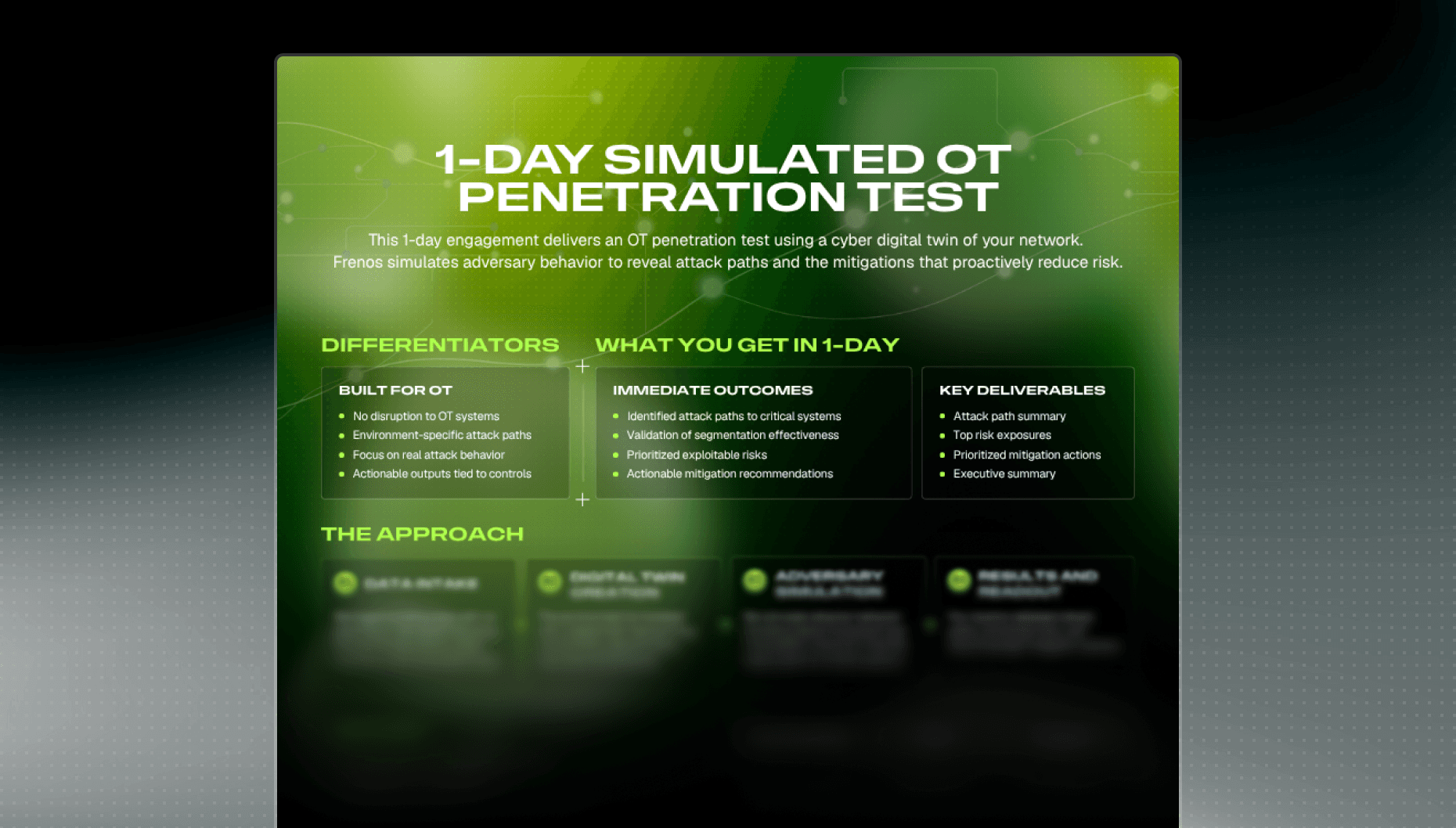

1-Day Simulated OT Pentest
Take a deep dive into understanding how Frenos' simulated OT penetration testing platform allows you to understand and improve your OT security posture at scale.
Read more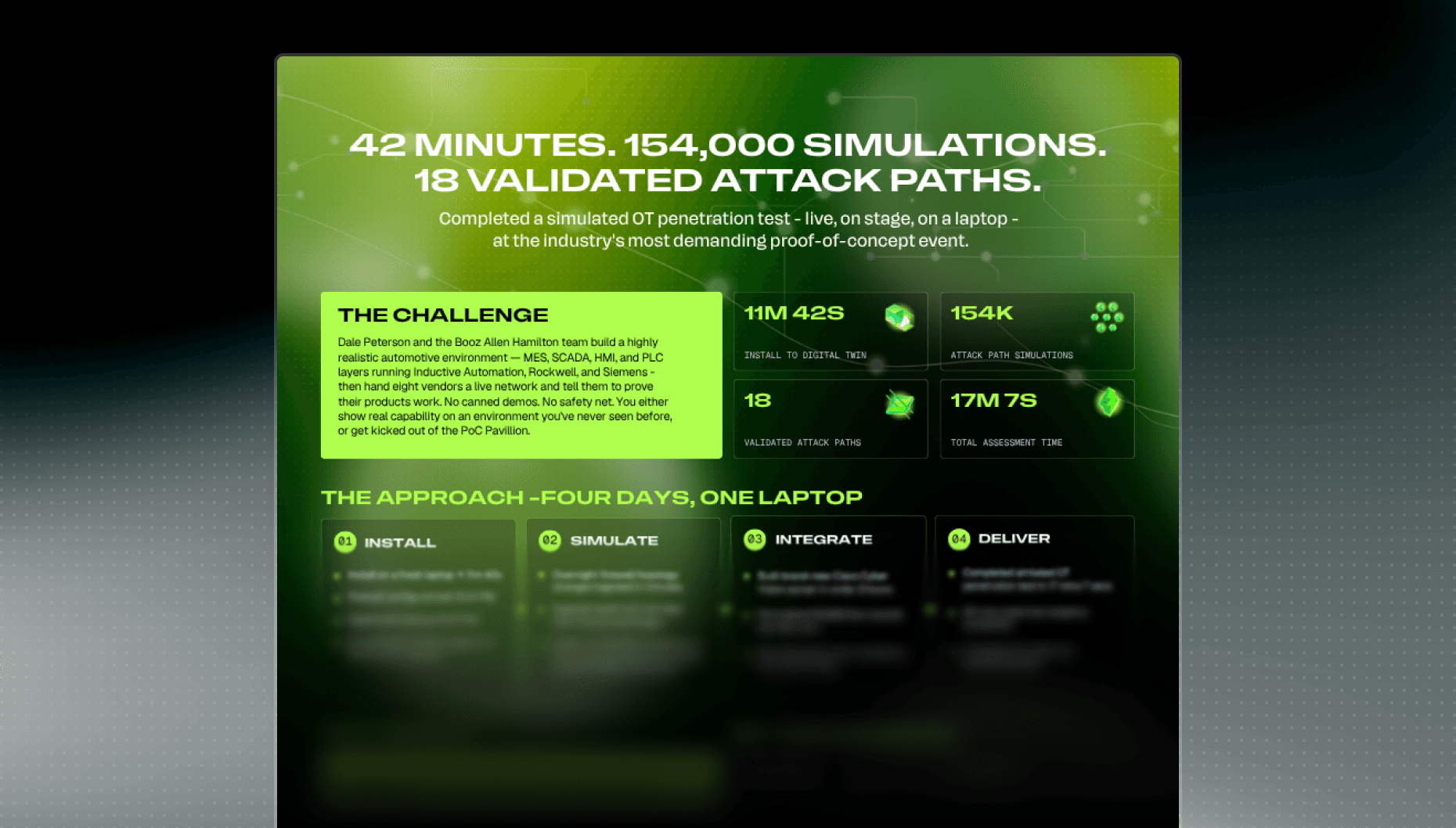
S4x26 Case Study
At the S4x26 POC Pavilion, Frenos completed 154,000 OT attack path simulations in 17 minutes and 7 seconds in a documented engagement. From three assumed-breach starting points (iDMZ, Plant Operations, Enterprise), the platform validated 18 attack paths into the critical Rockwell and Siemens zone. Those paths are exploitable given the actual controls, firewall rules, routing, and configurations modeled in the digital twin.
Read more
Threat Intelligence
Transform static threat intelligence into dynamic attack simulations. Reveal exactly how specific threat actors could compromise your OT environment before they try.
Read more