
MITRE ATT&CK for ICS: practical threat mapping, validation, and detection for OT teams



MITRE ATT&CK for ICS is often adopted with good intent but inconsistent outcomes. Many critical infrastructure teams build technique lists, tag alerts, and run tabletop exercises, yet still struggle to answer the operational questions that matter: Which attack paths are realistic in our plant? What telemetry would confirm each step? Which controls actually break the path? And how do we validate this safely without touching production systems?
This article explains how to use the MITRE ATT&CK for ICS framework to move from a catalog of techniques to a defensible, testable security program. We will cover how to map ATT&CK for ICS to your architecture, translate techniques into hypotheses and detections, and validate end to end attack paths using safe testing approaches such as digital twins. If you want additional architecture context, see ICS and SCADA Security: Architecture, Risks, and Safe Validation for Critical Infrastructure and the Complete Guide to OT Security: Protecting Industrial Control Systems. For a deeper view on safe testing and attack path analysis in OT, read SCADA Cyber Security: Visibility, Attack Paths, and Safe Testing with Digital Twins.
What is MITRE ATT&CK for ICS (and what it is not)
MITRE ATT&CK for ICS is a knowledge base of adversary tactics and techniques observed in industrial control system environments. It is designed to help OT security teams describe attacker behavior in a consistent way and connect that behavior to defenses.
It is not a complete risk assessment, a threat model by itself, or a checklist you can “implement.” The framework does not know your process constraints, interlocks, safety instrumentation, vendor-specific behaviors, or which assets actually sit on critical paths. To make it operational, you need to map it to your real architecture and then validate the paths and detections you believe matter.
A useful mental model is: ATT&CK for ICS gives you the verb set, your environment provides the nouns, and your security program defines the “if this, then that” logic that turns the verbs into testable scenarios and monitoring requirements.
Why ATT&CK for ICS matters for OT teams (beyond compliance)
OT environments have constraints that make security work different from IT. Patch cycles are longer, remote support is common, visibility is uneven, and availability and safety dominate decision-making. Because of this, high-level threat statements like “protect the PLC network” rarely translate into concrete engineering and monitoring actions.
ATT&CK for ICS helps you:
- Standardize communication between SOC, OT engineers, and leadership. A technique name and description is clearer than ad hoc phrasing.
- Prioritize detection and validation around attacker behavior, not only vulnerabilities. Many impactful scenarios in OT involve credential misuse, remote access paths, engineering workstation compromise, and unsafe changes, even without a “critical CVE.”
- Build a measurable program. You can define coverage goals such as “we can detect and investigate these techniques on the paths that matter,” then test whether that is true.
However, the framework only becomes actionable when you move from technique lists to attack-path validation. That is where safe testing and digital twins become especially valuable in OT settings.
A practical method to map MITRE ATT&CK for ICS to your environment
The most common failure mode is mapping every technique to everything. You end up with a spreadsheet that looks complete but does not reflect how your site actually operates.
Instead, map ATT&CK for ICS through the lens of “paths to consequence.” Start with the outcomes you must prevent or quickly detect, then work backward through the technical routes an attacker could take in your specific architecture.
The output should be a small set of high-value attack paths, each expressed as a sequence of techniques tied to real assets, zones, trust boundaries, and operator workflows. If your team is still consolidating OT visibility and boundaries, the architectural overview in ICS and SCADA Security: Architecture, Risks, and Safe Validation for Critical Infrastructure can help align terminology before you map tactics and techniques.
- Define the consequence-driven scenarios.
Examples include unauthorized logic changes, loss of view, loss of control, unsafe setpoint manipulation, or denial of control network communications. - Identify the enabling access conditions.
Document external connections, remote access methods, vendor support paths, and identity stores used in OT. Be explicit about what is routable versus only logically reachable via jump hosts or data diodes. - Create an asset-to-function map.
Focus on engineering workstations, historians, OT domain services, remote access gateways, HMI nodes, safety-related systems, and the PLC or controller families that matter most to the process. - Select relevant ATT&CK for ICS techniques per step.
Choose techniques that match how an attacker would realistically move and act, given your protocols, vendors, and operating practices. - Add detection hypotheses and control breakpoints.
For each step, define what telemetry would prove it happened and which control would prevent or contain it. - Rank paths by feasibility and impact.
Consider required access, skill, dwell time, and the blast radius of the targeted process area.
From threat mapping to detection engineering: turning techniques into signals
ATT&CK for ICS is most valuable when each mapped technique becomes a detection and investigation requirement, not merely a label.
For each technique on a prioritized path, define three items:
- Evidence sources: where proof could exist. In OT this often spans identity infrastructure (AAA, jump hosts), endpoint logs on engineering workstations, remote access gateways, historian and OPC logs, network telemetry at key conduits, and controller change records when available.
- Expected behavior: what “normal” looks like in your plant. This matters because OT environments can be noisy and deterministic. A change window, a vendor session, or a maintenance outage will strongly affect baselines.
- Detection logic: how you would reliably alert with acceptable false positives. In OT, useful detections are frequently context-driven, such as “engineering workstation to controller write outside approved window” or “new remote session route to an OT zone without ticket correlation.”
An important nuance: many high-impact ICS scenarios are detectable earlier in the chain than the final “impact” technique. You often get better response time by detecting the preparatory steps: credential access, remote service use, project file staging, new routes, or tool transfers.
If you are building a broader OT monitoring strategy, the coverage concepts in Complete Guide to OT Security: Protecting Industrial Control Systems are a good complement to ATT&CK mapping because they help you connect telemetry gaps to operational constraints.
Validate attack paths without disrupting production: why digital twins change the trade-off
Many teams want to validate their ATT&CK for ICS mapping with adversary emulation or red teaming, but OT constraints make direct testing risky. Production systems can be fragile, vendor support agreements may restrict testing, and an error can trigger downtime or safety issues.
This is where digital twins and safe testing approaches remove a major trade-off. Instead of choosing between realism and safety, you can validate full-scope attack paths against a representative model of your environment without touching production systems.
A safe validation workflow typically includes:
- Build or refine a digital twin that reflects key assets, configurations, communications paths, and critical dependencies. Maturity varies. You do not need a perfect replica of every controller to start. You need enough fidelity to test the attack paths you prioritized.
- Execute attack-path validation in the twin. Simulate the same identity flows, remote access routes, and system interactions that an attacker would use. Confirm which steps are feasible, where defenses break, and where they do not.
- Translate findings back into production actions. This is the critical step. Validation should produce changes you can implement safely: segmentation adjustments, identity hardening, remote access controls, monitoring improvements, and response playbooks.
Frenos is designed to support this style of continuous security validation for industrial environments, enabling full-scope testing of attack paths without interacting with production systems. For a more detailed explanation of the underlying approach, see SCADA Cyber Security: Visibility, Attack Paths, and Safe Testing with Digital Twins.
What you should get at the end: deliverables that make ATT&CK mapping operational
A solid MITRE ATT&CK for ICS initiative should produce outcomes that engineers and security teams can use immediately. If the deliverable is only a technique heatmap, it is hard to turn into action.
At minimum, aim for:
- A prioritized set of attack paths tied to real assets and zones. Each path should include assumptions, prerequisites, and what makes it feasible in your environment.
- A detection coverage matrix that is evidence-based. It should explicitly map which data sources support which techniques, what is currently collected, and what is missing.
- Control validation results. Identify which safeguards actually break the path and which are assumed but unproven.
- A remediation and monitoring backlog. Convert gaps into implementable work items with owners across OT engineering, IT, and security operations.
- Response playbooks for the high-risk paths. Include decision points that reflect OT constraints, such as when to involve operations, when to isolate remotely, and when to shift to manual control.
If your organization wants to reduce assessment downtime, focus on approaches that minimize production interaction. Frenos’ model emphasizes safe testing and attack-path validation, with the goal of keeping production impact near zero where feasible. If you need the broader context on how this fits into OT security programs, ICS and SCADA Security: Architecture, Risks, and Safe Validation for Critical Infrastructure is a helpful reference.
Common pitfalls when mapping MITRE ATT&CK to ICS (and how to avoid them)
Even experienced teams run into predictable problems when applying ATT&CK for ICS.
One pitfall is treating all techniques as equally relevant. OT networks vary widely. A water utility SCADA environment, a discrete manufacturing plant, and a pharmaceutical batch facility will differ in protocols, remote access patterns, and safety controls. Your mapping must reflect these specifics.
A second pitfall is focusing only on the “impact” techniques. Impact is important, but earlier steps are often easier to detect and interrupt. Prioritize the earliest feasible detection points on each path.
A third pitfall is assuming visibility that you do not have. If you cannot observe remote access sessions, engineering workstation activity, or controller changes, your “coverage” is not real. Make evidence sources explicit.
Finally, many programs do not validate feasibility. Threat modeling can drift into hypotheticals. Attack-path validation, ideally in a safe environment such as a digital twin, keeps the program grounded in what can actually happen.
FAQs
The framework itself is just a model, so it does not disrupt anything. The risk comes from how you validate assumptions. Traditional on-network testing can create operational risk in OT. A safer approach is to validate attack paths in a digital twin or dedicated test environment that mirrors production dependencies, so you can test full scenarios without interacting with production systems.
They answer different questions. A traditional pentest often focuses on point-in-time findings and may be constrained by what is safe to test in production. ATT&CK-based mapping plus attack-path validation focuses on end to end adversary behavior, ties results to specific detection and control breakpoints, and can be repeated as the environment changes. Many organizations use both: pentesting for specific components and ATT&CK-driven validation for continuous, consequence-focused assurance.
It depends on scope, site complexity, and data availability. Initial mapping can move quickly if you already have accurate zone and conduit documentation, asset inventories, and remote access details. Validation time depends on whether you can test in a safe environment like a digital twin and how many attack paths you prioritize. A practical approach is to start with a small number of high-consequence paths, validate them, then expand iteratively.
You should expect prioritized attack paths mapped to your real assets, a detection coverage matrix tied to concrete evidence sources, validated control breakpoints, and an actionable backlog of monitoring and remediation work. The best outputs are specific enough that OT engineers, SOC analysts, and vulnerability management can each take clear next steps.
No. You need enough fidelity to represent the systems and pathways that matter for the attack paths you are validating, such as remote access flows, identity dependencies, and key OT hosts like engineering workstations and HMIs. Most organizations start with available configuration data and network context, then improve the twin over time as gaps are discovered.
Next Steps
If you want to use MITRE ATT&CK for ICS to produce measurable improvements, focus on prioritized attack paths, evidence-based detection coverage, and safe validation that does not interfere with production. Frenos helps critical infrastructure teams validate full-scope OT attack paths through digital twins and continuous security validation. Request an OT Security Assessment to see what is feasible in your environment and what you can validate safely.
Related Resources
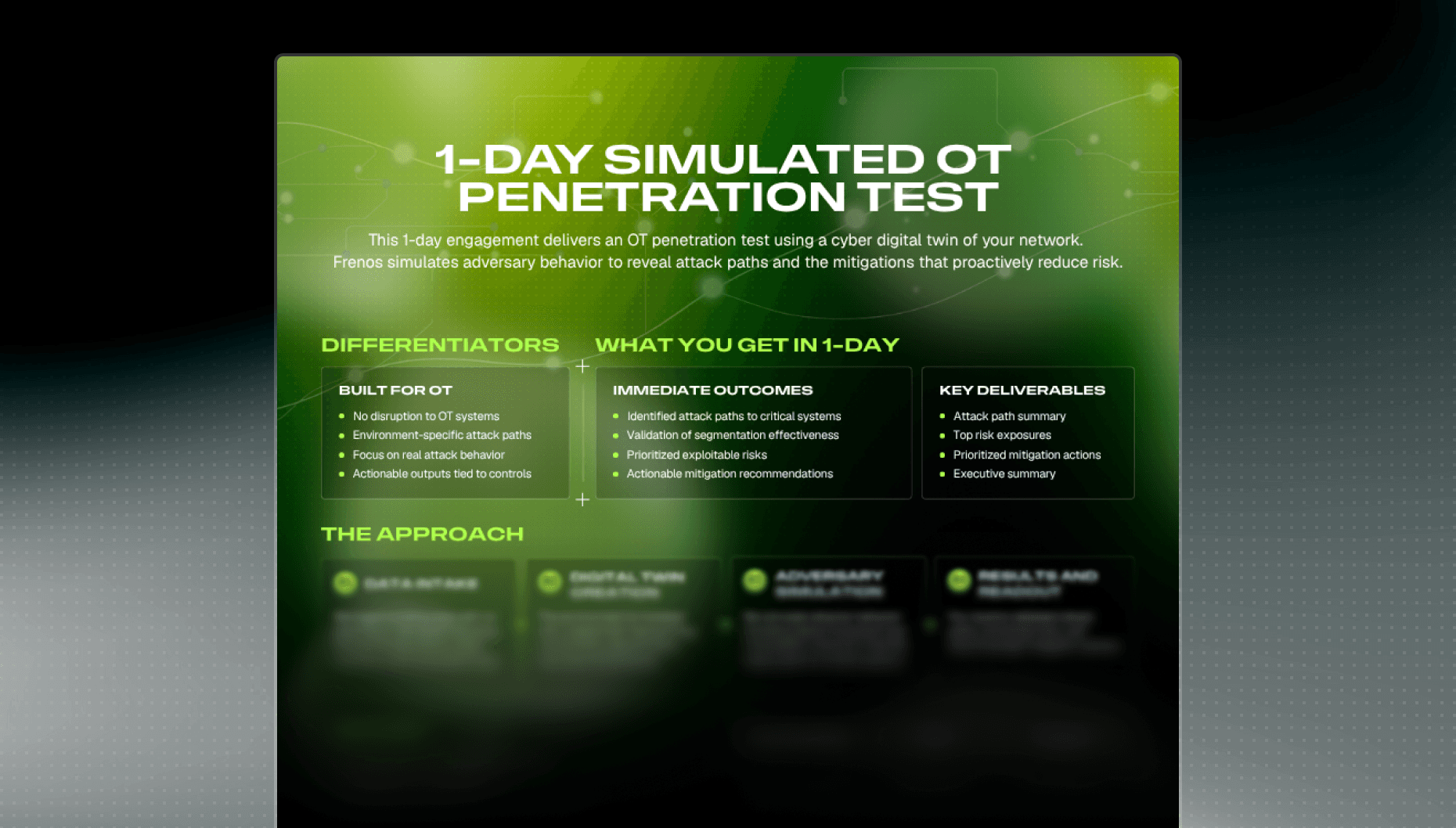

1-Day Simulated OT Pentest
Take a deep dive into understanding how Frenos' simulated OT penetration testing platform allows you to understand and improve your OT security posture at scale.
Read more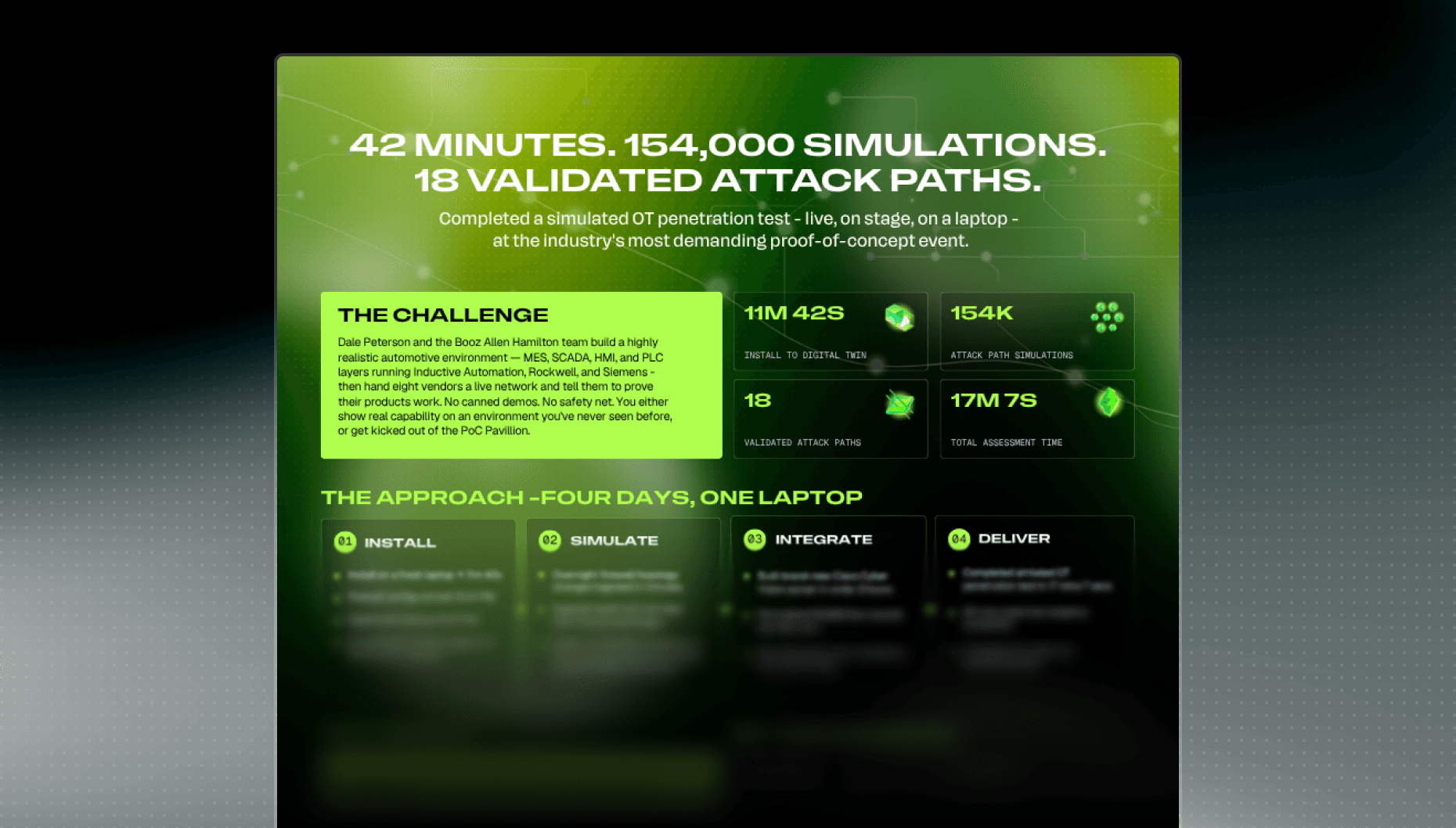
S4x26 Case Study
At the S4x26 POC Pavilion, Frenos completed 154,000 OT attack path simulations in 17 minutes and 7 seconds in a documented engagement. From three assumed-breach starting points (iDMZ, Plant Operations, Enterprise), the platform validated 18 attack paths into the critical Rockwell and Siemens zone. Those paths are exploitable given the actual controls, firewall rules, routing, and configurations modeled in the digital twin.
Read more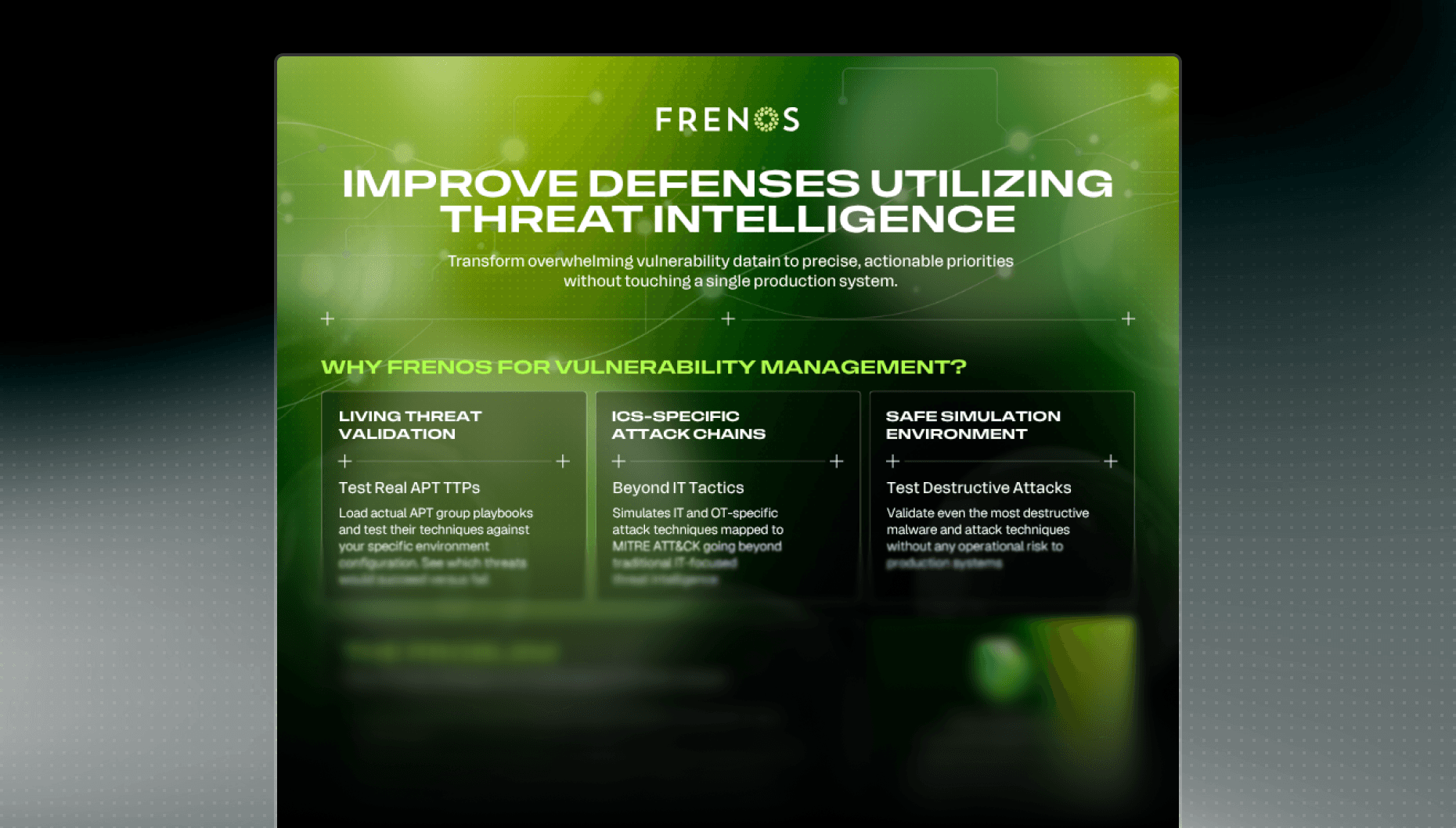
Threat Intelligence
Transform static threat intelligence into dynamic attack simulations. Reveal exactly how specific threat actors could compromise your OT environment before they try.
Read more