
AI Vulnerability Discovery in OT: What Changes When Zero-Days Arrive at Machine Speed



AI-driven vulnerability discovery is moving faster than most OT vulnerability management programs can absorb. Systems such as Anthropic’s Mythos and Project Glasswing have shown that AI can identify weaknesses at a speed and scale that breaks traditional workflows: triage, reproduction, patch planning, outage coordination, and validation.
For critical infrastructure operators, the hard part is not “finding more CVEs.” The hard part is determining which AI-discovered issues are actually reachable in your specific ICS architecture, whether exploitation creates a cyber-physical safety risk, and how to test mitigations without disrupting production. This is why Frenos focuses on the missing layer between discovery and decision-making: digital twin validation that simulates how vulnerabilities behave inside real industrial environments. If this framing resonates, see Finding the Bug Is Easy. Knowing What It Breaks Is the Hard Part. for a deeper look at the gap between detection and operational impact.
Definition: What “AI vulnerability discovery OT” actually means
In this context, AI vulnerability discovery refers to using AI systems to identify software and protocol weaknesses, including previously unknown vulnerabilities, across components that appear in OT environments: embedded firmware, PLC engineering tools, HMIs, historians, gateways, remote access stacks, protocol implementations, and supporting IT services that bridge into OT.
It is different from “AI in SOC” alert triage. The key shift is upstream: AI is increasing the rate of vulnerability creation and identification (including potential zero-days), producing more candidate findings than a typical OT team can safely reproduce, validate, and remediate. The resulting bottleneck is no longer discovery. It is verification and operationalization: does the issue exist in our environment, what does it affect, and what is the lowest-risk path to mitigation?
Why Mythos and Glasswing change the OT vulnerability management equation
Whether you compare Mythos vs Glasswing at a model level or treat them as signals of a broader trend, the operational implication is the same: vulnerability discovery is scaling. That creates a mismatch with OT constraints.
Classic OT vulnerability management assumes a manageable inflow: vendor advisories, occasional pentest findings, periodic scanning, and a patch cadence aligned to shutdown windows. AI-driven discovery increases the inflow and changes the shape of the data. You may see more novel chains, more edge-case parsing bugs, more “works in theory” exploit narratives, and more uncertainty about reachability.
OT teams then face three compounding constraints:
- You often cannot reproduce exploit behavior in production. Even “read-only” testing can create fragile conditions in legacy PLCs, serial gateways, or safety-adjacent networks.
- Many vulnerabilities are only meaningful in context. A bug in a protocol stack is not automatically a plant risk if segmentation, one-way flows, or safety interlocks change the actual blast radius.
- Patch validation is the slowest part. Even when a patch exists, you still need to know whether it breaks process communications, engineering workflows, or vendor support assumptions.
This is where a digital twin approach becomes relevant as a scaling mechanism. The goal is to keep pace with discovery without turning your OT environment into a test lab. For more on how AI is increasing pressure on both defenders and attackers, see AI Is Arming Both Sides of Cybersecurity But Only One Side Has a Plan to Scale.
The new bottleneck: from “can we find it?” to “can we act on it safely?”
AI cybersecurity tools for zero-day discovery can surface issues faster than engineering and security can operationalize.
In OT, that operationalization step includes:
- Proof and reproduction: confirming the finding maps to your firmware version, configuration, and deployment model.
- Reachability: determining whether an attacker path exists from realistic entry points, including vendor remote access, IT-OT conduits, jump hosts, and maintenance laptops.
- Consequence: translating technical exploit effects into process effects, such as loss of view, loss of control, controller stoppage, or unsafe state transitions.
- Mitigation options: patching, compensating controls, segmentation changes, protocol whitelisting, application allowlisting, service hardening, credential and access changes, or temporary isolation.
This is why many OT vulnerability management challenges are not solved by “more scanning.” You need a way to validate exploitability and impact under conditions that mirror your environment, but without putting production at risk.
A practical way to think about it is to treat every AI-discovered issue as a hypothesis. Your program needs a repeatable method to confirm or reject that hypothesis with evidence relevant to operations.
Digital twin validation: the missing layer between AI findings and OT decisions
A digital twin for cybersecurity validation is a controlled environment that mirrors key parts of your OT stack closely enough to test real behaviors: protocol interactions, application logic, network paths, identity and access assumptions, and system-to-system dependencies. The twin does not need to perfectly replicate physics to be useful for cyber validation. It needs to accurately represent the systems and communications that an exploit would touch.
Digital twin cybersecurity validation helps OT teams answer the questions that matter for prioritization:
- Does the vulnerability reproduce against our versions and configurations?
- What preconditions are required (auth, network adjacency, specific protocol states)?
- What is the observable effect on engineering operations and process visibility?
- Does exploitation create a plausible cyber-physical risk, or is it constrained to a non-critical segment?
- Which mitigations reduce risk without breaking required communications?
This approach is especially relevant for ICS vulnerability detection and SCADA cybersecurity threats where the same vendor product behaves differently across sites due to topology, segmentation, and engineering practices. If you want a broader view of safe validation patterns for critical infrastructure, see ICS and SCADA Security: Architecture, Risks, and Safe Validation for Critical Infrastructure.
A practical workflow: turning AI findings into OT-ready remediation decisions
To handle the volume and uncertainty introduced by AI driven vulnerability discovery, treat vulnerability management as an evidence pipeline. The objective is not to investigate everything deeply. It is to move each finding to a decision state with minimal operational risk.
Below is a field-tested workflow structure that maps well to OT realities and scales when zero-day volume increases.
- Normalize the finding into an OT artifact: Identify the affected product, firmware/software versions, protocol surfaces, and required conditions. Convert model output or researcher notes into reproducible test requirements.
- Map to your environment: Link the affected component to your asset inventory, including where it sits in the Purdue model, which zones and conduits apply, and what remote access or vendor pathways exist. If the component is not deployed, close the loop quickly.
- Create an exploitability hypothesis: Define the attacker starting point (internal workstation, compromised jump host, vendor VPN, IT foothold) and the path to the target. This prevents spending time on findings that require unrealistic adjacency in your architecture.
- Validate safely in a digital twin: Reproduce the issue and observe system behavior under controlled conditions. Capture evidence that matters to operations: service crashes, loss of view, authentication bypass, configuration changes, or persistence mechanisms.
- Translate impact into operational terms: Describe what breaks in the process context, not just what breaks in the packet trace. For example: “Loss of operator visibility for X minutes,” “engineering workstation cannot download logic,” or “controller enters STOP state.”
- Choose mitigations that match constraints: If patching is feasible, plan validation and rollout around outage windows. If not, apply compensating controls such as segmentation changes, protocol filtering, hardening of engineering stations, or tighter remote access controls.
- Prioritize with context-aware criteria: Rank issues by reachable attack paths, consequence, and time-to-mitigate, not by generic CVSS alone. This is where digital twin evidence is most valuable.
- Produce an audit-ready decision package: Document reproduction evidence, affected scope, chosen mitigations, residual risk, and any required operational actions. This becomes the artifact your plant leadership and engineering teams can act on.
Where Frenos fits: bridging AI discovery and operational decision-making
Frenos is positioned for the layer that most organizations struggle to scale: validation and prioritization grounded in real industrial behavior. AI systems can accelerate discovery, but they do not automatically tell you what will happen in your specific environment when a vulnerability is exploited or when a mitigation is applied.
By simulating vulnerabilities inside digital twin environments, Frenos helps teams move from “we have a finding” to “we have evidence and a decision.” That includes confirming exploitability, understanding blast radius across zones, and testing mitigations without risking production.
If you are building a longer-term operational technology cybersecurity strategy that incorporates agentic systems safely, see How Digital Twins & AI Improve OT Security and OT Agentic AI for related models of how reasoning systems and simulation can work together in OT settings.
Common objections (and how to evaluate them rationally)
Will this disrupt production? A properly designed validation approach avoids production disruption by running exploit and mitigation tests in a controlled twin rather than on live controllers and HMIs. The operational question becomes: what fidelity is required to trust the result, and what minimum dataset is needed to build that fidelity.
Is it better than a traditional pentest? It is complementary. A pentest provides point-in-time adversarial validation and often strong operator education. AI-driven discovery changes the volume and frequency of new issues. Digital twin validation provides a repeatable mechanism to test and prioritize continuously, including between scheduled assessments.
How long does it take? The time driver is usually environment mapping and data collection, not the exploit test itself. Once a baseline twin exists, additional findings can often be validated faster because you reuse topology, system images, and test harnesses.
What do we get at the end? You should expect decision-grade outputs: which vulnerabilities reproduced, what conditions were required, what the impact looks like in operational terms, and a prioritized mitigation plan with validation notes.
Are we mature enough and do we have the necessary datasets? Many organizations start with partial data: a subset of critical zones, representative controller and HMI builds, and key communication paths. You do not need perfect completeness to get value. Start where the consequence is highest and expand the twin as part of ongoing vulnerability management.
Next Steps
AI vulnerability discovery is accelerating, but OT risk reduction still depends on safe validation and operationally grounded decisions. If your team is seeing more findings than you can confidently act on, request an OT Security Assessment with Frenos to evaluate how digital twin validation can help you prioritize, test mitigations safely, and keep vulnerability management aligned with production realities.
FAQs
The challenge is not just raw count. AI can increase the rate of candidate findings and reduce the cost of exploring edge cases. Even if only a portion are relevant to your environment, the triage and validation workload grows. OT constraints make “just test it” unsafe in production, so teams need a scalable way to confirm relevance and impact.
Prioritize based on reachable attacker paths, required preconditions (auth, adjacency, protocol state), operational consequence, and time-to-mitigate. Digital twin validation adds evidence for exploitability and consequence, which are the two areas CVSS typically cannot capture for site-specific OT deployments.
Yes, if the twin represents the OT communications, control stack, and key dependencies that link cyber actions to operational effects. You do not always need a full physics model to identify high-risk outcomes like loss of view, loss of control, controller stop conditions, or unsafe command acceptance. The goal is to validate the pathways from vulnerability to operational effect.
Detection identifies potential weaknesses or indicators that a system may be vulnerable. Validation proves whether the vulnerability reproduces in your versions and configurations, and what it does in a realistic environment. In OT, validation is often the step that turns a theoretical issue into a concrete remediation decision.
No. It makes patching programs more efficient by focusing effort on vulnerabilities that are demonstrably exploitable and impactful in your environment, and by testing mitigations before they touch production. It also provides options when patching is delayed by vendor constraints or operational uptime requirements.
Related Resources
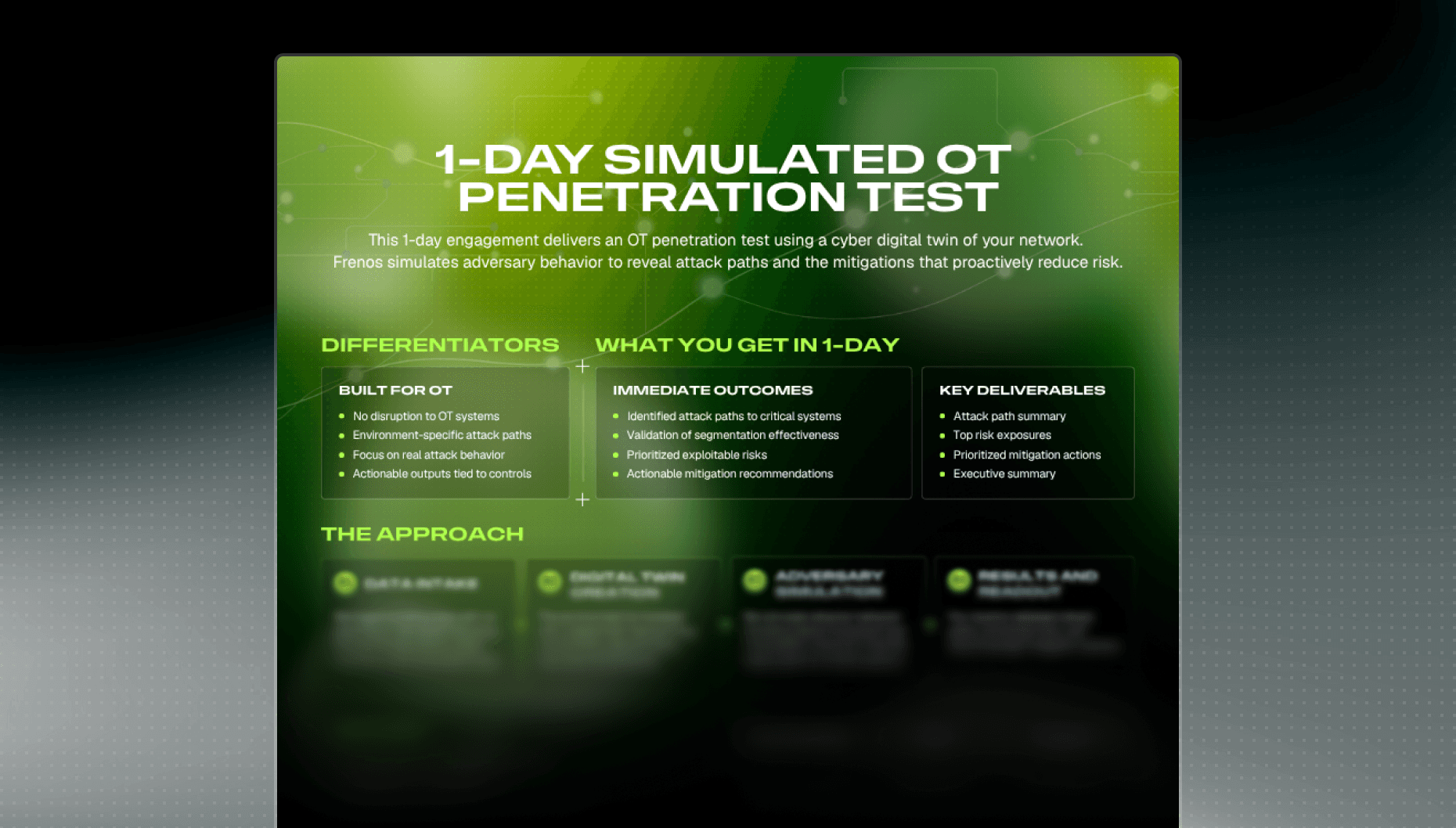

1-Day Simulated OT Pentest
Take a deep dive into understanding how Frenos' simulated OT penetration testing platform allows you to understand and improve your OT security posture at scale.
Read more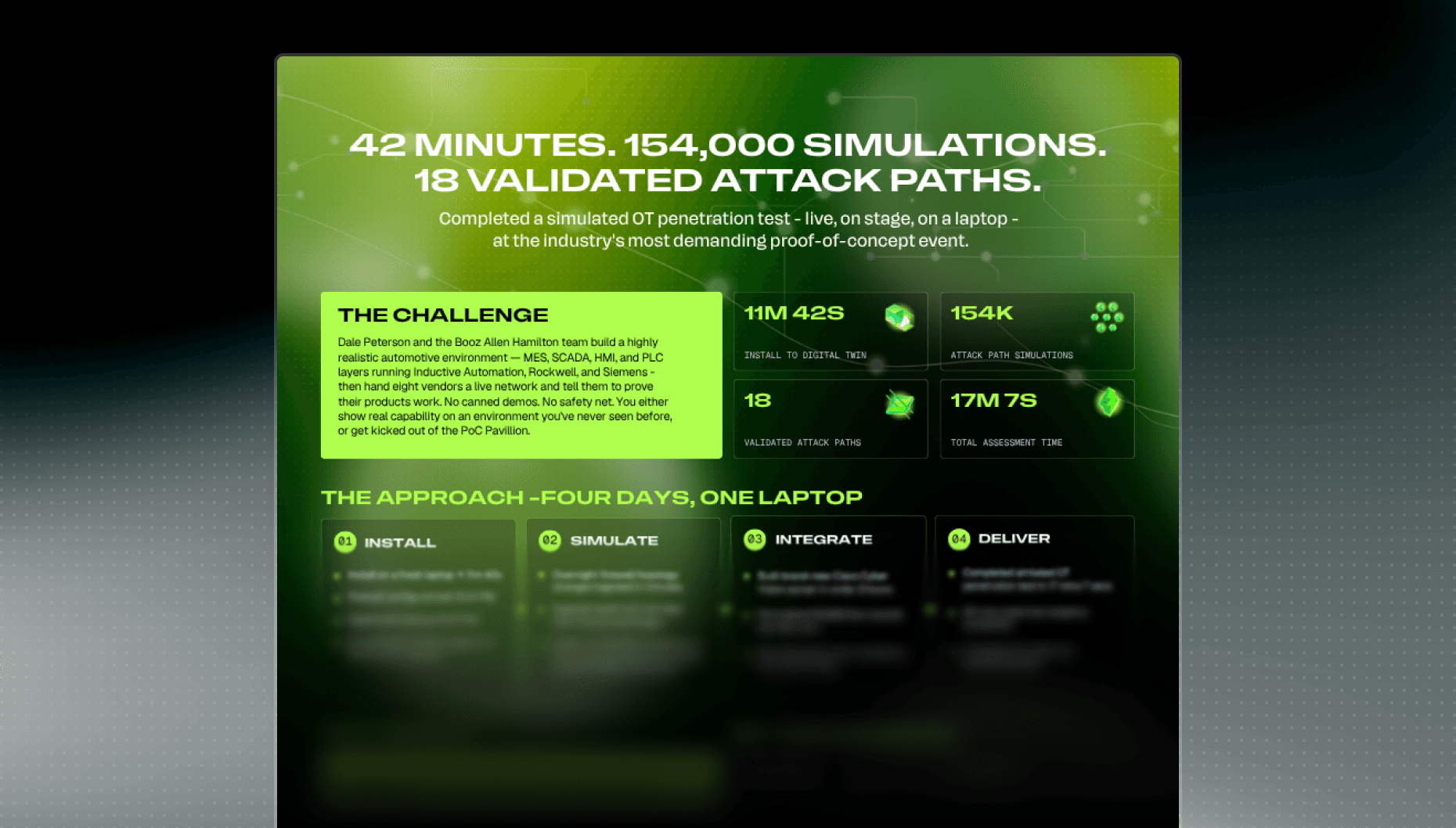
S4x26 Case Study
At the S4x26 POC Pavilion, Frenos completed 154,000 OT attack path simulations in 17 minutes and 7 seconds in a documented engagement. From three assumed-breach starting points (iDMZ, Plant Operations, Enterprise), the platform validated 18 attack paths into the critical Rockwell and Siemens zone. Those paths are exploitable given the actual controls, firewall rules, routing, and configurations modeled in the digital twin.
Read more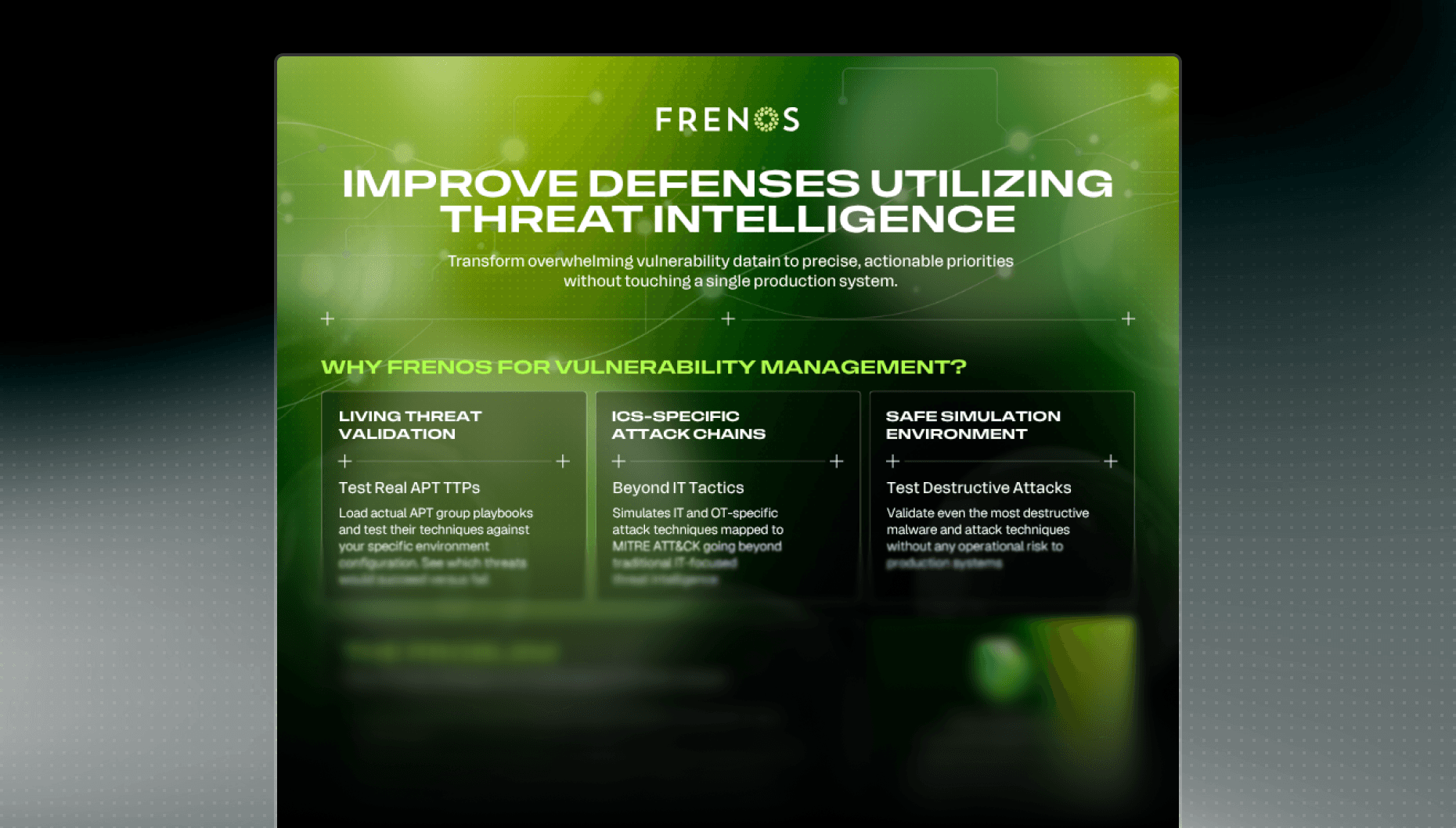
Threat Intelligence
Transform static threat intelligence into dynamic attack simulations. Reveal exactly how specific threat actors could compromise your OT environment before they try.
Read more