
Adversary Emulation in OT: Validate Real Attack Paths Without Disrupting Production



Adversary emulation is a threat-informed way to prove what a real attacker can reach in your environment, not just what is theoretically vulnerable. For OT and critical infrastructure teams, the challenge is doing this safely: production systems cannot tolerate aggressive scanning, unstable exploits, or changes that might impact safety, quality, or uptime.
This guide explains how to apply adversary emulation to industrial environments with a focus on practical outcomes: validated attack paths, measurable detection and response performance, and remediation priorities tied to real exposure. It also covers how digital twins make full-scope testing possible without touching production, and how Frenos supports continuous OT security validation by replaying realistic attack behaviors against a digital replica of your environment. If you are evaluating approaches, start with Adversary Simulation: Validate Real Attack Paths in IT/OT Safely and the deeper mapping guidance in MITRE ATT&CK for ICS: How to Map, Validate, and Detect Real OT Attack Paths.
What is adversary emulation (definition and outcome)?
Adversary emulation is the practice of reproducing the behaviors, sequences, and decision points of specific threat actors or classes of attackers to test whether your defenses prevent, detect, and contain realistic attack paths. It is not a generic “scan for vulnerabilities” exercise. It is a controlled rehearsal of how compromise is achieved, maintained, and operationalized in a target environment.
In OT, the most useful definition is outcome-based: adversary emulation validates whether an attacker can traverse from initial access to an operationally meaningful objective such as unauthorized control changes, loss of view, inhibition of safety functions, or disruption of operations. The goal is to produce evidence you can act on, including which controls broke the chain, where detection failed, and which remediation actions reduce true risk instead of just lowering a vulnerability score.
A well-scoped emulation produces three categories of deliverables: an attack-path narrative tied to your architecture, observable telemetry and detection results mapped to techniques, and a remediation plan prioritized by what the attacker could actually reach.
Adversary emulation vs penetration testing vs red teaming (and why the distinction matters in OT)
These terms are often used interchangeably, but they answer different questions. Confusing them can lead to mismatched expectations, unsafe test plans, or reports that do not help operations teams.
Penetration testing primarily answers: “What can I exploit right now?” It focuses on finding and demonstrating vulnerabilities, typically in a time-boxed engagement. In OT, a traditional approach must be adapted because many common techniques (aggressive scanning, exploit proof-of-concept execution, credential stuffing) can create instability.
Red teaming primarily answers: “Can a capable adversary achieve an objective against our people, process, and technology?” It is broader than a pentest and often includes social engineering, physical access, and stealth.
Adversary emulation answers: “Can the behaviors we expect from relevant threats succeed in our environment, and do our controls and detections hold up across the full path?” It is anchored in known tactics and techniques, and it is most valuable when repeated over time as controls change.
For OT and critical infrastructure, the practical difference is risk management. A pentest may stop at a vulnerable service and a red team may prioritize stealth over evidence. Adversary emulation should produce defensible, repeatable validation of the specific attack paths you care about, ideally without touching production. If you are deciding between methods, OT Penetration Testing: How to Test SCADA Safely Without Production Risk provides a useful baseline for what “safe” needs to mean in industrial environments.
Why OT adversary emulation is different from IT emulation
OT environments differ from IT in ways that materially change how you design and run an emulation.
First, safety and availability constraints are stricter. A test that is acceptable on an IT subnet might cause controller communication timeouts, overload fragile devices, or interrupt a safety-critical operator workflow.
Second, the “crown jewels” are different. In IT, the end state is often data theft or ransomware impact. In OT, attacker objectives include manipulation of setpoints, loss of operator visibility, forced manual operation, or denial of control. Those outcomes can be reached without deploying noisy payloads if an attacker can pivot through engineering workstations, remote access paths, historians, or domain trust.
Third, heterogeneity and legacy are the norm. You may have unmanaged switches, serial gateways, vendor remote support appliances, and controllers that cannot be patched on a normal cadence. This changes both the feasible attacker behaviors and the feasible mitigations.
Finally, evidence collection is different. Many plants have partial telemetry coverage across Level 0 to Level 3. A good emulation plan accounts for the reality of what logs exist today and uses the exercise to prioritize instrumentation improvements.
The implication is clear: OT adversary emulation must be designed to be safe by default, realistic enough to be meaningful, and structured so results translate into engineering-friendly remediation actions.
How MITRE ATT&CK for ICS supports adversary emulation
MITRE ATT&CK for ICS provides a common language for describing attacker behavior in industrial environments. It helps teams plan emulations, map detections, and communicate results across OT security, SOC, and engineering.
In practice, ATT&CK for ICS is most useful when you treat it as a behavior library rather than a checklist. You start with relevant threat scenarios and pick techniques that match your environment and constraints. Then you define what “success” and “detection” look like for each technique.
A pragmatic way to apply ATT&CK for ICS in an emulation program is:
- Build a small set of OT-relevant scenarios, such as remote access compromise leading to engineering workstation access, or IT-to-OT pivot culminating in HMI manipulation.
- For each scenario, select techniques across the stages that matter: initial access, lateral movement, privilege escalation, discovery, collection, command and control, and impact.
- Define observables per technique. For example, which authentication logs, endpoint events, network flows, or OT protocol anomalies should show up if the behavior occurs.
- Execute the emulation and score detections and response actions against those observables.
If you need a step-by-step approach to mapping and validation, MITRE ATT&CK for ICS: How to Map, Validate, and Detect Real OT Attack Paths goes deeper on building technique-to-telemetry links and using outcomes to prioritize controls.
Common OT adversary behaviors worth emulating (practical examples)
The right behaviors to emulate depend on your architecture, remote access model, and operational constraints. However, several patterns show up repeatedly in critical infrastructure incidents and are good candidates because they validate real attack paths rather than isolated vulnerabilities.
A productive emulation set often includes behaviors such as:
Initial access and foothold establishment through remote access paths, vendor support channels, misconfigured VPNs, or exposed management interfaces.
Credential access and privilege escalation on Windows systems that bridge IT and OT, including engineering workstations, jump servers, and domain-joined HMIs.
OT network discovery that is safe and representative, focused on identifying key nodes such as historians, OPC servers, asset gateways, and controller management stations.
Lateral movement into Level 2 and Level 1 assets through allowed administration paths, shared credentials, RDP/SMB, or mis-scoped firewall rules.
Manipulation of OT-relevant services such as OPC DA/UA endpoints, historian queries, or HMI configuration access, focusing on “loss of view” and “loss of control” conditions.
Living-off-the-land behaviors that are common in real intrusions, including remote tooling that blends with normal administration and avoids obvious malware signatures.
The point is not to “hack PLCs” as a stunt. The point is to validate whether your segmentation, identity controls, remote access governance, and monitoring prevent the attacker from getting to the systems that can change process state or operator decision-making.
- Compromise paths through remote access, vendor support tooling, and jump hosts
- Privilege escalation and credential reuse across dual-homed or domain-joined OT systems
- Discovery and enumeration that mirrors attacker tradecraft without stressing fragile devices
- Pivoting across segmentation boundaries using permitted administration flows
- HMI and historian manipulation that produces realistic “loss of view” scenarios
- Command execution using native tools to test detection of low-noise intrusions
Why testing in production creates real risk (and what “safe” should mean)
Production OT systems are sensitive to actions that are routine in IT security testing. Even passive behaviors can be risky if they generate unexpected traffic patterns or trigger device faults.
Common production risks include:
Device and protocol fragility. Some controllers and embedded devices respond poorly to bursts of network traffic, malformed packets, or repeated connection attempts.
Operational coupling. Seemingly isolated systems may have implicit dependencies, including shared authentication, shared time services, shared engineering workstations, or vendor support tunnels.
Change control and audit requirements. Even a harmless configuration change can violate operational procedures or regulatory expectations.
Safety impact. An emulation that reaches an actuator control plane or safety-related system without robust safeguards can create unacceptable risk.
A professional standard for “safe” OT emulation should include explicit constraints: no unapproved writes to control logic, no uncontrolled stress on devices, clear rollback plans, and operational approvals. It should also include a plan for evidence collection that does not depend on risky instrumentation changes.
For many organizations, these constraints effectively limit what can be done in production. That is why teams end up with assessments that are either safe but shallow, or realistic but risky. The gap is solvable if you can validate full attack paths in a controlled replica of the environment.
How digital twins enable safer, more realistic adversary emulation
A security-focused digital twin is a functional replica of your OT environment that allows you to execute realistic attacker behaviors, validate segmentation and identity paths, and test detections without interacting with production systems.
Digital twins change the trade-off. Instead of choosing between realism and operational safety, you can emulate end-to-end attack paths in a sandbox that mirrors the architecture, connectivity, and security controls that matter for attacker movement.
For adversary emulation, a digital twin is valuable because it supports:
Full-scope validation. You can test paths that would be off-limits in production, including lateral movement attempts and credential abuse scenarios.
Repeatability. You can rerun the same emulation after a firewall change, IAM change, or detection tuning to prove improvement.
Broader participation. OT engineering, SOC, and security teams can review outcomes and iterate without scheduling plant downtime.
Evidence quality. You can capture telemetry and packet traces in the twin to understand exactly what occurred and why a control did or did not work.
If you want the technical rationale and use cases, How Digital Twins Enable Safe, Comprehensive OT Security Testing explains how teams use twins to validate controls without introducing production risk.
Frenos’ approach centers on this principle: validate real attack paths against a digital twin so you can test realistically while keeping production untouched. This supports continuous security validation rather than periodic point-in-time testing.
FAQs
OT adversary emulation recreates realistic attacker behaviors in industrial environments to validate whether an adversary can move from entry points to operational objectives such as loss of view, unauthorized changes, or disruption. The focus is on end-to-end attack paths and measurable defensive performance, not just finding vulnerabilities.
Red teaming is broader and often optimized for stealth and objective completion across people, process, and technology. Adversary emulation is technique-driven and designed to be repeatable, measurable, and mapped to specific threat behaviors so you can validate controls and detections over time, especially in environments where production safety limits testing.
Yes. Using a security-focused digital twin, you can execute realistic behaviors and validate full attack paths without interacting with production OT assets. This avoids the instability risks of aggressive scans or exploit activity on sensitive devices while still producing evidence-based remediation priorities.
Measure technique-level detection and false positives, time to detect and contain based on the emulation timeline, validated control blocks (segmentation and access control), reduction in reachable attack paths to high-risk assets, and retest pass rates after remediation.
You should receive a validated attack-path narrative with evidence, technique-to-telemetry mapping showing what was and was not observed, a prioritized remediation backlog tied to broken attacker steps, and retest criteria so you can prove risk reduction after changes.
Next Steps
Adversary emulation is most valuable when it shows what an attacker can actually reach in your OT environment and lets you validate improvements over time without taking on production risk. If you want to emulate real-world OT attack paths safely using a digital twin and turn the results into a prioritized remediation plan, request an OT Security Assessment with Frenos.
Related Resources
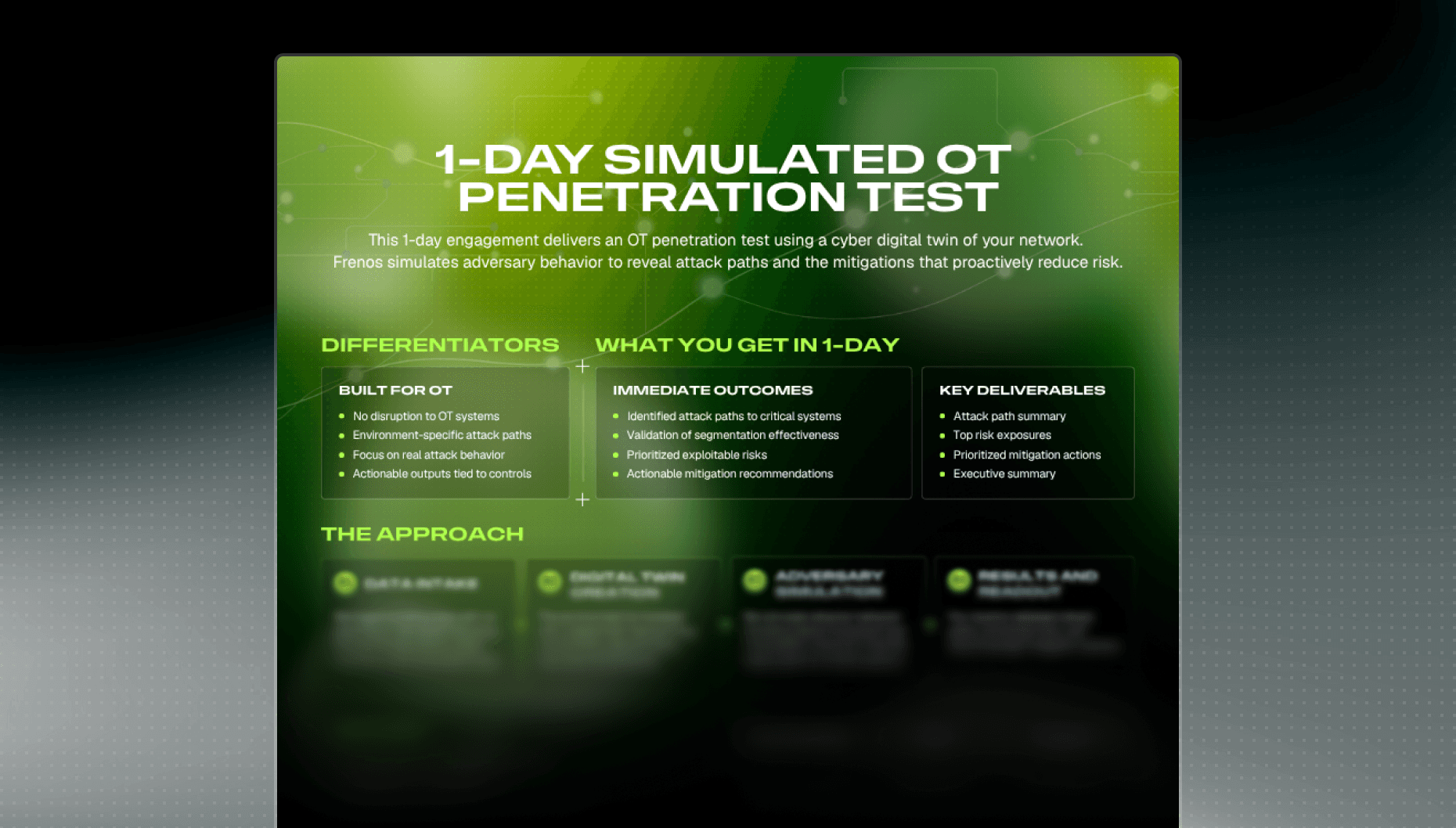

1-Day Simulated OT Pentest
Take a deep dive into understanding how Frenos' simulated OT penetration testing platform allows you to understand and improve your OT security posture at scale.
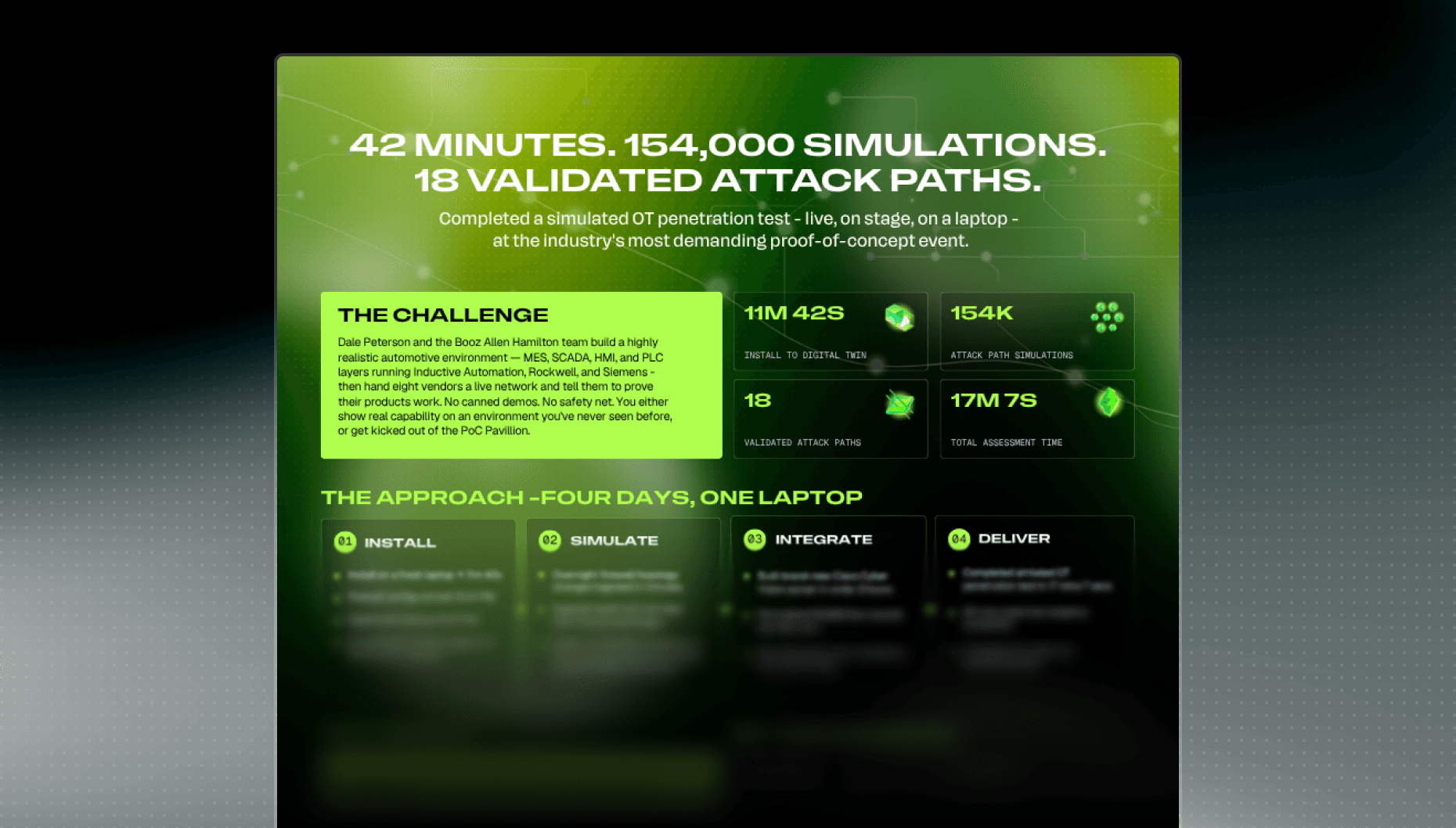
S4x26 Case Study
At the S4x26 POC Pavilion, Frenos completed 154,000 OT attack path simulations in 17 minutes and 7 seconds in a documented engagement. From three assumed-breach starting points (iDMZ, Plant Operations, Enterprise), the platform validated 18 attack paths into the critical Rockwell and Siemens zone. Those paths are exploitable given the actual controls, firewall rules, routing, and configurations modeled in the digital twin.
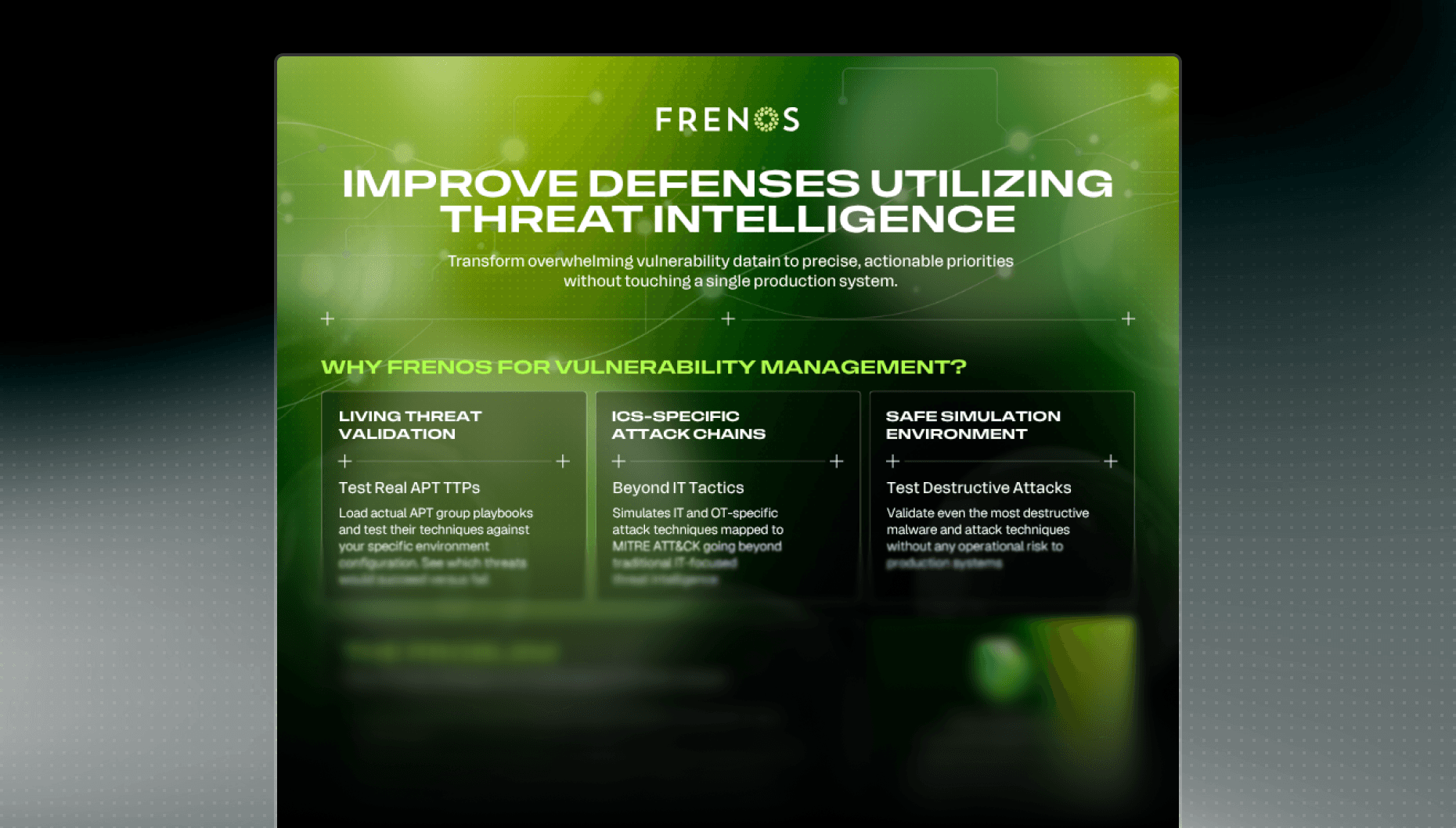
Threat Intelligence
Transform static threat intelligence into dynamic attack simulations. Reveal exactly how specific threat actors could compromise your OT environment before they try.