
OT Penetration Testing That Validates Real Attack Paths Without Disrupting Production



Most OT penetration testing programs start with a sensible goal: find exploitable weaknesses before an adversary does. In practice, industrial environments add constraints that traditional pentests are not designed to handle: safety requirements, uptime targets, change control, limited access windows, vendor restrictions, and fragile legacy protocols. The result is a familiar pattern. The test scope narrows to what is “safe,” interaction with production systems is minimized, and the final report lists isolated findings rather than the end-to-end attack paths that would actually put a process at risk.
A more useful standard for OT penetration testing is validated attack-path testing across IT and OT boundaries, identities, assets, and controls, without forcing risky interaction with live control systems. This is the gap Frenos is built to address: full-scope testing of industrial environments using digital twins and continuous security validation so you can measure exploitability and blast radius while preserving safety.
If you want background on safe SCADA testing approaches, start with OT Penetration Testing: How to Test SCADA Safely Without Production Risk. For teams evaluating simulated testing, see Frenos Platform 3.0 Simulated OT Penetration Testing for Industrial Environments.
What OT penetration testing should accomplish (commercial intent definition)
OT penetration testing is the controlled verification of whether an attacker can progress from realistic entry points to safety, availability, or integrity impacts in industrial systems. That includes validating whether controls actually prevent movement across the IT/OT boundary and within OT, and whether an attacker can reach and manipulate high-consequence assets such as controllers, safety systems, engineering workstations, historians, remote access infrastructure, and process networks.
A commercial buyer typically needs more than a list of vulnerabilities. The valuable output is evidence of: which attack paths are feasible, which controls stop them, which compensating controls reduce risk, and which remediation actions measurably reduce the likelihood of process impact. In OT, “proof” must be balanced with non-disruption. You need realism without touching fragile production endpoints, and you need coverage across identity, network, endpoint, and application layers in hybrid environments.
Why traditional OT pentests often miss the real risk
Traditional penetration testing methods were shaped around enterprise IT assumptions: you can scan aggressively, you can patch quickly, and you can interact with targets to confirm exploitability. OT environments break those assumptions.
First, safety and uptime constraints limit interaction. Many teams prohibit active scanning, authentication testing, brute forcing, or exploit validation on control networks. Even “benign” actions can cause performance degradation, state changes, or timeouts in older devices and protocols.
Second, access constraints reduce scope. External providers often receive restricted network access, short windows, or a limited list of testable IPs. That pushes the assessment toward the “easy-to-reach” segment of the environment rather than the assets that matter most.
Third, OT risk is about chained paths, not single findings. A medium-severity misconfiguration on an IT jump host may become high impact if it enables access to an engineering workstation, which then enables controller programming. Point-in-time vulnerability lists rarely capture that end-to-end story.
Fourth, segmentation and identity controls are hard to validate from within a narrow test zone. Many industrial environments rely on layers of access management, firewall rules, remote access gateways, and vendor support channels. If you cannot safely test how these controls behave under adversarial behavior, you end up assuming they work.
Finally, OT changes slowly. A once-a-year pentest can become stale as accounts change, firewall rules drift, new remote access paths appear, and new engineering laptops come and go. You may be measuring last quarter’s reality, not today’s exposure.
If your team is weighing whether a classic pentest or a broader adversary simulation is appropriate, OT Penetration Testing vs Red Teaming: Key Differences Explained | Frenos provides a clear comparison for OT decision-makers.
Common OT pentest limitations to address explicitly in your scope
Many OT security programs struggle because limitations are discovered mid-engagement. Making these constraints explicit improves outcomes, whether you use a traditional approach, a simulated approach, or a hybrid.
Key limitations to address upfront include: what “no disruption” means operationally, which protocols and device types are off-limits for active testing, what evidence is acceptable as “validated,” and how the team will handle vendor-managed systems.
It also helps to define what success looks like: not the number of findings, but the clarity of validated attack paths to high-risk assets and the remediation plan that follows.
- Interaction constraints: prohibited scans, exploit attempts, authentication testing, or configuration changes on production OT segments
- Access constraints: limited visibility into routes that traverse IT to OT, vendor connections, remote access, and intermediate zones
- Asset fragility: legacy controllers, serial gateways, and protocol converters that do not tolerate unexpected traffic
- Evidence constraints: inability to demonstrate impact safely, leading to “theoretical” findings that are hard to prioritize
- Time constraints: short windows that prevent broad coverage, especially across multiple sites or plants
- Organizational constraints: split ownership across IT, OT, engineering, vendors, and operations
Reframing “good OT pentesting” as attack-path validation
A practical way to improve OT penetration testing is to shift the objective from “find vulnerabilities” to “validate attack paths.” Attack-path validation asks a different set of questions:
Where can a realistic attacker start: phishing into IT, compromised VPN credentials, exposed remote access, vendor access, engineering laptop exposure, or a contractor connection? From there, can they reach the assets that affect the process? Which controls block them, and which controls fail open due to misconfiguration, implicit trust, or operational exceptions?
This approach is especially effective in environments where direct interaction with OT devices is restricted. You can still validate the feasibility of movement across zones, identities, and management planes, and you can measure how far an attacker can get before a compensating control stops them.
Attack-path validation also produces a remediation roadmap that maps to risk. Instead of treating vulnerabilities as independent tasks, you prioritize the smallest set of fixes that break the most consequential paths to high-risk assets.
A practical methodology for OT penetration testing without production risk
Below is a methodology that aligns with safety constraints while still producing validated outcomes. It is designed for hybrid IT/OT environments where the highest-value insight comes from understanding how paths traverse identities, remote access, management tooling, and segmentation.
This is also where simulation and digital twins can replace risky interaction with live production systems. You can test attacker behavior against a representative environment, measure control effectiveness, and produce evidence that is actionable without generating operational risk.
- Define crown-jewel outcomes: Identify the process impacts that matter, then map the specific assets involved (engineering workstations, controllers, safety systems, historian, remote access, domain services).
- Map trust boundaries and dependencies: Document zone architecture, conduit rules, jump hosts, remote access methods, identity providers, and vendor support paths that connect IT and OT.
- Build a testable representation: Assemble the minimum data needed to model the environment safely, including network topology, asset inventory, identity and access flows, and key control policies. Where possible, use a digital twin approach to reproduce paths without touching production.
- Enumerate realistic entry points: Focus on likely starting points such as IT endpoints, exposed services, remote access infrastructure, vendor access, and credential compromise scenarios that mirror real incidents.
- Validate attack paths end-to-end: Chain tactics across IT and OT boundaries. Test how segmentation, MFA, jump host hardening, application allowlisting, and monitoring behave under attacker workflows.
- Measure control effectiveness: For each attempted path, capture which control stopped progress, what misconfiguration enabled movement, and what detection coverage exists at each stage.
- Prioritize fixes by path disruption: Recommend remediation that breaks high-impact paths first, such as tightening conduit rules, hardening remote access, reducing identity over-permissioning, and enforcing workstation baselines.
- Re-test continuously: Re-validate critical paths after changes, and periodically re-run scenarios to detect drift in segmentation, identity, and remote access policies.
How Frenos approaches OT penetration testing differently
Frenos is designed for industrial environments where the trade-off between safety and realism has historically limited what OT pentests can prove. The goal is not to create more findings. The goal is to validate the attack paths that matter, with evidence, without interacting with production systems.
Frenos uses digital twin based testing to reproduce industrial architectures and attacker paths in a safe environment. That allows full-scope validation across IT and OT, including routes that typically get excluded due to uptime and safety concerns. It also supports continuous security validation, so you can re-test critical paths after network changes, access policy updates, or remediation.
Instead of a point-in-time snapshot, the outcome is a defensible view of current exposure: which paths exist, which controls stop them, and which fixes reduce real process risk.
For an overview of simulated testing in industrial settings, see Frenos Platform 3.0 Simulated OT Penetration Testing for Industrial Environments.
What you get at the end: deliverables that OT and engineering can use
OT stakeholders need deliverables that translate security findings into engineering and operations decisions. A strong OT penetration testing outcome should explain not only what is wrong, but what can happen, how it happens, and what breaks the path.
Because many organizations cannot accept production disruption, evidence must be collected in ways that preserve safety while still demonstrating feasibility. Digital twin based validation helps produce repeatable evidence, including control validation results, without requiring risky interaction with live systems.
Where proof points are available, teams often aim to minimize assessment downtime and reduce operational impact. In some engagements, assessment downtime can be reduced substantially, potentially approaching near-zero, depending on environment readiness and data availability. Results also typically include mapped attack paths to the highest-risk assets, which helps prioritize remediation and funding.
- Attack-path map: clear routes from entry points to high-consequence assets, including required privileges and choke points
- Control validation results: what stopped an attacker, what failed open, and where monitoring coverage is insufficient
- Risk-ranked remediation plan: changes that break the highest-impact paths first, with practical implementation notes
- Evidence package: artifacts that support internal risk decisions and audit conversations without requiring production exploitation
- Retest plan: what to re-validate after remediation and what should be validated continuously to prevent drift
FAQs
It can, depending on methods used. Active scanning, exploit attempts, and protocol fuzzing on live OT networks can introduce risk, especially with legacy devices and time-sensitive protocols. A safer approach is attack-path validation using digital twins or simulated environments to test end-to-end feasibility without interacting with production systems, reserving any live testing for tightly controlled cases with explicit operational approval.
It is better for answering a different question: not just “what is vulnerable,” but “can an attacker reach the assets that affect the process, and which controls stop them.” Traditional pentests can be strong for validating specific systems when interaction is permitted. Attack-path validation is stronger for hybrid IT/OT environments where the highest risk is in the chain across identities, remote access, and segmentation, and where production interaction is restricted.
Timelines vary by number of sites, scope, and data availability. Many delays come from access approvals and assembling environment context. A structured approach that starts with crown-jewel definition and minimum viable data collection helps keep timelines predictable. Simulated validation can also reduce operational scheduling complexity because it avoids production maintenance windows for most testing activity.
You should expect validated attack paths to high-consequence assets, documentation of which controls blocked or enabled progress, and a risk-ranked remediation plan that breaks the most important paths first. Strong deliverables also include evidence artifacts suitable for internal risk reviews and a retest plan to confirm remediation and detect future drift.
Perfect data is not required. The goal is a testable representation of trust boundaries and key paths, not a complete replica of every device. Most organizations can start with network architecture, a focused asset inventory around critical systems, identity and remote access flows, and known constraints. Maturity helps, but it is not a prerequisite. The assessment process often improves documentation and clarifies ownership, which is valuable even before remediation begins.
Next Steps
If your OT penetration testing program is constrained by safety, uptime, or access limitations, you do not have to choose between realism and non-disruption. Frenos validates end-to-end IT/OT attack paths using digital twins and continuous security validation so you can prioritize fixes that measurably reduce process risk without touching production systems. Request an OT Security Assessment to scope your highest-risk attack paths and define a safe validation plan.
Related Resources
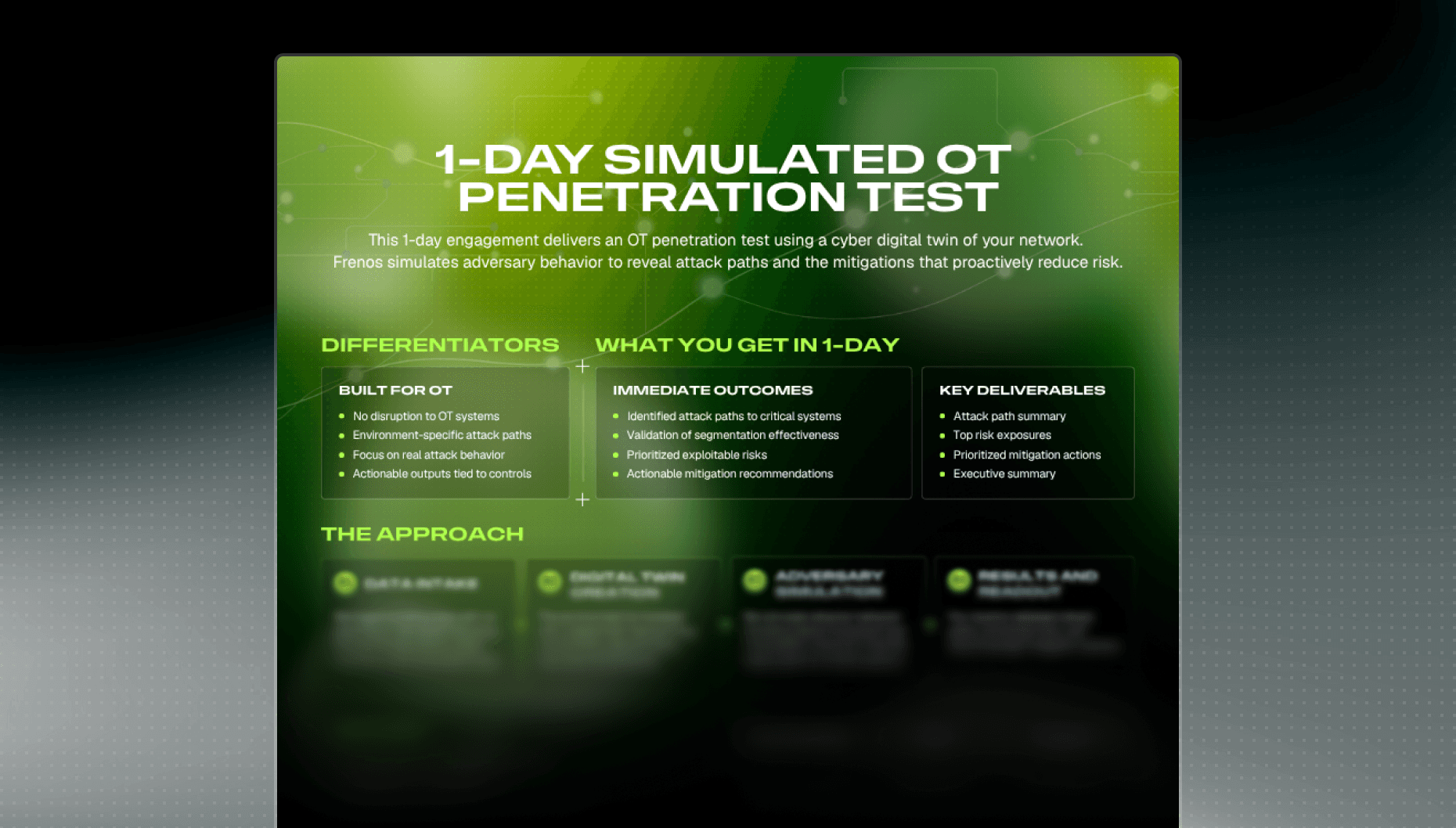

1-Day Simulated OT Pentest
Take a deep dive into understanding how Frenos' simulated OT penetration testing platform allows you to understand and improve your OT security posture at scale.
Read more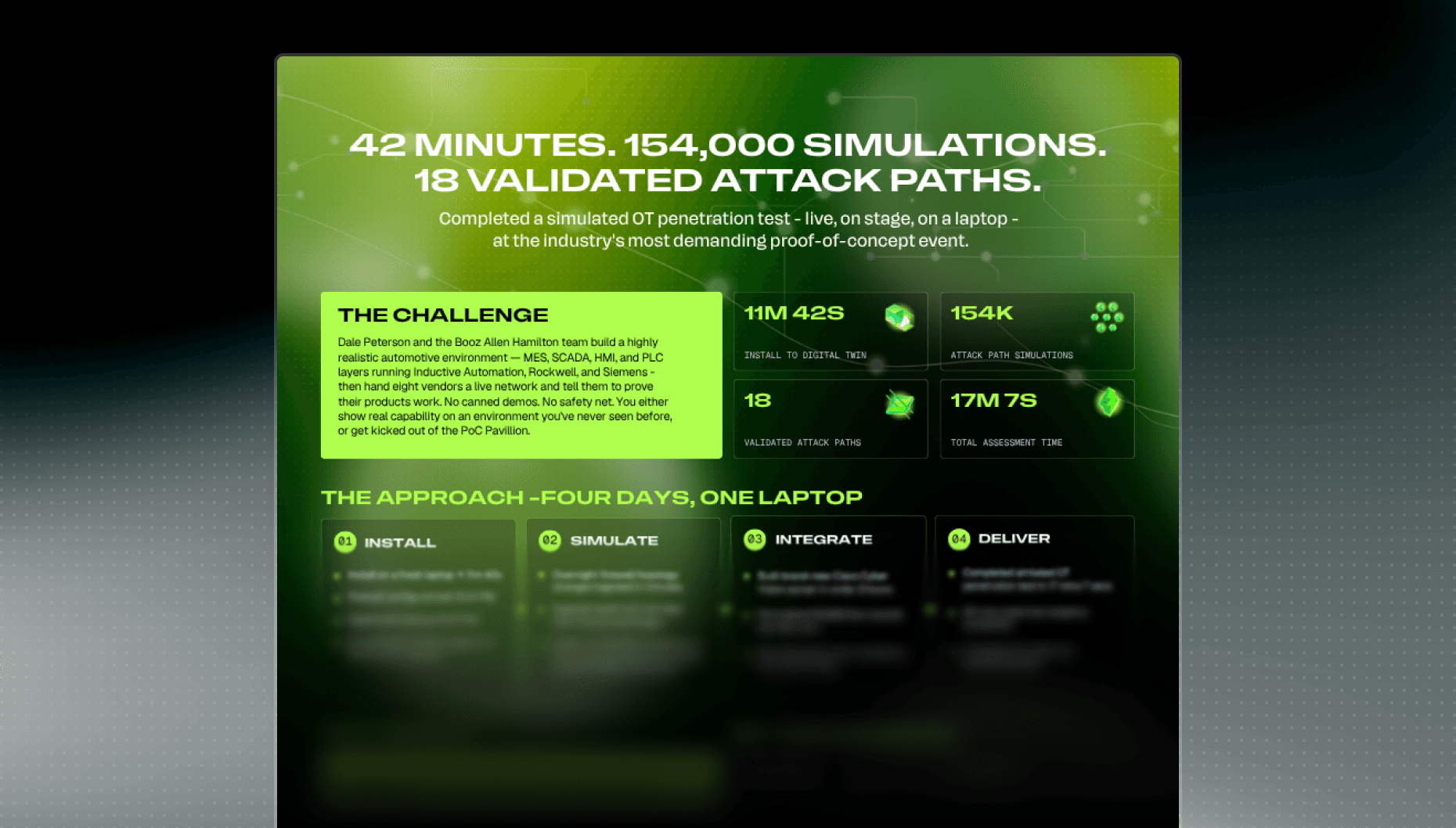
S4x26 Case Study
At the S4x26 POC Pavilion, Frenos completed 154,000 OT attack path simulations in 17 minutes and 7 seconds in a documented engagement. From three assumed-breach starting points (iDMZ, Plant Operations, Enterprise), the platform validated 18 attack paths into the critical Rockwell and Siemens zone. Those paths are exploitable given the actual controls, firewall rules, routing, and configurations modeled in the digital twin.
Read more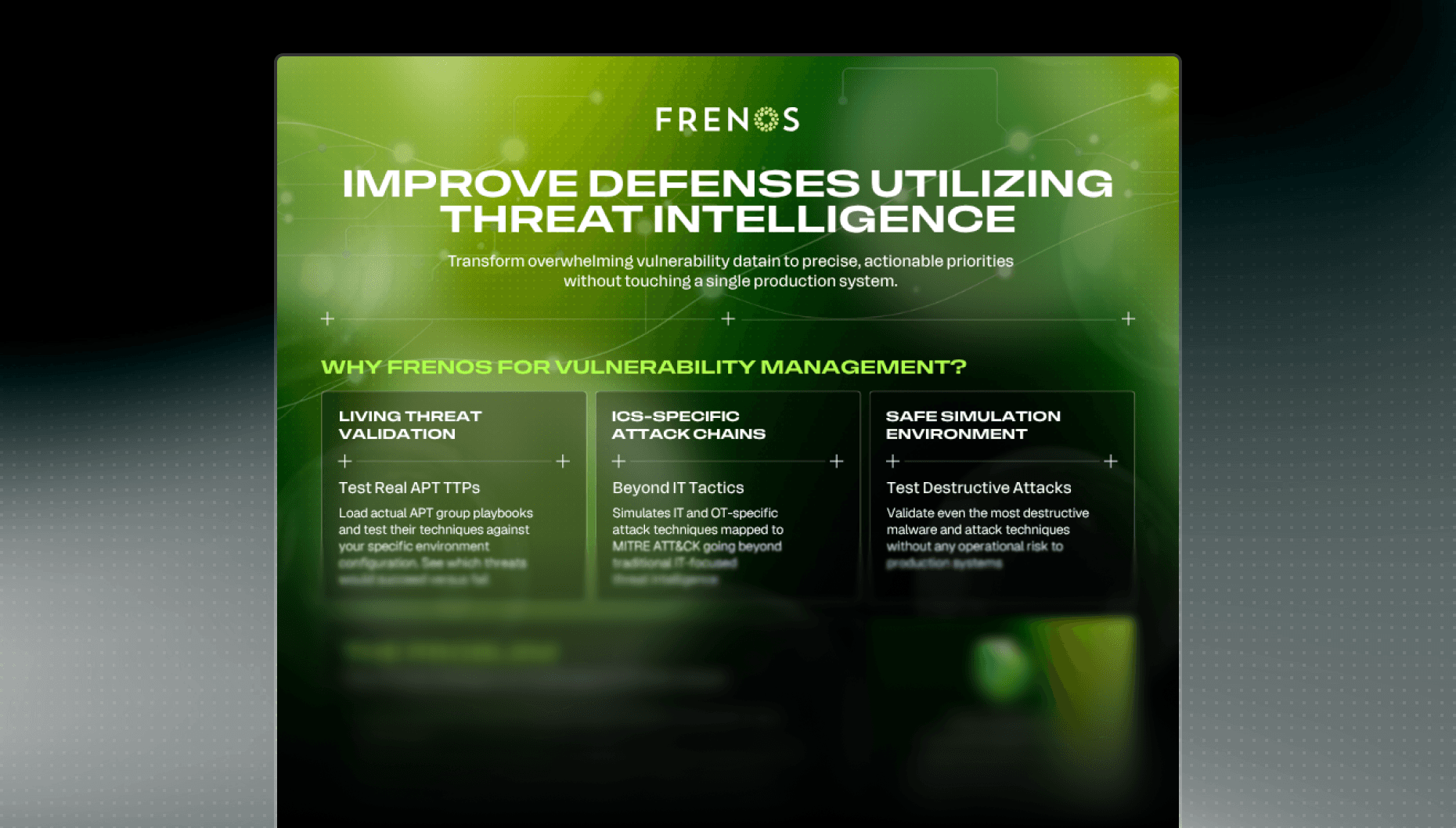
Threat Intelligence
Transform static threat intelligence into dynamic attack simulations. Reveal exactly how specific threat actors could compromise your OT environment before they try.
Read more