
Attack Path Validation for OT and Industrial Environments



Industrial security teams rarely struggle to generate findings. The hard part is proving which risks are real, reachable, and likely to impact safety, uptime, and compliance, without risking operations to find out. Attack path validation addresses that gap by confirming whether an adversary can actually traverse from realistic entry points to high impact assets in your environment.
For OT, “validation” needs a higher safety bar than IT. Running intrusive tests on production PLCs, HMIs, historians, safety systems, or fragile network segments can introduce downtime or process risk. Frenos is built around a different approach: validate real-world attack paths using digital twins so you can test broadly and continuously without interacting with production systems.
If you want context on how OT architectures create or constrain paths, start with ICS and SCADA Security: Architecture, Risks, and Safe Validation for Critical Infrastructure. For the underlying safety model behind testing in replicas, see How Digital Twins Enable Safe, Comprehensive OT Security Testing.
What attack path validation means (and what it is not)
Attack path validation is the practice of confirming, through evidence-based testing and analysis, whether a chain of conditions in your environment enables an attacker to move from a plausible starting point to a defined objective. In OT, objectives are typically tied to high risk assets and outcomes: disruption of production, manipulation of setpoints, loss of view, loss of control, or compromise of safety-related functions.
Attack path validation is not the same as drawing an attack tree on a whiteboard, generating a theoretical “kill chain,” or simply listing vulnerabilities. It also differs from one-off penetration testing. A traditional pentest can be valuable, but it typically samples a subset of systems, is time-bound, and often avoids the most sensitive OT targets because the safest choice is not to touch them.
Validation is about answering questions you can act on:
Which paths are actually possible given segmentation, identity controls, protocol constraints, and engineering workflows?
Which controls break the chain, and which controls look good on paper but fail under realistic conditions?
Which remediation steps eliminate the most risk fastest, without triggering operational change you cannot accept?
In the Frenos model, validation is performed in a digital twin so the test can be full-scope and repeatable while maintaining operational safety.
Why OT attack paths are different from IT attack paths
OT environments create unique conditions that change how attack paths form and how they must be validated.
First, availability and safety dominate. Even benign scanning can create issues on legacy devices, low-bandwidth links, or sensitive protocol stacks. That makes many IT-style validation techniques unsuitable for production.
Second, trust relationships are often shaped by engineering operations. Examples include shared engineering workstations, vendor remote access, jump hosts, file shares for project backups, and credential reuse across domains. These are not “misconfigurations” in isolation. They are operational shortcuts that become attack path accelerants.
Third, the target is frequently not a server. The crown jewels may be PLC logic, SIS engineering access, recipe management, batch control, or the ability to change parameters silently. Attack paths need to account for industrial protocols, control network boundaries, and the difference between visibility and control.
Finally, OT networks are hybrid by design. Most real incidents involve cross-boundary movement from IT to OT, or from a third-party access point into engineering zones. That is why “OT attack paths” usually begin outside the control network.
For a deeper mapping between attacker behaviors and industrial techniques, see MITRE ATT&CK for ICS: How to Map, Validate, and Detect Real OT Attack Paths.
Common OT attack paths worth validating first
Not every path has the same likelihood or impact. In critical infrastructure, you typically start with the paths that combine realism with high consequence.
A practical way to prioritize is to focus on what connects to engineering capability and what can change process state. That often leads to a short list of recurring path patterns across industries.
These patterns are not “one exploit.” They are chains that mix identity, remote access, segmentation, host posture, and protocol-level reachability.
- IT foothold to OT engineering zone: initial access in IT, credential theft, access to remote tools or jump servers, then lateral movement into an engineering workstation or terminal server.
- Vendor remote access to control assets: third-party VPN or remote access service, weak access governance, then reachability to engineering services or OT management interfaces.
- Historian or OT DMZ bridge: compromise of a dual-homed or data broker system, pivot through allowed flows into control zones, then discovery of OT services.
- Engineering workstation to PLC logic: access to engineering workstation, project files or programming software, then authentication and write operations to controllers.
- Backup and restore abuse: access to backups or project repositories, insertion of modified logic or configuration, then operational deployment through normal maintenance processes.
- Identity and directory dependency: shared local admin, domain trust extensions, weak segmentation of directory services, then broad access to systems that should be isolated.
- Mis-scoped firewall rules: rules intended for monitoring or vendor support that inadvertently allow management protocols or lateral movement between zones.
What you get at the end of attack path validation
Commercial intent searches often boil down to a simple question: what deliverables make this operationally useful?
A strong OT attack path validation outcome is not just a list of findings. It is a set of validated paths tied to assets that matter, with clear evidence and a remediation plan that respects operational constraints.
In practice, you should expect:
A mapped set of high-risk assets and the paths that can reach them, including the entry points and intermediate hops.
Evidence for each path step. Evidence can include authentication paths, allowed network flows, reachable services, and technique feasibility in the environment model.
Control effectiveness assessment. This highlights which controls stop the attacker and where controls fail or are bypassable.
A remediation plan focused on breaking chains. The best fixes interrupt multiple paths at once, such as tightening remote access governance, reducing credential exposure, correcting firewall scope, and hardening engineering workstations.
A re-testable baseline. Validation should be repeatable so you can confirm that changes reduced risk, and so you can monitor drift over time.
Frenos is designed to support full-scope validation with minimal operational disruption by conducting the validation in a digital twin rather than on production assets.
Digital twin based validation: how Frenos removes the safety vs realism trade-off
Traditional OT security testing frequently forces a compromise. You can test safely by limiting scope, reducing depth, or avoiding sensitive targets, but then you lose realism. Or you can test realistically by touching production, but then you introduce operational risk.
Frenos is positioned around removing that trade-off by using digital twins to validate attack paths. Instead of interacting with production PLCs, HMIs, and engineering infrastructure, Frenos validates in a replica environment built to reflect the real architecture, configurations, and dependencies required to prove paths.
This approach supports:
Safety: no need to run intrusive tests on production systems.
Full-scope: broader coverage across zones, identity relationships, remote access pathways, and engineering workflows.
Continuous validation: the ability to re-run validation as the environment changes and as new threats emerge.
If you are evaluating methods, it can be helpful to compare this to adversary emulation approaches. See Adversary Simulation: Validate Real Attack Paths in IT/OT Safely.
A practical framework for OT attack path validation
A repeatable framework helps ensure validation stays grounded in operational reality and produces outputs that drive remediation. The steps below reflect how OT security teams and red teams typically structure an evidence-based validation program, adapted for safe execution using digital twins.
The goal is to connect four elements: assets that matter, realistic entry points, validated traversal steps, and concrete control improvements.
- Define objectives and high-impact assets: Identify the systems and functions that represent the highest operational risk, such as SIS engineering, batch control, critical PLCs, substation automation, or process control segments tied to safety and uptime.
- Establish realistic entry points: Select starting points that match your threat model, including vendor access, IT compromise, exposed services in the OT DMZ, compromised laptops used for maintenance, or supply chain and update mechanisms.
- Model zones, conduits, and trust relationships: Document segmentation intent and actual allowed flows, identity dependencies, jump hosts, remote access paths, and where credentials or tokens can be obtained and reused.
- Enumerate candidate paths: Combine reachability, authentication possibilities, protocol requirements, and operational workflows to build candidate chains to the objectives.
- Validate steps with evidence: For each hop, confirm whether the necessary conditions hold. Examples include whether a firewall rule truly permits the protocol and direction, whether an account can authenticate, whether an engineering toolchain can reach the target, and whether write operations are feasible under the modeled constraints.
- Score and prioritize based on impact and feasibility: OT prioritization should weight operational consequence and likelihood, not just CVSS. A moderate vulnerability on a pathway to engineering write access can outrank a critical CVE that is not reachable.
- Recommend chain-breaking remediations: Focus on controls that break multiple paths, such as tightening vendor access, enforcing MFA and just-in-time access on jump hosts, reducing credential reuse, hardening engineering endpoints, and correcting conduit rules.
- Re-validate continuously: After changes, re-run validation to prove risk reduction and detect drift. This turns validation into an operational practice rather than a periodic project.
Where attack path validation fits with pentesting, vulnerability management, and risk assessments
OT programs often have multiple assessment motions running in parallel, each with different strengths.
Vulnerability management is good at coverage and trend tracking, but it struggles to answer “so what?” in an industrial context where exploitability and reachability are constrained by segmentation and operations.
Traditional pentesting is good at showing impact and attacker creativity, but it is typically time-boxed, scoped narrowly, and constrained by safety limits around production OT. That can leave blind spots around the most critical assets.
Risk assessments are good at governance and prioritization, but they often rely on interviews and documentation, and can drift into hypothetical scenarios that are not validated.
Attack path validation complements these by providing evidence of reachable, end-to-end chains to high-impact assets. In practice:
Use vulnerability management to supply candidate weaknesses.
Use attack path validation to determine which weaknesses form real paths to objectives.
Use pentesting selectively for targeted confirmation where safe, or to test compensating controls.
Use risk assessments to translate validated paths into business and safety risk decisions.
For OT leaders building a broader program, see the Complete Guide to OT Security: Protecting Industrial Control Systems.
FAQs
Attack path analysis identifies potential paths based on architecture, vulnerabilities, and access relationships. Attack path validation confirms which paths are actually feasible by checking the real prerequisites step-by-step, such as allowed flows, authentication possibilities, and whether required actions would succeed. In OT, validation is especially important because many “possible” paths are constrained by segmentation, protocols, and operational practices.
Yes. A digital twin based approach can validate attack paths in a replica environment that reflects your architecture and dependencies, avoiding intrusive actions on production assets. This is the core safety advantage of Frenos’ approach: full-scope validation without interacting with production systems.
Vulnerability management tells you what is present. Attack path validation tells you what is reachable and consequential. By tying vulnerabilities and misconfigurations to validated paths leading to high-impact assets, teams can prioritize remediation based on real-world risk rather than severity scores alone.
Start with a short list of crown-jewel assets and key engineering workflows, plus whatever segmentation and remote access documentation you have. Helpful items include network diagrams, firewall or remote access information, asset inventories for critical zones, and known constraints around change windows. If some of this is incomplete, you can still begin with a focused scope and expand iteratively.
At minimum, after meaningful changes such as new remote access paths, segmentation updates, major upgrades, or incident-driven control changes. For critical infrastructure operators, continuous or regularly scheduled validation is often preferred because OT environments drift over time through vendor work, maintenance, and incremental architecture changes.
Next Steps
If you need higher confidence in which risks are truly reachable in your OT environment, Frenos can help you validate real-world attack paths safely using digital twins rather than touching production systems. Request an OT Security Assessment to map and validate paths to your highest-risk assets and get a prioritized remediation plan grounded in evidence.
Related Resources


1-Day Simulated OT Pentest
Take a deep dive into understanding how Frenos' simulated OT penetration testing platform allows you to understand and improve your OT security posture at scale.
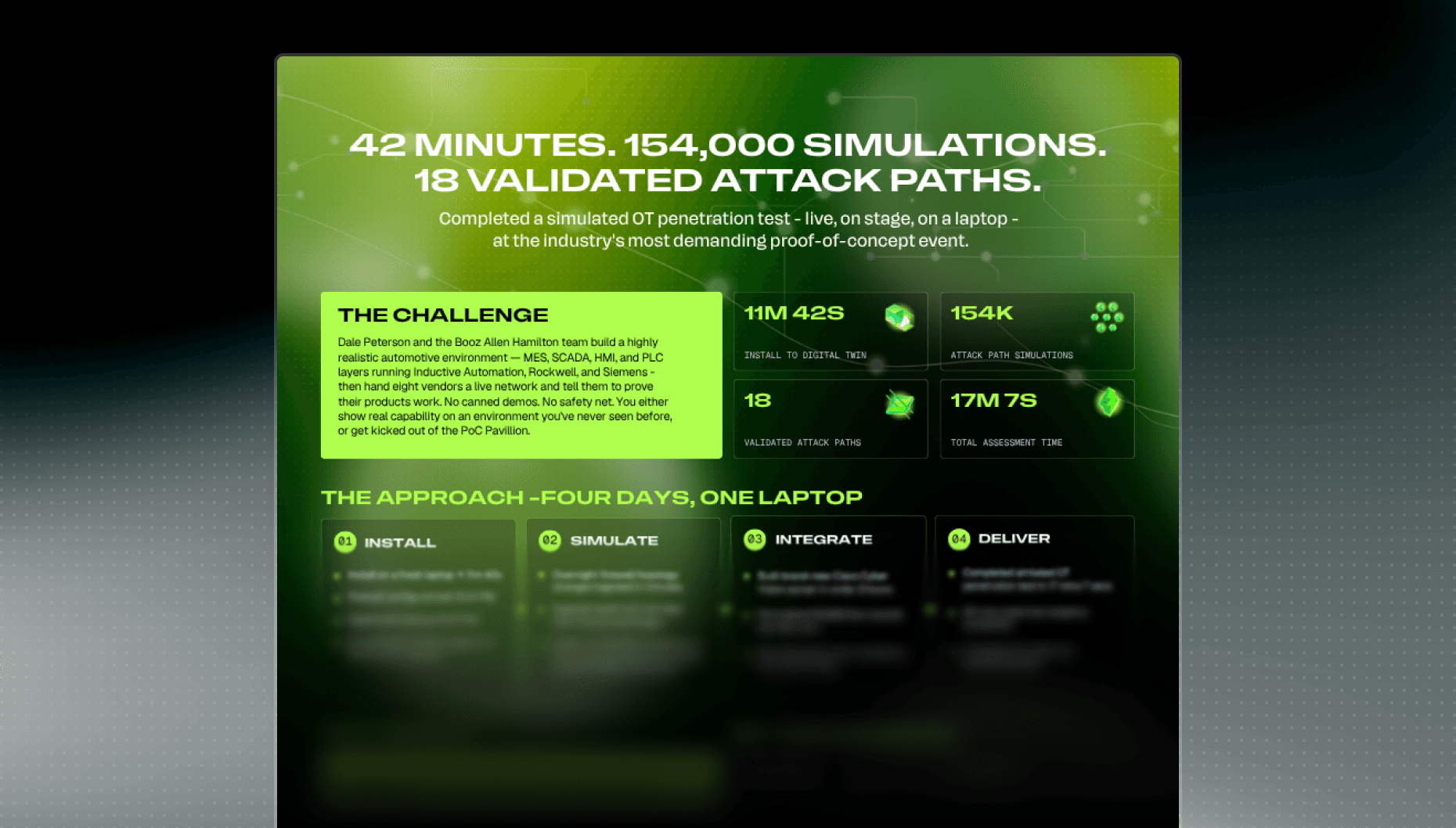
S4x26 Case Study
At the S4x26 POC Pavilion, Frenos completed 154,000 OT attack path simulations in 17 minutes and 7 seconds in a documented engagement. From three assumed-breach starting points (iDMZ, Plant Operations, Enterprise), the platform validated 18 attack paths into the critical Rockwell and Siemens zone. Those paths are exploitable given the actual controls, firewall rules, routing, and configurations modeled in the digital twin.
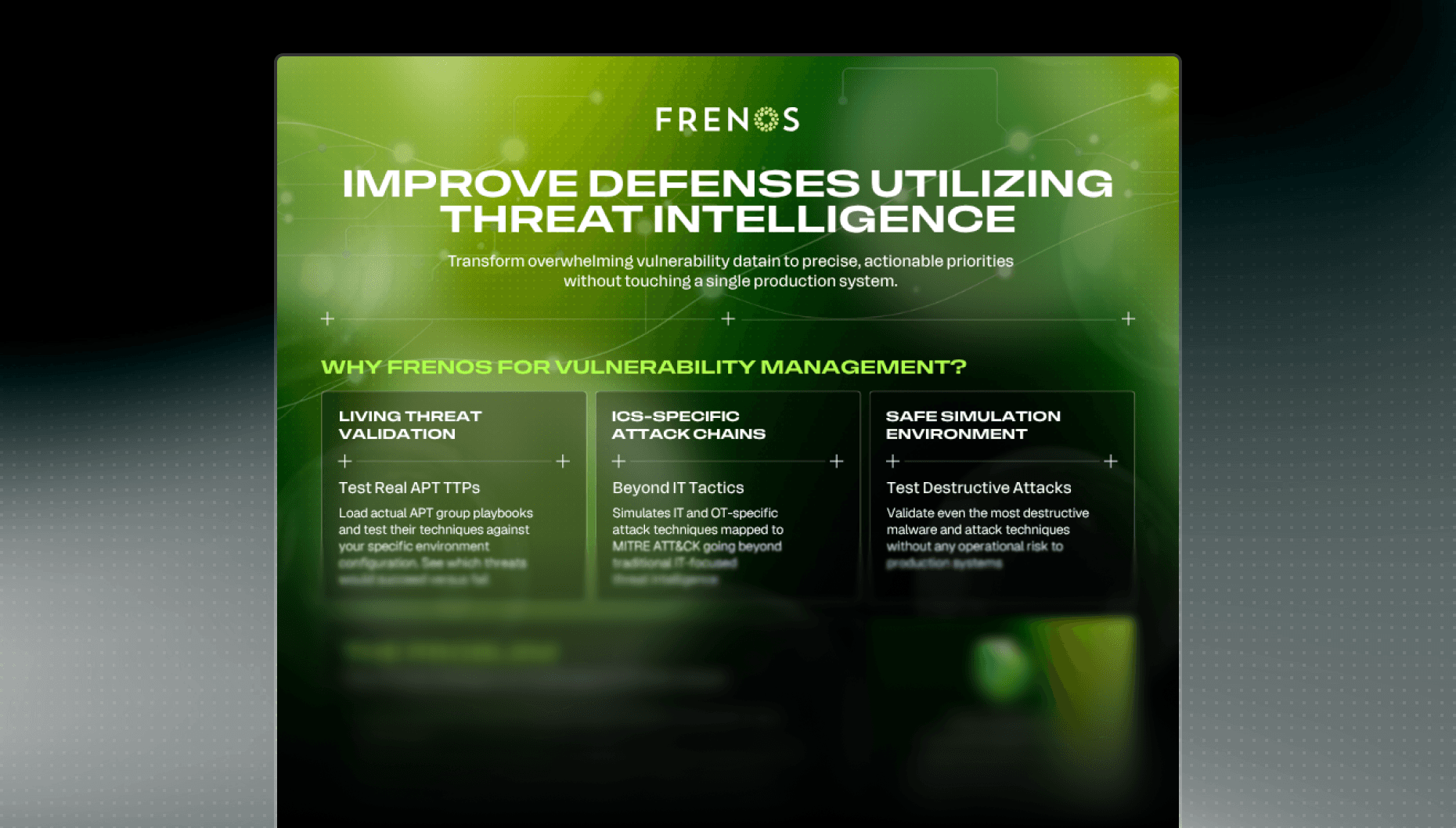
Threat Intelligence
Transform static threat intelligence into dynamic attack simulations. Reveal exactly how specific threat actors could compromise your OT environment before they try.