
Frenos Appoints Former KnowBe4 CIO Colin Murphy as Chief Hacking Officer


Press | Critical Infrastructure | April 16, 2025
Frenos Appoints Former KnowBe4 CIO Colin Murphy as Chief Hacking Officer
Security industry veteran to drive innovation in critical infrastructure protection
Frenos appointed former KnowBe4 CIO Colin Murphy as Chief Hacking Officer on April 16, 2025. Murphy will oversee product engineering and operations while supporting cybersecurity community engagement and continuing research.
CHARLOTTE, NC, April 16, 2025. Frenos, the autonomous OT security assessment platform, announced the appointment of Colin Murphy as Chief Hacking Officer.
Murphy brings more than a decade of experience as a cybersecurity researcher, practitioner, and technology innovator. Most recently, he served as CIO for KnowBe4. In that role, he helped guide the company from startup to its $1 billion unicorn status, IPO, and subsequent private equity acquisition.
The appointment marks a return to Murphy's roots as an ethical hacker. His background includes years of red teaming experience alongside the late Kevin Mitnick at Mitnick Security, where he continues to collaborate. This work supports the shared Frenos mission of advancing offensive security innovation and making the digital world safer.
> "My passion has always been pushing the boundaries of what's possible in cybersecurity," Murphy said.
>
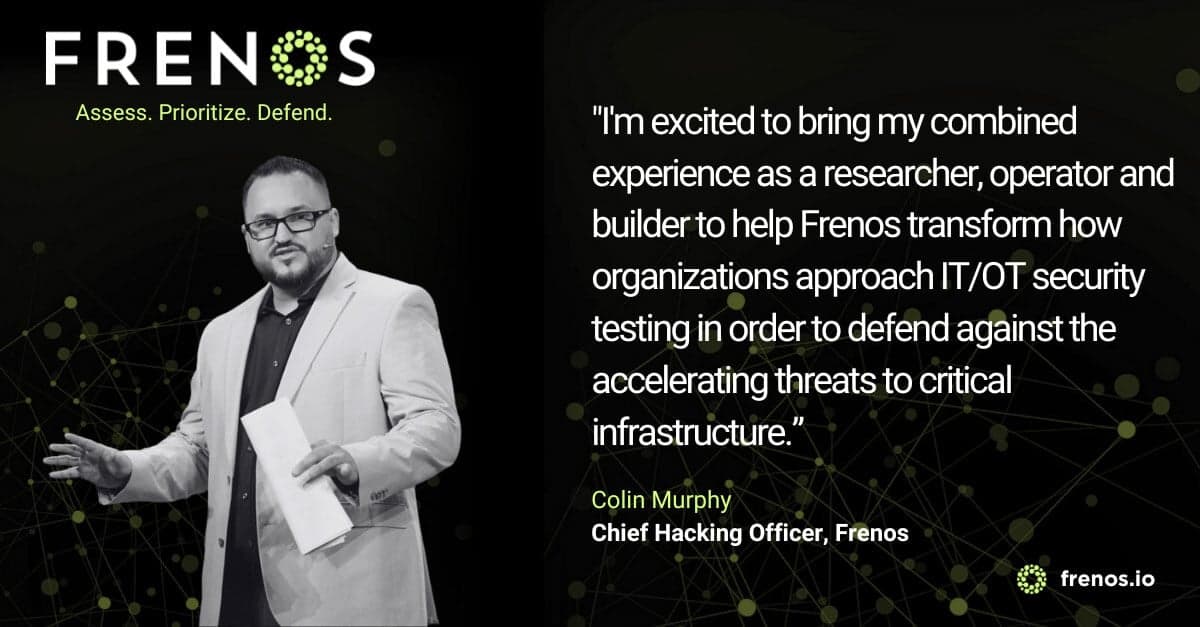
> "I'm excited to bring my combined experience as a researcher, operator and builder to help Frenos transform how organizations approach IT/OT security testing in order to defend against the accelerating threats to critical infrastructure."
Murphy's role at Frenos
As Chief Hacking Officer, Murphy will:
- Oversee product engineering and operations
- Foster engagement with the cybersecurity community
- Support continuing cybersecurity research
- Help ensure the Frenos platform provides significant value to users
How the role supports Frenos' OT security vision
The Frenos vision centers on combining a digital twin with an AI reasoning agent called SAIRA, or Simulated Adversarial Intelligence Reasoning Agent. The approach is designed to continuously simulate adversary and hacker techniques at scale across IT and OT environments.
Traditional hands-on security and penetration testing can occur infrequently in OT environments. These environments are sensitive, and conventional IT tools and techniques can create potential operational impacts.
As a result, organizations may rely on point-in-time paper assessments or audits. This can leave them with a limited understanding of the security posture of their most critical environments.
Frenos changes that approach by modeling tactics, techniques, and procedures against a digital twin of the operational technology environment. The platform identifies critical exposure pathways and provides proactive risk mitigations that operators can act on.
Murphy views this digital twin approach as a new way to test sensitive OT environments without disrupting operations.
> "Traditional security assessment, vulnerability and penetration tools cannot be trusted to not impact operational reliability," Murphy said. "By creating a digital twin, we can model attacks against critical systems with zero impact on operations."
Leadership perspectives
Murphy said his goal is to help security teams anticipate potential attacks instead of only reacting to them.
> "My goal is to help build a platform that helps security teams stay ahead of threat actors by predicting potential attacks rather than just reacting to them. The security industry needs to move from reactive to proactive, and AI gives us the opportunity to finally close that gap."
Brian Proctor, CEO of Frenos, said Murphy's combination of technical and executive experience supports the company's mission.
> "Colin brings a wealth of cybersecurity expertise that aligns perfectly with our mission of transforming how critical infrastructure organizations manage their security posture," Proctor said.
>
> "His unique combination of hands-on ethical hacking experience, technology strategy and executive leadership will be invaluable as we scale our AI-native platform to autonomously assess and defend the world's most critical environments."
Company context
The appointment followed Frenos' $3.88 million seed funding round led by DataTribe. It also complemented the company's growing advisory board, which includes industrial cybersecurity expert Robert M. Lee, co-founder and CEO of Dragos.
At the time of the announcement, Frenos invited attendees to meet its team at the RSAC 2025 Conference in San Francisco from April 28 to May 1. The company planned to preview the Frenos 2.0 Platform and discuss the next evolution of OT security.
About Frenos
Frenos transforms how critical infrastructure teams assess the cybersecurity posture of mission-critical environments, devices, and applications.
The company's continuous security assessment platform reduces assessment time from months to minutes, with zero impact on operations. By proactively identifying effective risk mitigations at scale, Frenos helps companies save time, money, and resources.
Discover more at frenos.io.
Media contact
Leslie Kesselring
Kesselring Communications
leslie@kesscomm.com
Related resources
1-Day Simulated OT Pentest
Explore how Frenos' simulated OT penetration testing platform helps teams understand and improve their OT security posture at scale.
S4x26 Case Study
At the S4x26 POC Pavilion, Frenos completed 154,000 OT attack path simulations in 17 minutes and 7 seconds during a documented engagement.
From three assumed-breach starting points in the iDMZ, Plant Operations, and Enterprise environments, the platform validated 18 attack paths into the critical Rockwell and Siemens zone. Those paths were exploitable based on the controls, firewall rules, routing, and configurations modeled in the digital twin.
Threat Intelligence
Learn how Frenos transforms static threat intelligence into dynamic attack simulations to show how specific threat actors could compromise an OT environment.
Related links
- Frenos
- digital twin with an AI reasoning agent
- funding round
- here
- frenos.io
- Solution Briefs 1-Day Simulated OT Pentest Take a deep dive into understanding how Frenos' simulated OT penetration testing platform allows you to understand and improve your OT security posture at scale. Read more
- Case Studies S4x26 Case Study At the S4x26 POC Pavilion, Frenos completed 154,000 OT attack path simulations in 17 minutes and 7 seconds in a documented engagement. From three assumed-breach starting points (iDMZ, Plant Operations, Enterprise), the platform validated 18 attack paths into the critical Rockwell and Siemens zone. Those paths are exploitable given the actual controls, firewall rules, routing, and configurations modeled in the digital twin. Read more
- Solution Briefs - Critical Infrastructure Threat Intelligence Transform static threat intelligence into dynamic attack simulations. Reveal exactly how specific threat actors could compromise your OT environment before they try. Read more
Related Resources


Why OT Cybersecurity Assessments Need to Evolve
Learn why OT cybersecurity assessments are moving from manual reviews to continuous assessment without testing live production systems.
Read more
Weaponizing Threat Intelligence Against Iranian Ransomware Enablers
See how SAIRA turns intelligence on Iranian ransomware enablers into adversarial simulations that help validate security controls.
Read more
AI Vulnerability Discovery in OT: From Findings to Safe Decisions
Learn how OT teams can validate AI-discovered vulnerabilities in digital twins, assess operational impact, and prioritize safer mitigation decisions.
Read more