
From the Firewall to the Boardroom: Innovating OT Cybersecurity with Rob Lee and Frenos


Blogs · Critical Infrastructure · December 4, 2024
From the Firewall to the Boardroom: Innovating OT Cybersecurity with Rob Lee and Frenos
OT cybersecurity is moving beyond asset visibility toward data-driven risk prioritization, stronger IT and OT collaboration, and executive accountability. In this conversation, Robert M. Lee explains why organizations should treat OT security as a strategic resilience priority rather than only a technical or compliance concern.
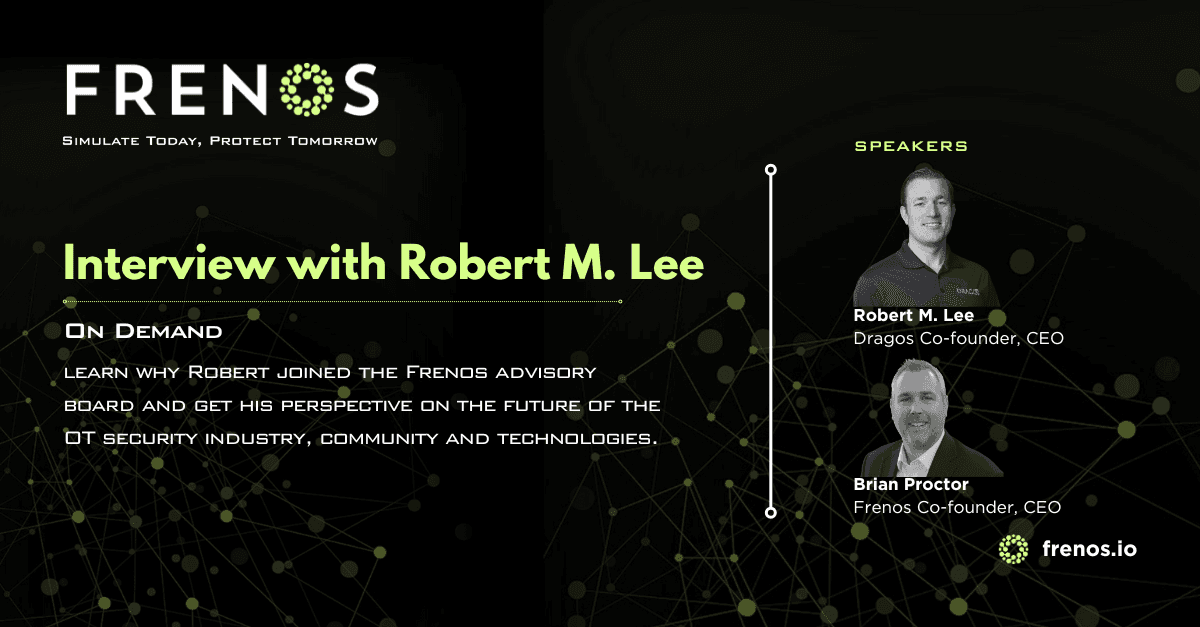
In the world of operational technology (OT) cybersecurity, where critical infrastructure meets relentless digital threats, progress is not optional. That message came through clearly in a recent conversation with Robert M. Lee, founder and CEO of Dragos and the first advisory board member of Frenos.
Lee’s decades-long journey in OT cybersecurity provides a rare perspective on how the field is evolving and where it is heading.
[Video conversation with Robert M. Lee]
The OT Cybersecurity Maturity Curve
OT cybersecurity is not new, but its mainstream relevance is growing. As Lee explained, early industry pioneers focused on mapping the assets and systems within the OT environments they were responsible for protecting.
“Initially, it was all about visibility: understanding what you have. But today, we’re far beyond just identifying assets; now, it’s about operationalizing that data for strategic decision-making.”
This evolution reflects broader changes in technology and executive awareness. Modern OT networks are no longer isolated systems. They are deeply integrated with IT systems, cloud platforms, and third-party vendors.
AI-driven analytics and risk-prioritization platforms such as Frenos are changing how organizations approach the intersection of security and business operations.
Innovating With Data-Driven Security
One of the central themes from the discussion was Frenos’ role in the next stage of OT cybersecurity.
First-generation solutions focused primarily on monitoring and detection. Frenos uses data to produce actionable insights. Its continuous security assessment platform is designed to help OT teams prioritize risks and align security strategies with business objectives without disrupting operations.
“Frenos is about more than security assessments,” Lee said. “It’s about using data to drive smarter decisions across your entire OT ecosystem.”
Lee emphasized that this innovation is not only about technology. It is also about timing. OT environments now produce extensive data, including endpoint logs and network telemetry. The challenge is turning that data into actionable intelligence.
Executive Strategies for the Evolving Threat Landscape
The conversation also highlighted the importance of executive support. Lee described growing awareness among CEOs and boards of directors about OT-specific risks.
Cybersecurity can no longer be treated solely as an IT issue. OT systems support critical operations and revenue generation, making their resilience a business concern.
“Executives aren’t confused about where they make money; it’s in the operations,” Lee noted. “The challenge is that they’ve historically delegated cybersecurity to IT teams who aren’t equipped for OT’s unique challenges.”
Lee’s advice to executives is to treat OT cybersecurity as a strategic priority rather than a compliance checkbox. That includes:
- Giving security teams clear mandates and appropriate resources
- Encouraging collaboration between IT and OT teams
- Connecting cybersecurity decisions to operational resilience
- Recognizing the distinct safety, reliability, and uptime requirements of OT environments
Bridging IT and OT Through a Cultural Shift
One of the most significant barriers to OT cybersecurity maturity is cultural. Many organizations continue to separate IT and OT teams, which can create friction and misaligned priorities.
According to Lee, progress requires collaboration and mutual respect.
“If you’re an OT security leader, spend time in the field. Understand the operational realities,” he urged. “Likewise, IT teams must acknowledge that OT security isn’t just an extension of IT. It requires unique approaches tailored to safety, reliability, and uptime.”
This cultural shift also affects how organizations frame cybersecurity investments. Lee observed that companies may view security spending only as a cost instead of recognizing its role in business continuity and competitive advantage.
Compliance as a Catalyst
Regulatory pressure can accelerate OT cybersecurity improvements. Frameworks and requirements such as NERC CIP, TSA regulations, and Europe’s NIS2 directive are prompting organizations to give OT cybersecurity greater attention.
Lee cautioned, however, that compliance should not become the final objective.
“Compliance sets the floor, not the ceiling,” he explained. “Organizations that focus solely on meeting regulatory requirements risk falling behind in an environment where threats evolve faster than standards.”
Compliance can establish a baseline, but organizations still need security strategies that address changing threats and operational priorities.
The Future of OT Cybersecurity
Lee expects OT cybersecurity to move from a reactive model toward a more proactive approach over the next decade. He predicts that AI and machine learning will play an important role in automating threat detection, prioritization, and mitigation.
In this outlook, platforms such as Frenos can help organizations make better security decisions faster by turning available data into prioritized, actionable information.
The broader shift will be in how organizations view cybersecurity. Instead of treating it as a back-office function, leaders will increasingly recognize it as a boardroom priority and an enabler of resilience, growth, and innovation.
“In OT, we’re not just protecting data; we’re protecting lives and livelihoods,” Lee concluded. “That’s a responsibility we can’t afford to take lightly.”
Key Takeaways
The evolution of OT cybersecurity requires technology, leadership, and strategic alignment. The discussion with Lee points to several practical conclusions:
- Asset visibility is a foundation, not the final objective.
- OT data must be operationalized to support risk-based decisions.
- Executive support is essential because OT security affects business operations.
- IT and OT teams need to collaborate while respecting their different priorities.
- Compliance provides a baseline but does not replace an adaptive security strategy.
- Proactive assessment and prioritization can help organizations strengthen resilience.
For practitioners working in critical infrastructure and industrial environments, the central message is clear: OT cybersecurity should support informed decisions across both technical teams and executive leadership.
Get a demo to learn how Frenos can help your organization make more sense of its data and move from reactive to proactive security.
Related Resources
1-Day Simulated OT Pentest
Learn how Frenos’ simulated OT penetration testing platform can help organizations understand and improve their OT security posture at scale.
S4x26 Case Study
At the S4x26 POC Pavilion, Frenos completed 154,000 OT attack path simulations in 17 minutes and 7 seconds in a documented engagement. From three assumed-breach starting points across the iDMZ, Plant Operations, and Enterprise, the platform validated 18 attack paths into the critical Rockwell and Siemens zone.
The paths were exploitable based on the actual controls, firewall rules, routing, and configurations modeled in the digital twin. This is a specific event example, not a universal performance expectation.
Threat Intelligence
Explore how dynamic attack simulations can help organizations understand how specific threat actors could compromise an OT environment before an attack occurs.
Related links
- Get a demo today
- Solution Briefs 1-Day Simulated OT Pentest Take a deep dive into understanding how Frenos' simulated OT penetration testing platform allows you to understand and improve your OT security posture at scale. Read more
- Case Studies S4x26 Case Study At the S4x26 POC Pavilion, Frenos completed 154,000 OT attack path simulations in 17 minutes and 7 seconds in a documented engagement. From three assumed-breach starting points (iDMZ, Plant Operations, Enterprise), the platform validated 18 attack paths into the critical Rockwell and Siemens zone. Those paths are exploitable given the actual controls, firewall rules, routing, and configurations modeled in the digital twin. Read more
- Solution Briefs - Critical Infrastructure Threat Intelligence Transform static threat intelligence into dynamic attack simulations. Reveal exactly how specific threat actors could compromise your OT environment before they try. Read more
Related Resources


Penetration Testing as a Service Reporting for OT
Learn what an OT penetration testing service report should include, from validated attack paths and evidence to remediation and retesting.
Read more
Third-Party and Supply Chain Cyber Risk Management for OT
Manage OT supplier risk across selection, contracts, onboarding, product integrity, continuous oversight, and attack-path validation.
Read more
Penetration Testing as a Service for OT and Critical Infrastructure
Learn how simulated OT penetration testing validates attack paths, evaluates defenses, and prioritizes risk without testing live production systems.
Read more