
Third-Party and Supply-Chain Cyber Risk Management for OT



Operational technology depends on an interconnected supply chain. Original equipment manufacturers provide controllers, drives, safety systems, and engineering tools. Integrators design and commission systems. Maintenance vendors troubleshoot equipment. Software providers distribute applications and updates. Remote support teams connect to industrial environments to keep production running.
Every relationship can improve reliability and operational performance. It can also introduce identities, network connections, software, firmware, hardware, and dependencies that an attacker may exploit.
OT supply chain security is the discipline of identifying, assessing, controlling, and continuously monitoring cyber risk created by third parties and the products or services they deliver into industrial environments. It must cover more than annual vendor questionnaires. A mature program governs the complete relationship lifecycle, including selection, contracting, onboarding, access, software provenance, continuous oversight, incident response, renewal, and offboarding.
The objective is not to eliminate every supplier risk. That is rarely possible in environments built around specialized, long-lived equipment. The objective is to understand which suppliers can influence critical operations, restrict their access and privileges, verify the integrity of what they deliver, and validate whether existing controls prevent a supplier compromise from becoming an operational event.
Why third-party cyber risk is different in OT
Third-party risk management practices designed for business IT do not fully address industrial conditions. In OT, a supplier may have direct or indirect influence over a physical process, safety function, production line, or essential service.
Several characteristics make the risk distinct:
- Specialized access: Vendors may require proprietary engineering software, diagnostic protocols, privileged accounts, or direct access to controllers.
- High availability requirements: Removing access, patching software, or replacing a product may require a planned outage.
- Long asset lifecycles: Industrial equipment can remain operational for decades, often beyond the supported life of embedded operating systems and software components.
- Safety and process consequences: Compromise can affect equipment, product quality, environmental controls, worker safety, or public services.
- Opaque product composition: Operators may receive appliances or firmware without visibility into their open source and third-party components.
- Shared responsibility: Procurement, engineering, operations, legal, IT, and cybersecurity may each own part of the supplier relationship, leaving gaps between teams.
- Persistent connectivity: Temporary remote access installed during commissioning can become a permanent and poorly monitored path into OT.
An IT-focused review might confirm that a vendor has policies, certifications, and endpoint protection. An OT-focused review must also determine what the vendor can reach, how its products interact with the process, whether access can be contained, and what happens if the vendor, its credentials, or its update infrastructure is compromised.
For broader program context, review this practical guide to OT cybersecurity.
Define the OT supply chain security scope
Begin by defining what counts as a third party and what types of dependencies belong in the program. Limiting scope to major equipment suppliers will leave important exposure unmanaged.
The inventory should include:
- OEMs and industrial equipment manufacturers
- System integrators and engineering firms
- Maintenance and field service providers
- Managed service providers and remote operations centers
- Automation software and engineering tool vendors
- Firmware, embedded operating system, and library providers
- Industrial cloud, analytics, and IIoT service providers
- Telecommunications and connectivity providers
- Distributors, resellers, and authorized repair facilities
- Contractors with physical or logical access
- Suppliers of replacement parts, removable media, and preconfigured devices
- Subcontractors used by primary vendors
Do not treat the vendor record as the only unit of analysis. A large supplier may provide several products and services with very different risk profiles. Track the relationship, product, service, site, access path, data flow, and supported assets separately where practical.
Identify the assets and consequences in scope
Tie every material supplier dependency to an operational context. Record:
- The sites, zones, systems, and assets supported by the supplier.
- Whether the supplier can affect control, monitoring, safety, availability, or product quality.
- The data exchanged with the supplier.
- The physical and remote access methods used.
- The software, firmware, hardware, and removable media introduced.
- Dependencies on the supplier's cloud, licensing, update, or authentication infrastructure.
- Recovery options if the supplier or product becomes unavailable.
This connection between supplier and consequence prevents the program from becoming a spreadsheet of generic vendor scores.
Establish governance and accountability
OT third-party risk crosses organizational boundaries. Assign an executive owner, a program operator, and named decision makers for each stage of the relationship.
A practical responsibility model includes:
| Function | Core responsibility |
|---|---|
| OT security | Defines technical controls, assesses exposure, and validates safeguards |
| Operations and engineering | Defines operational need, criticality, safety constraints, and acceptable maintenance practices |
| Procurement | Applies security requirements before purchase and tracks supplier obligations |
| Legal | Converts requirements into enforceable contract language |
| IT and identity teams | Operate identity, authentication, endpoint, and network services used for vendor access |
| Product security or vulnerability management | Evaluates advisories, SBOMs, affected components, and remediation options |
| Incident response | Coordinates supplier-related detection, containment, investigation, and recovery |
| Business owner | Accepts residual risk and confirms continuing business need |
Create a cross-functional exception process. Some legacy products will not support modern authentication, signed updates, or detailed component disclosure. Exceptions should document the limitation, operational justification, compensating controls, owner, expiration date, and reassessment trigger.
Tier suppliers by operational consequence and access
Not every supplier needs the same depth of assessment. Tiering focuses effort on relationships that could create meaningful operational consequences.
Consider these factors:
- Ability to access critical OT zones
- Level of privilege available to vendor personnel or software
- Ability to modify controller logic, safety configurations, recipes, or setpoints
- Presence of persistent remote connectivity
- Distribution of software or firmware into OT
- Dependence on vendor-hosted infrastructure
- Number of sites and assets affected
- Availability of substitutes, local expertise, and recovery options
- Sensitivity of engineering files, configurations, and process data
- Supplier concentration and systemic dependency
- Use of subcontractors
- History of vulnerabilities, incidents, or delayed disclosure
A simple three-tier model is often sufficient:
Tier 1: Critical OT suppliers
These suppliers can directly influence critical operations, provide privileged remote support, distribute trusted code, or create a common dependency across multiple sites. They receive the most extensive pre-contract review, technical validation, monitoring, and executive oversight.
Tier 2: Material OT suppliers
These suppliers support important systems or receive controlled access but have limited ability to alter critical processes. They require documented controls, periodic review, and monitored access.
Tier 3: Limited-impact suppliers
These suppliers have no direct OT connectivity and limited influence over critical systems. Baseline due diligence and event-driven review may be adequate.
Tier the individual service or product when a company provides multiple offerings. Reassess the tier after architectural changes, acquisitions, new remote access, product updates, or movement into a more critical zone.
Perform risk-based due diligence before selection
A questionnaire is useful for gathering information, but it is not evidence that controls work in your environment. Combine documentary review, technical architecture analysis, product security evidence, and interviews with the people responsible for delivery and support.
Organization-level questions
Evaluate whether the supplier:
- Maintains an OT or product security program appropriate to its role
- Assigns responsibility for vulnerability handling and incident response
- Screens and trains personnel who receive industrial access
- Protects development, build, signing, update, and support systems
- Controls subcontractors that may access your environment or product data
- Maintains business continuity and disaster recovery plans
- Can notify customers rapidly about incidents and affected products
- Has a coordinated vulnerability disclosure process
- Tracks product support and end-of-life dates
- Can provide relevant independent assessment or certification evidence
Certifications can support due diligence, but they should not substitute for analysis of the exact product, service, and access path being purchased.
Product and service questions
Ask how the product or service handles:
- Authentication, authorization, and role separation
- Default credentials and credential reset
- Secure configuration and hardening
- Audit logging and security event export
- Network services and required communications
- Cryptographic key and certificate management
- Secure boot and code signing
- Software and firmware update integrity
- Vulnerability disclosure and remediation
- Backup, restore, and configuration recovery
- SBOM availability and supported formats
- Remote support capabilities
- Cloud or licensing dependencies
- End-of-support planning
Request architecture diagrams, port and protocol requirements, hardening guidance, account requirements, data-flow descriptions, logging details, and support procedures before approval.
Validate operational fit
A technically secure feature can still create operational risk if it is incompatible with plant constraints. Include engineering and operations in the review. Confirm that security controls will not interfere with deterministic communications, safety functions, equipment warranties, vendor support, or recovery procedures.
Put enforceable OT security requirements in contracts
Security requirements have the greatest leverage before selection and signature. Once proprietary equipment is installed, replacing the supplier or renegotiating access can be expensive and disruptive.
Contract language should be specific, measurable, and aligned with the supplier's role. Consider requirements covering the following areas.
Security control requirements
Require the supplier to:
- Use uniquely assigned identities for personnel and services
- Support multifactor authentication where technically feasible
- Apply least privilege and role-based access
- Prohibit shared or default passwords unless formally approved
- Encrypt supported remote connections
- Log access, administrative activity, and security-relevant changes
- Protect development, signing, distribution, and support infrastructure
- Restrict and oversee subcontractor access
- Follow agreed secure development and product security practices
Vulnerability and update obligations
Define:
- A monitored channel for vulnerability notifications
- Time frames for acknowledging and assessing reported issues
- Expectations for remediation, mitigation, and workarounds
- Delivery methods for authenticated software and firmware
- Procedures for emergency updates
- Advance notification of material architecture or dependency changes
- Support periods and end-of-life notification windows
- Access to security advisories and affected-version information
Avoid relying only on fixed patch deadlines. OT remediation depends on exploitability, process impact, approved maintenance windows, and compensating controls. Contracts should require timely information and support for risk-based decisions.
Incident notification and cooperation
Specify what constitutes a reportable event and when the notification clock begins. Cover incidents involving:
- Vendor credentials used to access the operator
- Products or versions deployed in the operator's environment
- Build, signing, update, distribution, or support systems
- Sensitive operator data or engineering information
- Subcontractors with relevant access
- Malicious or unauthorized product changes
Require sufficient technical information for scoping and containment, preservation of relevant evidence, designated points of contact, and cooperation during investigation and recovery. Legal teams should align notification periods with applicable regulatory duties without using compliance as the only criterion.
Audit and assurance rights
For critical suppliers, retain proportionate rights to request evidence, perform assessments, review remediation, and validate contractual controls. Define reasonable boundaries so the provision can be exercised in practice.
Termination and transition
Contracts should require the return or destruction of data, removal of access, transfer of configurations and documentation, assistance with migration, and continued vulnerability support during an agreed transition period.
IEC 62443, NIST guidance, and sector-specific requirements can help structure controls. The OT cyber security framework guide explains how to translate frameworks into industrial practices.
Secure vendor onboarding
Onboarding is where written requirements become real controls. No supplier should receive OT access simply because a contract exists or a work order is urgent.
Use a documented onboarding workflow:
- Confirm sponsorship and scope. Identify the business owner, sites, supported assets, work purpose, and approved duration.
- Verify personnel. Validate identities, required training, authorization, and employment or subcontractor status.
- Approve access architecture. Document the connection path, jump host, destination assets, protocols, privileges, and monitoring controls.
- Provision individual accounts. Use time-bound accounts and least privilege. Avoid generic vendor identities.
- Enroll strong authentication. Apply multifactor authentication at the controlled access boundary where possible.
- Validate vendor endpoints. Define whether access must originate from operator-managed devices, hardened vendor devices, or virtual workstations.
- Establish logging. Capture authentication, session, command, file-transfer, and administrative activity where supported.
- Test revocation. Confirm that security or operations can terminate a session and disable access promptly.
- Brief the supplier. Communicate approved activities, prohibited actions, escalation paths, safety rules, and incident reporting duties.
- Record an expiration date. Access should not persist indefinitely without reapproval.
Include physical access and removable media in the same process. A technician carrying a laptop or USB device into a control environment can bypass network boundary controls.
Control and monitor remote access
Remote access is one of the most consequential third-party pathways into OT. It should be treated as a managed industrial service, not an informal convenience.
A defensible architecture typically includes:
- A controlled entry point rather than direct internet exposure
- A hardened jump host or remote access gateway
- Individual identities and multifactor authentication
- Approval before each session or within a tightly defined maintenance window
- Access limited to specific destination assets and protocols
- Separation between enterprise, DMZ, and OT zones
- Session recording or equivalent audit evidence for critical activity
- File-transfer inspection and explicit approval
- Automatic session termination and account expiration
- Monitoring by operations or security personnel
- Emergency revocation procedures
Do not allow vendors to install unapproved modems, consumer remote desktop tools, unmanaged cellular connections, or persistent outbound tunnels. Discovery of an unknown connection should trigger investigation and risk review.
Segmentation is essential, but the presence of a firewall does not prove that a vendor session cannot traverse unintended routes. Use the OT network segmentation guide to design zones, conduits, and boundary rules around supplier access.
Define emergency access without creating a permanent bypass
Plants sometimes need urgent vendor assistance. Create an emergency process before an outage occurs. It should identify approvers, approved technologies, monitoring requirements, temporary privileges, and post-session review. Emergency access must expire automatically and should never become an undocumented alternative to the standard pathway.
Manage software, firmware, and hardware provenance
Provenance answers a fundamental question: can the organization establish where a product came from, what it contains, whether it was altered, and whether it is approved for use?
Establish an authorized source
Purchase equipment, software, firmware, and replacement parts through approved channels. Counterfeit or modified components can enter through secondary markets, unauthorized distributors, repair processes, or emergency sourcing.
Record:
- Supplier and distributor
- Product identifier and version
- Serial number or hardware revision
- Firmware and software versions
- Date received and installed
- Cryptographic hash where available
- Signature or certificate validation result
- Installation location
- Approval and change record
Verify software and firmware integrity
Before deployment:
- Obtain the package from an authenticated supplier location.
- Validate the digital signature or vendor-provided hash.
- Confirm that the signing certificate and download channel are legitimate.
- Compare the version with the approved change request and security advisory.
- Scan the package using methods that do not risk OT production.
- Test it in a representative nonproduction environment when possible.
- Preserve the approved package, integrity evidence, release notes, and rollback plan.
If a legacy vendor provides unsigned firmware, document the limitation and establish compensating measures, such as authenticated delivery, dual-person verification, offline preservation of known-good images, and tighter deployment controls.
Protect the update process
An authenticated package can still create risk if the update process uses uncontrolled laptops, shared folders, or removable media. Define approved staging systems, technician devices, media handling, change authorization, backup, rollback, and post-installation verification.
Use SBOMs as decision support, not a checkbox
A software bill of materials identifies components included in a software or firmware product. In OT, an SBOM can help determine whether an embedded component is affected by a newly disclosed vulnerability, even when the product name does not appear in public vulnerability data.
Ask critical product suppliers to provide:
- A machine-readable SBOM in a recognized format
- Product name, version, and unique identifiers
- Component names and versions
- Dependency relationships where available
- Supplier and licensing information
- Update frequency and delivery mechanism
- A vulnerability disclosure or exploitability statement process
- Mapping between SBOM versions and deployed product releases
An SBOM is not proof that a vulnerability is exploitable or that the product is unsafe. Component presence is only the beginning of the analysis. Teams must consider whether the component is enabled, reachable, configured in a vulnerable way, and located on a path to a critical consequence.
Create a repeatable SBOM workflow:
- Associate each SBOM with the exact deployed product and version.
- Monitor disclosed vulnerabilities affecting listed components.
- Request supplier analysis when applicability is unclear.
- Evaluate exposure, reachability, exploit conditions, and operational consequence.
- Choose remediation, mitigation, monitoring, or documented acceptance.
- Update records after product or firmware changes.
This avoids replacing an unmanageable vulnerability list with an unmanageable component list. For a deeper approach, see how OT vulnerability discovery can be converted into operational decisions.
Continuously oversee suppliers and dependencies
A point-in-time assessment begins aging as soon as it is completed. Supplier personnel change, products are updated, remote access expands, companies are acquired, and new vulnerabilities emerge.
Continuous oversight should combine scheduled reviews with event-driven reassessment.
Monitor high-value indicators
Track metrics such as:
- Critical suppliers with a current owner and risk tier
- Vendor accounts reviewed and recertified
- Dormant, shared, or expired accounts found
- Remote sessions outside approved windows
- Critical products with current SBOMs
- Products approaching end of support
- Supplier vulnerabilities awaiting applicability analysis
- Contractual findings past their remediation date
- Unapproved remote access pathways discovered
- Supplier incidents and time to notification
- Exceptions approaching expiration
- Validated attack paths involving vendor access or products
Metrics should reveal reduced exposure and improved control effectiveness, not merely the number of questionnaires completed.
Define reassessment triggers
Reassess when:
- A supplier reports a breach or compromised credential
- A critical vulnerability affects a supplied product
- The supplier changes ownership or key subcontractors
- A product reaches end of life
- Remote access scope or privilege increases
- The product moves into a more critical environment
- New cloud or internet dependencies are introduced
- Security monitoring identifies abnormal vendor activity
- An assessment reveals a route to critical OT assets
- The contract is renewed or materially changed
Include supplier risk in incident exercises
Tabletop exercises should cover compromised vendor credentials, malicious updates, unavailable licensing services, corrupted firmware, and a supplier unable to provide support during an operational incident. Confirm that the organization can identify affected assets, revoke access, preserve evidence, obtain known-good software, and operate safely without the supplier.
Validate whether supplier risk can become an OT attack path
Vendor questionnaires, asset inventories, vulnerability scanners, and SBOMs provide important information. They do not establish whether an attacker can use a supplier identity, product weakness, or remote connection to reach critical systems.
Attack-path validation connects supplier exposure to network relationships, privileges, vulnerabilities, trust boundaries, and operational consequences. Priority scenarios include:
- A stolen vendor credential used to enter a remote access gateway
- Compromise of a vendor laptop connected during maintenance
- Abuse of an overprivileged service account
- Movement from an engineering workstation to controllers
- A malicious or compromised software update
- A vulnerable component in a product reachable from an IT or OT zone
- A forgotten support tunnel bypassing the industrial DMZ
- Shared vendor infrastructure affecting multiple sites
Live offensive testing against production controllers can create unacceptable availability or safety risk. A cyber digital twin can model the relevant architecture and simulate adversary behavior without executing tests against live production assets. This helps teams evaluate whether segmentation, identity controls, monitoring, and compensating safeguards interrupt the path.
Frenos uses agnostic data ingestion, operationalized intelligence, and empirical evidence to model OT environments and validate IT-to-OT and OT attack paths through simulation. The goal is not to replace asset visibility, monitoring, vulnerability management, or engineering expertise. It is to show which combinations of exposure can plausibly lead to critical consequences and which remediation actions break those paths.
Learn more about attack-path validation for OT.
Build a disciplined supplier offboarding process
Supplier access often survives the project or contract that justified it. Offboarding must cover identities, technology, data, physical access, and operational knowledge.
Use this checklist when a contract ends, a technician changes roles, a product is retired, or a relationship is terminated:
- Disable individual, shared, service, VPN, cloud, and emergency accounts
- Revoke certificates, API keys, tokens, and cryptographic credentials
- Remove remote access software, tunnels, modems, and firewall rules
- Recover badges, keys, laptops, media, and other equipment
- Rotate credentials known to supplier personnel
- Transfer configurations, source files, backups, licenses, and documentation
- Confirm return or destruction of operator data
- Reassign alerts, support contacts, and vulnerability notifications
- Preserve required logs and evidence
- Validate that no residual access path remains
- Document replacement support and recovery procedures
- Update the asset, dependency, and risk inventories
For product retirement, preserve known-good firmware, installation packages, configurations, and recovery documentation according to operational and legal requirements. If an unsupported product remains in service, record the resulting risk and compensating controls rather than treating the supplier relationship as fully closed.
A practical 90-day implementation roadmap
Organizations do not need perfect supplier visibility before improving control.
Days 1 to 30: Establish control
- Name the executive sponsor and program owner.
- Identify suppliers with remote access or control-system influence.
- Inventory existing vendor accounts and remote access methods.
- Disable clearly dormant access.
- Define initial risk tiers and criticality criteria.
- Publish minimum remote access and incident notification requirements.
- Identify unsupported critical products and unknown connections.
Days 31 to 60: Standardize the lifecycle
- Add OT security reviews to procurement and change management.
- Create contract clauses for access, vulnerabilities, incidents, SBOMs, support, and termination.
- Implement a standard vendor onboarding checklist.
- Establish time-bound access and recertification.
- Create software and firmware provenance procedures.
- Define supplier incident and emergency access playbooks.
Days 61 to 90: Validate and improve
- Review Tier 1 supplier architectures and access paths.
- Map supplier dependencies to critical OT assets.
- Test account revocation and emergency containment.
- Exercise a vendor compromise scenario.
- Validate whether supplier access can reach critical operations.
- Prioritize remediation that removes or interrupts consequential paths.
- Set metrics and reassessment triggers for continuous oversight.
OT supply chain security checklist
Use these questions to evaluate program maturity:
- Do we know which suppliers can influence critical OT operations?
- Is each critical relationship tied to specific assets, sites, access paths, and owners?
- Are security requirements applied before contracts are signed?
- Does every vendor user have an individual, time-bound identity?
- Is remote access routed through a controlled and monitored boundary?
- Can access be revoked immediately?
- Do we verify software and firmware integrity before deployment?
- Can we map SBOM data to exact deployed versions?
- Are supplier incidents and vulnerability notices tied to response workflows?
- Do unsupported products have documented compensating controls?
- Are suppliers reassessed after material changes?
- Have we validated whether vendor-related exposures create paths to critical assets?
- Does offboarding remove accounts, connections, credentials, data, and physical access?
- Can operations recover if a critical supplier becomes unavailable?
A “no” does not always require immediate product replacement. It does require an owner, a risk decision, and a practical control or remediation plan.
Frequently asked questions
OT supply chain security manages cyber risk introduced by the organizations, personnel, products, software, firmware, hardware, and services that support industrial operations. It covers supplier selection, contracts, access control, provenance, monitoring, incident response, and offboarding.
The most consequential risks often involve privileged remote access, compromised vendor credentials, unverified software or firmware, vulnerable embedded components, and dependencies that create a path to critical systems. The highest risk varies by architecture and operational consequence.
An SBOM is valuable for understanding product composition and responding to component vulnerabilities, but it is not sufficient by itself. Teams must map it to deployed versions and evaluate reachability, exploit conditions, and operational impact.
Use a risk-based schedule and event-driven triggers. Critical suppliers may require annual or more frequent review, while lower-impact suppliers can be reviewed less often. Incidents, ownership changes, new access, major updates, end-of-life notices, and critical vulnerabilities should trigger reassessment.
Many architectural and attack-path questions can be evaluated through a cyber digital twin rather than live testing against production. Limited live validation may still be appropriate when approved by operations, engineering, safety, and equipment owners.
Turn supplier inventories into validated risk decisions
A strong OT third-party risk program does more than collect supplier documentation. It determines which external dependencies can affect operations, limits access to what is necessary, verifies the integrity of delivered technology, and continuously checks whether controls prevent compromise from reaching critical assets.
Frenos helps OT teams move from supplier findings and vulnerability lists to evidence-based attack-path priorities. Its AI-driven platform builds cyber digital twins from available OT data and simulates adversary behavior without testing live production systems.
Request a demo to see attack paths in your OT environment and assess defenses without production impact.
Related Resources
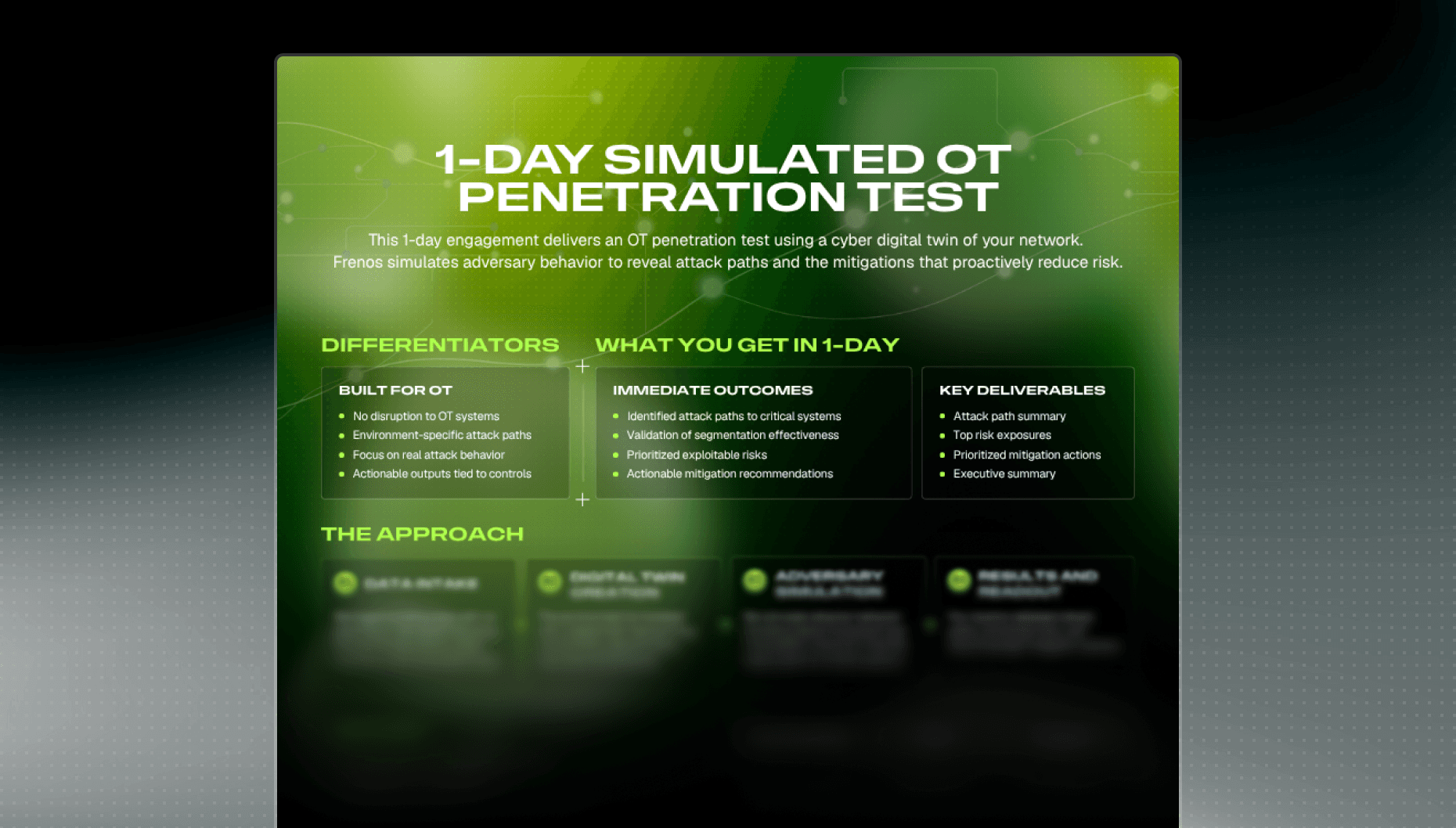

1-Day Simulated OT Pentest
Take a deep dive into understanding how Frenos' simulated OT penetration testing platform allows you to understand and improve your OT security posture at scale.
Read more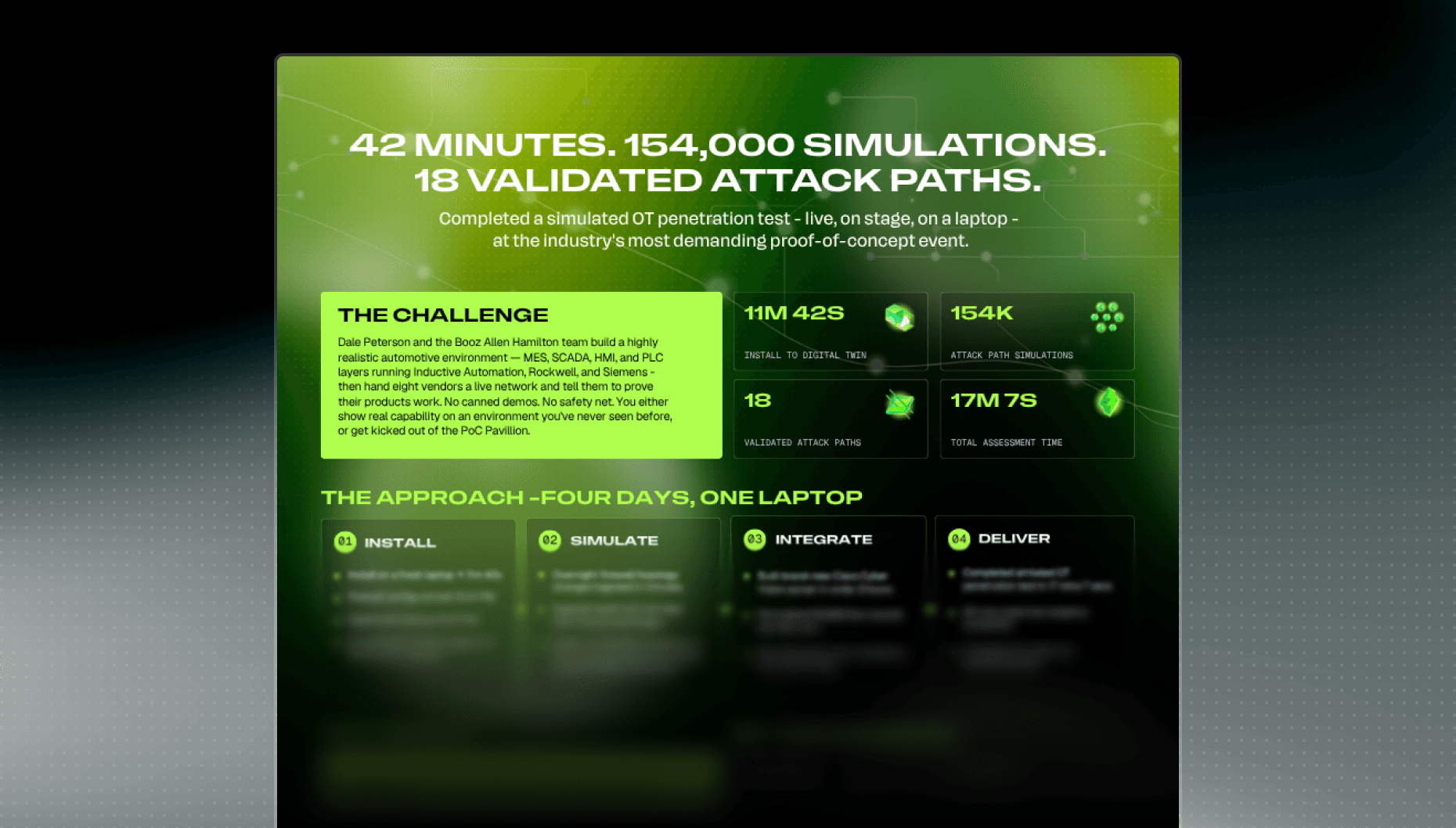
S4x26 Case Study
At the S4x26 POC Pavilion, Frenos completed 154,000 OT attack path simulations in 17 minutes and 7 seconds in a documented engagement. From three assumed-breach starting points (iDMZ, Plant Operations, Enterprise), the platform validated 18 attack paths into the critical Rockwell and Siemens zone. Those paths are exploitable given the actual controls, firewall rules, routing, and configurations modeled in the digital twin.
Read more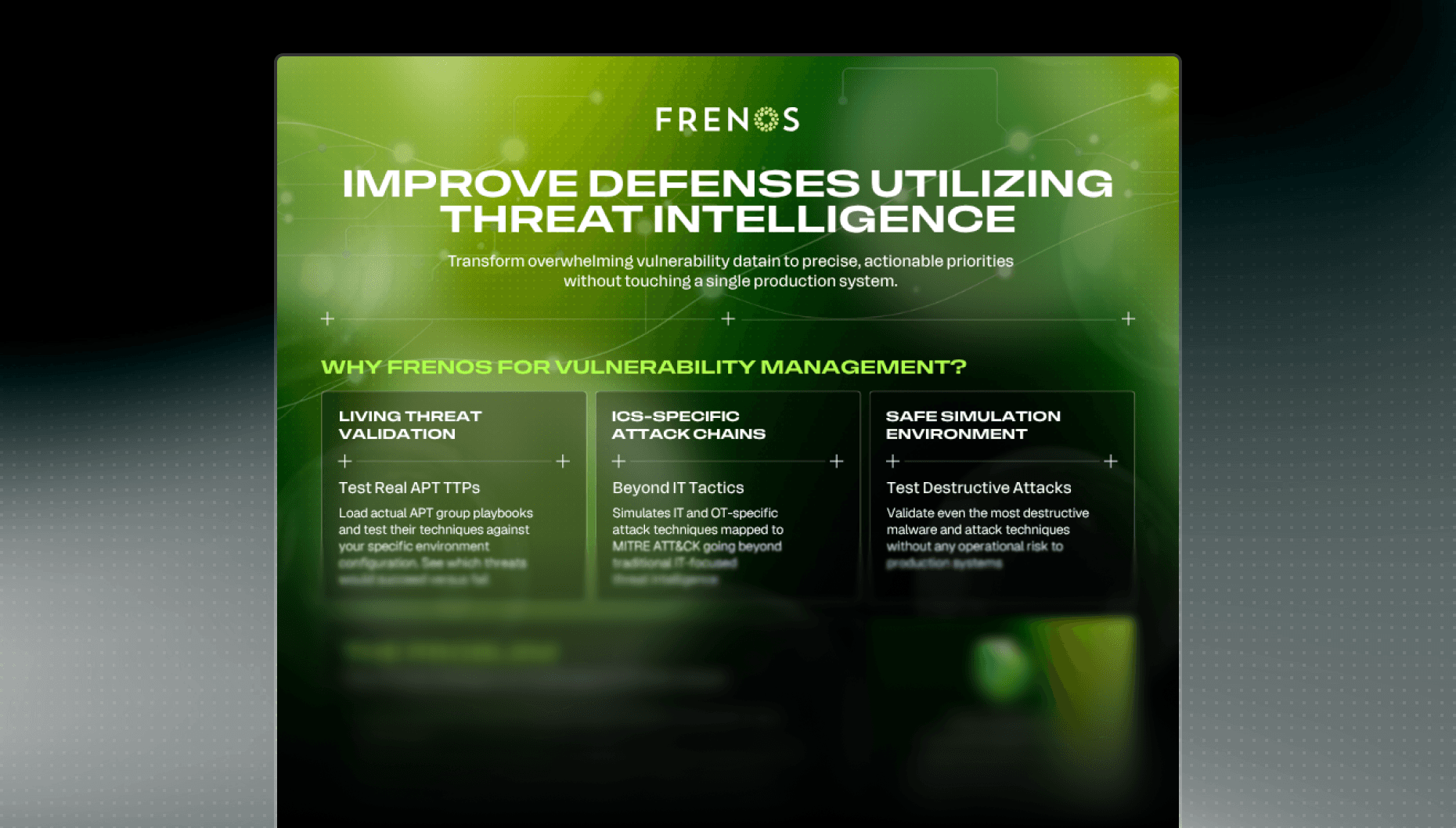
Threat Intelligence
Transform static threat intelligence into dynamic attack simulations. Reveal exactly how specific threat actors could compromise your OT environment before they try.
Read more