
OT Ransomware Defense and Recovery for Critical Infrastructure



Ransomware in operational technology is not only a data-loss problem. It can interrupt production, reduce operator visibility, disable supporting services, and force a facility into manual or degraded operations. Even when malware never reaches a controller, the loss of Active Directory, virtualization, engineering workstations, historians, or remote access can create an operational shutdown.
Effective OT ransomware protection therefore has two goals: prevent an attacker from reaching systems that affect operations, and preserve the ability to operate and recover safely when prevention fails.
This guide explains how critical infrastructure organizations can reduce ransomware exposure across IT and OT, detect malicious movement, isolate affected environments safely, recover in the right order, and validate whether ransomware attack paths remain exploitable.
Why ransomware defense is different in OT
Enterprise ransomware playbooks often prioritize rapid containment, endpoint rebuilding, and restoration of business data. OT environments add safety, process integrity, equipment, environmental, and availability constraints.
A response action that is routine in IT may be dangerous in an industrial facility. Disconnecting a server, blocking a protocol, resetting an account, or rebooting a host can interrupt control functions or remove operator visibility. Incident decisions must be coordinated among cybersecurity, operations, engineering, safety, legal, and executive leadership.
OT ransomware can produce several types of impact:
- Loss of operator access to HMIs, historians, or production applications
- Encryption of engineering workstations and configuration repositories
- Loss of identity, DNS, virtualization, or other shared infrastructure
- Disruption of remote access used by employees, integrators, or vendors
- Unavailable safety documentation, recipes, drawings, or maintenance records
- Forced shutdown because the organization can no longer demonstrate safe control
- Extended recovery caused by unsupported systems or unavailable installation media
The key question is not simply whether ransomware can execute on an OT asset. It is whether an attacker can follow a viable route from an initial foothold to systems whose loss would affect safe operations.
Common IT-to-OT ransomware intrusion routes
Many industrial ransomware incidents begin outside the control environment. Attackers compromise enterprise identities or exposed services, expand privileges, and move toward systems shared with or trusted by OT.
Common routes include:
- Compromised remote access. Stolen credentials, weak multifactor authentication, shared vendor accounts, or exposed remote services provide an initial foothold.
- Enterprise identity compromise. Excessive trust in centralized directories lets attackers reuse privileged identities across business and industrial environments.
- Poorly controlled IT/OT conduits. Broad firewall rules, dual-homed hosts, direct routing, and undocumented exceptions provide paths around intended boundaries.
- Industrial DMZ bypasses. Misconfigured jump hosts, replication services, file transfers, and management interfaces turn the DMZ into a transit network.
- Engineering and maintenance workflows. Laptops, removable media, software packages, and vendor tools move between security zones.
- Shared infrastructure. DNS, backup, virtualization, patching, endpoint management, and monitoring platforms may become common points of failure.
- Unmanaged or unpatchable systems. Legacy operating systems and insecure protocols can support lateral movement after an attacker crosses the boundary.
Asset inventories and vulnerability scans help identify exposure, but they do not prove which combinations of trust, access, configuration, and vulnerabilities create an end-to-end path. Teams should model and validate the complete route from plausible entry points to critical OT consequences. Frenos provides a deeper explanation of why IT-to-OT validation requires a cyber digital twin.
Segment OT to limit ransomware blast radius
Segmentation should make it difficult for ransomware operators to move from enterprise systems into industrial zones or between production areas. A firewall at the IT/OT boundary is necessary, but it is not sufficient.
Use an architecture based on defined zones, conduits, and trust boundaries:
- Separate enterprise IT, the industrial DMZ, site operations, control zones, safety-related environments, and remote access infrastructure.
- Deny traffic by default and permit only documented business and operational flows.
- Prevent direct enterprise access to controllers, HMIs, engineering workstations, and OT management interfaces.
- Route approved administration through hardened jump hosts with monitored sessions.
- Limit east-west communication between sites, production lines, and cells.
- Remove dual-homed hosts and undocumented modems or wireless connections.
- Review temporary firewall rules and vendor exceptions before they become permanent.
- Separate backup infrastructure and management planes from the identities used to administer production.
Segmentation quality should be measured by whether prohibited movement is actually blocked, not by the existence of a network diagram. See the OT network segmentation guide for detailed guidance on zones, conduits, and firewall policy validation.
Reduce identity-based ransomware paths
Ransomware operators frequently target identity systems because credentials can provide broader access than a single software exploit. OT identity controls should reduce standing privilege and prevent enterprise compromise from becoming OT compromise.
Priorities include:
- Require phishing-resistant multifactor authentication where operationally supportable, especially for remote and privileged access.
- Use separate administrative accounts for enterprise, OT, backup, and security functions.
- Eliminate shared accounts where possible and tightly govern necessary shared credentials.
- Prohibit routine web browsing and email from privileged OT workstations.
- Use privileged access workflows with approval, time limits, session recording, and credential rotation.
- Restrict service account logon rights and remove interactive access when it is not required.
- Inventory local accounts on engineering stations, servers, network devices, and appliances.
- Maintain emergency access procedures that do not depend entirely on enterprise identity services.
- Review vendor access regularly and disable it when no approved work is underway.
Identity design must account for outages. If Active Directory or a remote access platform is unavailable, the facility still needs a controlled method to authenticate authorized operators and responders.
Detect ransomware before operational impact
Detection should cover the attack sequence, not only the final encryption event. Early signals may appear in enterprise identity systems, remote access logs, boundary devices, or administrative activity before an attacker reaches OT.
Useful detection categories include:
- Unusual remote access times, locations, devices, or vendors
- Privileged account creation, group changes, or abnormal credential use
- New or unauthorized traffic crossing IT/OT boundaries
- Unexpected SMB, RDP, SSH, WinRM, or administrative tool activity
- Enumeration of directories, backups, hypervisors, or engineering assets
- Security-tool tampering and log clearing
- Changes to firewall rules, switch configurations, or remote access settings
- New scheduled tasks, services, remote execution, or mass file changes
- Unexpected communications between production zones
- Changes to controller logic, HMI projects, recipes, or engineering files
Collecting logs is not enough. The SOC and OT team should define which events require immediate operational coordination, who can authorize containment, and how analysts will distinguish legitimate maintenance from malicious behavior. Detection scenarios can be mapped to adversary techniques using MITRE ATT&CK for ICS, then tested against the organization’s actual architecture.
Isolate ransomware safely
Containment must prioritize human safety and process stability. Do not automatically disconnect OT assets solely because they appear suspicious. Isolation decisions should follow preapproved playbooks developed with operations and engineering.
A safe containment sequence should include:
- Confirm operational state. Identify active processes, safety constraints, dependencies, and the consequence of losing the affected system.
- Preserve operator visibility. Ensure operators retain the information and controls required to maintain or stop the process safely.
- Block the path where possible. Isolate at a firewall, switch boundary, remote access gateway, account, or conduit rather than immediately powering down field equipment.
- Disable compromised identities. Coordinate account changes carefully if services, applications, or emergency procedures depend on them.
- Protect known-good backups. Restrict access to backup infrastructure and prevent compromised administrators from deleting recovery data.
- Preserve evidence. Capture relevant logs, volatile data, configurations, and timelines without delaying actions needed for safety.
- Escalate through unified command. Security, operations, engineering, safety, communications, and leadership should work from one incident structure.
Predefine isolation points for each site and critical zone. Document which connections can be blocked, who has authority, how the block will be implemented, and how operators will verify that the process remains safe.
Prioritize recovery around safe operations
Recovery order should be based on operational dependencies rather than the convenience of restoring individual servers. Before an incident, identify the minimum systems required to monitor, control, and safely restart each process.
A practical recovery sequence is:
- Establish clean communications and an incident coordination environment.
- Confirm that the threat is contained and privileged access is trustworthy.
- Restore essential identity, DNS, time synchronization, and certificate services in a clean recovery zone as required.
- Recover safety and control dependencies according to engineering-approved procedures.
- Restore operator visibility, including essential HMI, alarm, and historian functions.
- Recover engineering workstations, configuration repositories, and required management services.
- Restore production applications, interfaces, reporting, and lower-priority business services.
- Reconnect zones in controlled stages while monitoring for recurrence.
Every recovered system should be rebuilt or restored from a trusted source, hardened, scanned using an OT-safe method, and validated before reconnection. Restoring encrypted systems without closing the original access path can recreate the incident.
Build OT backups that support real recovery
Backups should cover more than server data. Critical recovery materials may include:
- Controller and safety-system logic
- HMI and SCADA projects
- Historian configurations and tags
- Network-device and firewall configurations
- Recipes, calibration data, and device parameters
- Engineering software, licenses, firmware, and installation media
- Virtual machine images and server configurations
- Identity and certificate recovery materials
- Drawings, asset dependencies, and recovery procedures
Maintain offline or logically isolated copies that ransomware operators cannot delete through compromised production credentials. Track backup age, configuration version, software compatibility, and the equipment required to restore it.
Test restoration in a representative environment. A successful backup job does not prove that the organization can recover a controller, rebuild an engineering workstation, or restart a process within operational tolerances.
Prepare for manual and degraded operations
Some facilities can operate manually for a limited period, but manual operation should never be assumed. Determine in advance:
- Which processes can operate manually or locally
- Which processes require a controlled shutdown
- How long degraded operation can be sustained
- Which staffing levels and competencies are required
- How operators will communicate without normal IT services
- Which alarms, interlocks, and safety functions remain available
- How changes, readings, and decisions will be recorded
- What conditions require stopping operations
Exercise these procedures with actual operators. Paper procedures that have not been tested under realistic staffing and dependency constraints provide limited assurance.
Validate ransomware attack paths without testing production
Tabletop exercises verify decision-making, and monitoring verifies observable behavior. Neither proves that segmentation, identity controls, and other defenses prevent a ransomware operator from reaching critical OT assets.
Live exploitation can also create unacceptable production risk. Legacy systems may fail under scanning, malformed traffic, authentication testing, or unexpected load. Purpose-built simulation in a cyber digital twin offers a safer way to evaluate complete paths without executing attacks against production systems.
A ransomware validation program should test whether an adversary could:
- Enter through remote access or a compromised enterprise identity
- Escalate privileges and obtain credentials used in OT
- Traverse the industrial DMZ or bypass intended controls
- Reach jump hosts, engineering workstations, hypervisors, or backup systems
- Move between production zones
- Disable monitoring or interfere with recovery
- Reach systems whose loss would force shutdown or unsafe uncertainty
Results should include evidence for each viable path, the controls that failed or were bypassed, the operational consequence, and the remediation that breaks the path most efficiently. After changes, rerun the scenario to confirm that the route is no longer exploitable.
Frenos uses agnostic data ingestion, cyber digital twins, and simulated adversary techniques to validate IT-to-OT and OT attack paths without touching production. This complements existing asset visibility, vulnerability scanning, monitoring, and engineering expertise by showing which findings combine into consequential routes.
OT ransomware readiness checklist
Use this checklist to focus preparation:
- Identify processes and systems whose loss would affect safety or operations.
- Map plausible entry points and IT-to-OT trust relationships.
- Enforce zone-based segmentation and minimal conduits.
- Separate enterprise, OT, backup, and privileged identities.
- Govern remote and vendor access with strong authentication and monitoring.
- Detect identity abuse, boundary crossing, administrative activity, and control changes.
- Preapprove safe isolation points and decision authority.
- Define dependency-based recovery priorities for each site.
- Maintain isolated backups of data, logic, configurations, software, and documentation.
- Test restoration, manual operations, and clean-room recovery procedures.
- Validate ransomware paths in a representative environment rather than attacking production.
- Retest controls after remediation and meaningful architectural changes.
Move from assumed protection to validated resilience
OT ransomware resilience depends on more than malware prevention. Critical infrastructure teams must know how attackers could move from IT into OT, which controls would interrupt that movement, how to isolate affected zones safely, and whether operations can recover from trusted backups.
Frenos helps organizations validate those answers using AI-driven adversary simulation and cyber digital twins. The goal is not another vulnerability list. It is evidence showing which attack paths are exploitable, which consequences they could reach, and which remediations will reduce risk without production impact.
Request a demo to see ransomware attack paths in your OT environment and assess defenses without testing live production systems.
Frequently asked questions
Yes. Encryption or loss of identity services, HMIs, historians, engineering workstations, virtualization platforms, or production applications may be enough to disrupt operations or force a precautionary shutdown.
No single control is sufficient. Strong segmentation, separate privileged identities, controlled remote access, tested backups, OT-aware detection, and safe incident procedures work together. Organizations should validate whether these controls interrupt complete attack paths.
Not automatically. Responders must consider process safety, operator visibility, and system dependencies. When possible, isolate the affected route at a boundary or account level according to an engineering-approved playbook.
Test critical procedures regularly and after major architecture, identity, application, or process changes. Backup restoration, manual operation, isolation, and cross-functional incident exercises may require different schedules based on operational risk.
No. Simulation complements monitoring, response, vulnerability management, and engineering controls. It helps determine whether an attacker can combine weaknesses into a viable path and whether remediation actually breaks that path.
Related Resources
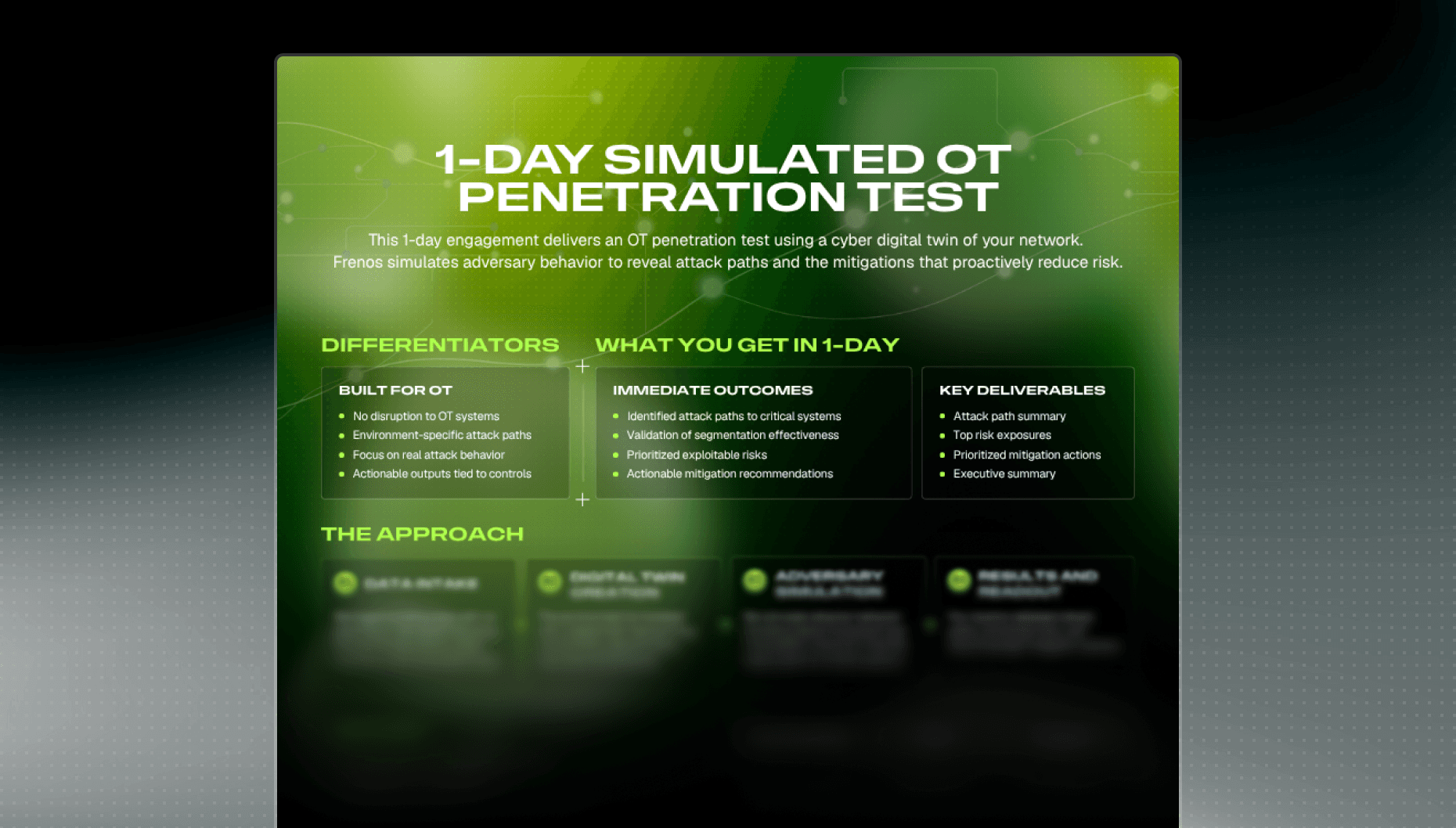

1-Day Simulated OT Pentest
Take a deep dive into understanding how Frenos' simulated OT penetration testing platform allows you to understand and improve your OT security posture at scale.
Read more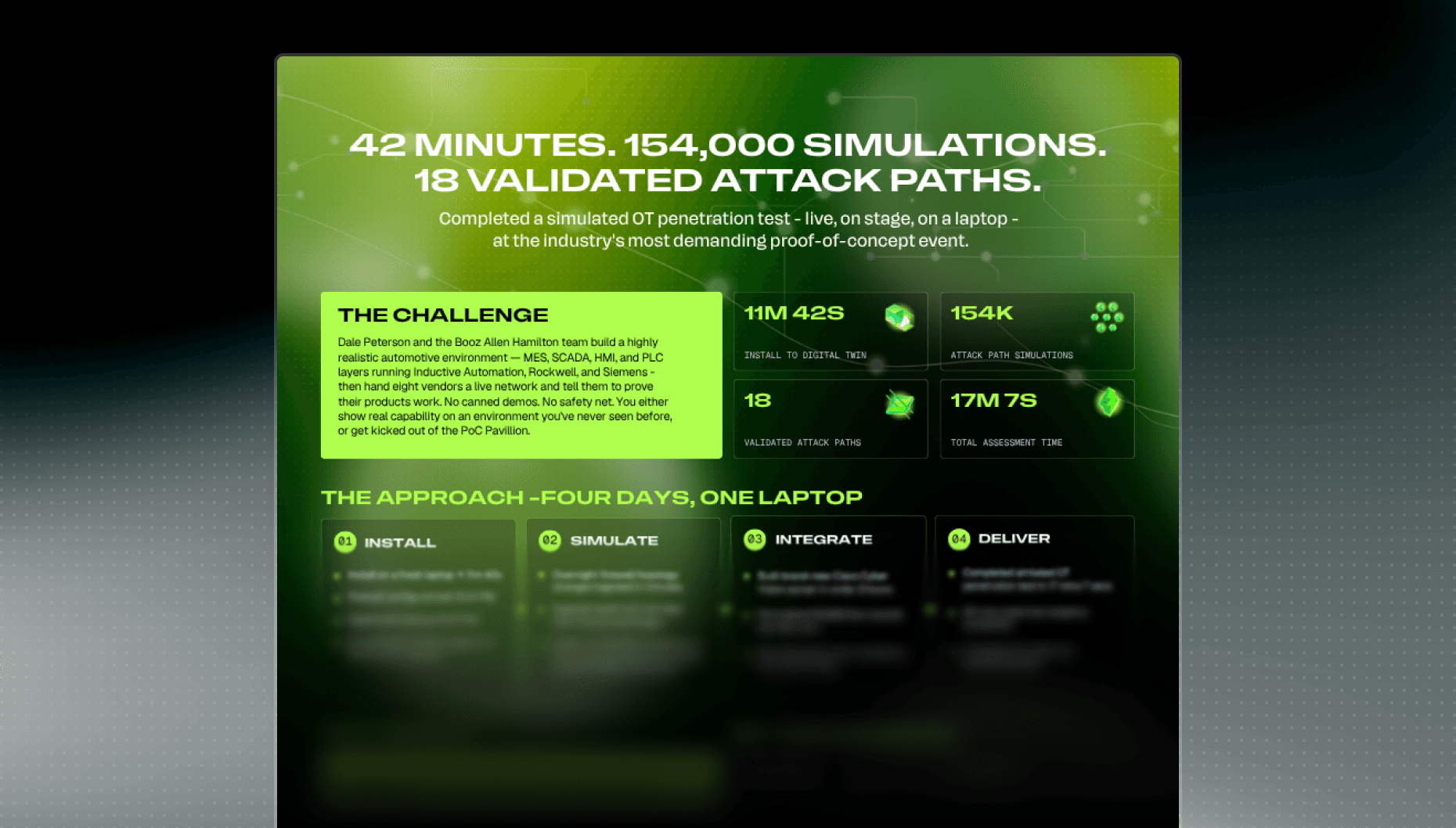
S4x26 Case Study
At the S4x26 POC Pavilion, Frenos completed 154,000 OT attack path simulations in 17 minutes and 7 seconds in a documented engagement. From three assumed-breach starting points (iDMZ, Plant Operations, Enterprise), the platform validated 18 attack paths into the critical Rockwell and Siemens zone. Those paths are exploitable given the actual controls, firewall rules, routing, and configurations modeled in the digital twin.
Read more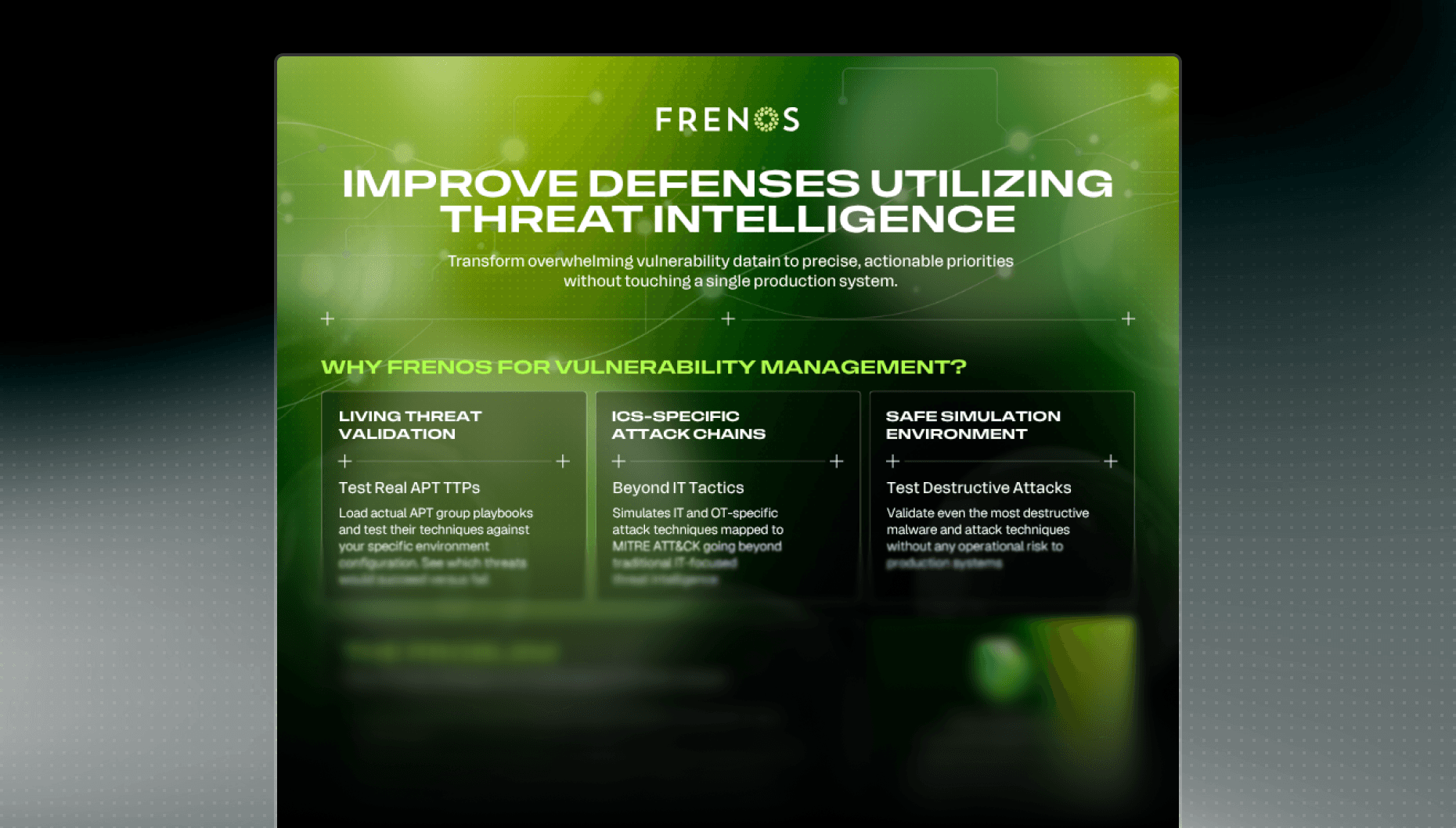
Threat Intelligence
Transform static threat intelligence into dynamic attack simulations. Reveal exactly how specific threat actors could compromise your OT environment before they try.
Read more