
OT Patch Management: Prioritize and Mitigate Vulnerabilities Without Disrupting Production



OT patch management is the controlled process of identifying, prioritizing, testing, deploying, and validating software and firmware updates across operational technology. Its objective is not to install every available patch as quickly as possible. It is to reduce exploitable risk while preserving safety, availability, product quality, and equipment reliability.
That distinction matters in industrial environments. A routine update can affect a controller, operator workstation, engineering application, safety-related dependency, or vendor-supported configuration. Some assets cannot be interrupted outside a planned outage. Others run unsupported operating systems or require vendor-qualified combinations of firmware, drivers, and applications.
A defensible OT patching program therefore needs more than a vulnerability score and a deadline. It needs an operational workflow that connects asset criticality, exploitability, maintenance windows, vendor qualification, testing, rollback planning, compensating controls, exceptions, and post-change validation.
What OT patch management means in industrial environments
OT patch management covers updates to the systems that monitor or control physical processes, including:
- Human-machine interfaces and operator workstations
- Engineering workstations and maintenance laptops
- SCADA servers, historians, and application servers
- PLCs, RTUs, protection devices, and other controllers
- Network appliances, firewalls, switches, and remote-access systems
- Industrial applications, databases, operating systems, and firmware
- Supporting IT systems with trusted access into OT
The scope should include connected IT assets when their compromise could create a route into industrial zones. A vulnerability on an enterprise jump host, identity service, or remote-access gateway may deserve attention before a higher-scoring flaw on an isolated OT asset.
This is why effective OT vulnerability management evaluates systems as part of an architecture rather than as an inventory of independent devices.
Why OT patching requires a different operating model
IT patching often emphasizes deployment speed and coverage. OT patching must account for additional constraints:
- Availability: A restart may stop production or remove process visibility.
- Safety: Unexpected behavior can create hazards for personnel, equipment, or the environment.
- Vendor support: An unqualified update may invalidate support or create incompatible configurations.
- System fragility: Legacy devices may respond unpredictably to updates or even routine security testing.
- Long asset lifecycles: Industrial systems commonly remain in service longer than their operating systems and applications.
- Limited test capacity: A representative spare controller, process simulator, or duplicate production environment may not exist.
- Coordinated dependencies: Firmware, drivers, applications, communications, and process logic may need to remain on approved versions.
These constraints do not justify indefinite delay. They mean each remediation decision must consider both cyber exposure and operational consequence.
A practical OT patch management workflow
A repeatable workflow should create an auditable chain from vulnerability intake to verified risk reduction. The following seven steps provide that structure.
Step 1: Establish asset, vulnerability, and operational context
Before assigning priority, verify that the finding applies to the deployed asset and configuration. Vulnerability feeds frequently contain incomplete matches, and passive inventory data may not show every software dependency.
For each affected asset, collect or confirm:
- Asset owner and operational custodian
- Site, cell, area, zone, and conduit
- Function in the physical process
- Hardware, firmware, operating system, and application versions
- Network communications and trusted relationships
- Internet, enterprise, vendor, and remote-access exposure
- Redundancy and failover status
- Safety, environmental, quality, and production consequences
- Available backups, spare equipment, and recovery procedures
- Vendor advisory and patch availability
- Current lifecycle and support status
Do not wait for a perfect inventory before acting on obvious exposure. Record confidence levels and data gaps, then prioritize additional discovery where uncertainty affects a high-consequence system. Frenos provides further guidance on how to turn OT vulnerability findings into safe, actionable fixes.
Step 2: Prioritize by criticality, exploitability, and consequence
CVSS can describe technical severity, but it cannot determine OT remediation order by itself. A practical prioritization model should combine at least five factors:
- Asset criticality: What process, safety, or operational function depends on the asset?
- Exploitability: Are the required access, privileges, protocols, and configurations present?
- Reachability: Can a credible adversary reach the vulnerable service through existing routes and trust relationships?
- Consequence: What could happen if the asset were compromised or unavailable?
- Mitigation status: Do segmentation, access controls, application allowlisting, monitoring, or redundancy materially reduce the risk?
A useful decision sequence is:
- Is the vulnerable component actually present?
- Is the vulnerable function enabled?
- Can an adversary reach it from a credible entry point?
- Could exploitation support movement toward a critical process?
- Would existing controls prevent, detect, or contain that activity?
- Is a production-safe patch available and qualified?
This approach moves urgent attention away from vulnerability counts and toward plausible operational risk. OT attack-path validation can help establish whether a finding participates in an end-to-end route to a critical zone or asset.
Step 3: Confirm vendor qualification and dependencies
Before approving deployment, obtain the vendor’s advisory, supported version matrix, installation instructions, known issues, prerequisites, and recovery guidance. Confirm whether the patch has been qualified for the exact combination of hardware, operating system, firmware, drivers, and industrial software in use.
The review should answer:
- Does the vendor recommend the update for this model and version?
- Does it require an intermediate upgrade or firmware sequence?
- Will it change communications, certificates, accounts, services, or licensing?
- Is a restart required?
- Are engineering tools and project files compatible afterward?
- Could the update affect deterministic communications or process timing?
- What support is available during the maintenance window?
When vendor qualification is pending, do not treat the ticket as inactive. Assign temporary controls, an owner, a review date, and conditions that would trigger escalation.
Step 4: Select a patch, compensating control, or accepted exception
Every validated vulnerability should lead to one of four documented outcomes:
- Patch now: Exposure and consequence justify the earliest safe window.
- Patch during a scheduled outage: Risk is meaningful, but deployment requires coordinated downtime.
- Apply compensating controls: Patching is unavailable, unsupported, or temporarily too disruptive.
- Accept a time-bound exception: Residual risk is formally approved with an expiration and review schedule.
Compensating controls may include:
- Restricting vulnerable ports, protocols, and source systems
- Tightening firewall rules between zones and conduits
- Removing direct internet or enterprise connectivity
- Requiring controlled jump-host access and multifactor authentication
- Disabling unused services or interfaces
- Applying application allowlisting or execution controls
- Increasing monitoring for relevant behavior
- Restricting vendor access to approved sessions and time periods
- Isolating the system behind a protocol break or additional boundary
Controls must address the conditions needed for exploitation. A generic monitoring rule should not be presented as equivalent to prevention. See these OT network segmentation best practices and alternative strategies for unpatchable OT systems for additional options.
Step 5: Test the change and prepare rollback procedures
Testing should reproduce the production configuration closely enough to reveal compatibility and operational problems. Depending on asset criticality, the test environment may use spare hardware, virtual machines, vendor test systems, a cyber digital twin, a process simulator, or a staged noncritical unit.
The test plan should verify:
- Installation completion and expected version
- Application startup and service health
- Controller and device communications
- HMI displays, alarms, trends, and historian collection
- Authentication and remote-access workflows
- Engineering upload, download, and diagnostic functions
- Failover, redundancy, and backup behavior
- Security controls and logging
- Representative process operations
A rollback plan should identify the decision authority, stop conditions, recovery sequence, required backups, known-good images, configuration exports, project files, firmware, licenses, credentials, and estimated recovery time. “Uninstall the patch” is not a sufficient rollback plan for a critical industrial asset.
Step 6: Schedule and execute the maintenance window
Maintenance windows should be based on operational readiness, not solely on a calendar. Coordinate the asset owner, operations, engineering, cybersecurity, safety personnel, the change manager, and the vendor when needed.
Before the window opens, confirm:
- Approved change record and implementation sequence
- Current backups and a tested restoration path
- Baseline configurations and performance data
- Named go/no-go and rollback authorities
- Vendor or integrator availability
- Communications and escalation channels
- Defined stop conditions
- Adequate time for validation and rollback
During execution, record timestamps, operator observations, deviations, errors, version changes, and configuration changes. Avoid combining unrelated high-risk changes when doing so would make troubleshooting or rollback ambiguous.
Step 7: Perform post-change validation
A successful installer message does not prove a successful OT change. Validation must confirm that the asset is secure, stable, and performing its operational function.
Post-change checks should include:
- Confirming the installed version and patch state
- Verifying process communications and data quality
- Reviewing alarms, events, logs, and performance indicators
- Testing operator and engineering workflows
- Confirming redundancy and failover health
- Checking firewall, identity, and monitoring controls
- Reassessing the original exploit conditions
- Confirming that no new route to critical systems was introduced
- Obtaining formal operational acceptance
Monitor the system for an appropriate stabilization period before closing the change. Update the asset inventory, configuration baseline, exception register, evidence repository, and vulnerability record.
How to manage OT patching exceptions
Exceptions should be explicit risk decisions rather than aging tickets. Each exception should document:
- The affected asset and vulnerability
- Why remediation cannot proceed
- Current exploitability and potential consequence
- Existing and planned compensating controls
- Residual risk owner and approval authority
- Approval date, expiration date, and review frequency
- Trigger conditions for immediate reassessment
- Target outage, replacement, or retirement date
Triggers may include evidence of active exploitation, changed network exposure, new remote access, failure of a compensating control, vendor patch qualification, or increased process criticality. Expired exceptions should automatically return to review.
How attack-path simulation improves patch prioritization
Traditional vulnerability workflows can tell teams that a weakness exists without showing whether it can be used in their environment. Attack-path simulation adds architectural and adversary context: entry points, network reachability, trust relationships, control effectiveness, and routes toward critical OT zones.
A cyber digital twin can also support analysis without sending tests directly to live controllers and other sensitive assets. This does not eliminate engineering approval, vendor qualification, or physical process testing. It helps teams decide which findings warrant scarce maintenance capacity and whether a proposed segmentation or access-control change breaks the relevant path.
The Frenos OT cybersecurity platform uses cyber digital twins and adversary-driven simulation to identify exploitable IT-to-OT routes, prioritize mitigations by operational impact, and validate defenses without testing directly on production assets.
OT patch management metrics that support better decisions
Useful measures should reflect risk reduction and execution quality rather than raw patch volume. Consider tracking:
- Time from advisory to applicability decision
- Time to mitigation for exploitable, high-consequence findings
- Percentage of critical assets with confirmed patch status
- Percentage of deferred findings with active compensating controls
- Number and age of expired exceptions
- Maintenance-window success and rollback rates
- Post-change incident or defect rate
- Percentage of changes with completed validation evidence
- Reduction in validated attack paths after remediation
- Assets approaching or beyond vendor support
Report results by site, criticality, and operational function. A single enterprise average can hide concentrated risk in a critical plant or process.
Frequently asked questions
There is no universal interval for every OT asset. Review new advisories continuously, assess applicability promptly, and deploy according to exploitability, operational consequence, vendor qualification, and available maintenance windows. Critical exposure may require immediate compensating controls even when patch deployment must wait.
No. CVSS is one input. OT priority should also account for asset criticality, reachability, actual exploit conditions, safety and production consequences, existing controls, and recovery readiness.
Reduce the conditions that make exploitation possible. Restrict reachability, disable unnecessary services, strengthen remote access, segment the asset, monitor relevant behavior, and plan replacement or isolation. Document residual risk through a time-bound exception.
A digital twin can help evaluate exposure, attack paths, and the likely security effect of control changes without interacting with production. Patch compatibility and physical process behavior may still require vendor testing, representative hardware, process simulation, or a controlled maintenance window.
Approval should include the operational asset owner and the organization’s change authority. High-consequence changes may also require cybersecurity, engineering, safety, vendor, and business approval. Cybersecurity should not make a production-impacting decision in isolation.
Turn vulnerability findings into production-safe action
OT patch management works when it connects cyber evidence with operational decision-making. Prioritize what is exploitable, understand what is at stake, test the change, prepare recovery, and verify the result after deployment. When patching is not immediately possible, use targeted compensating controls and governed exceptions rather than silent deferral.
Frenos helps industrial organizations model their connected IT and OT environments, simulate adversary attack paths, and identify mitigations with the greatest operational impact—without testing directly on live OT assets.
Request a demo to see how simulated OT penetration testing can support vulnerability prioritization and post-remediation validation.
Related Resources
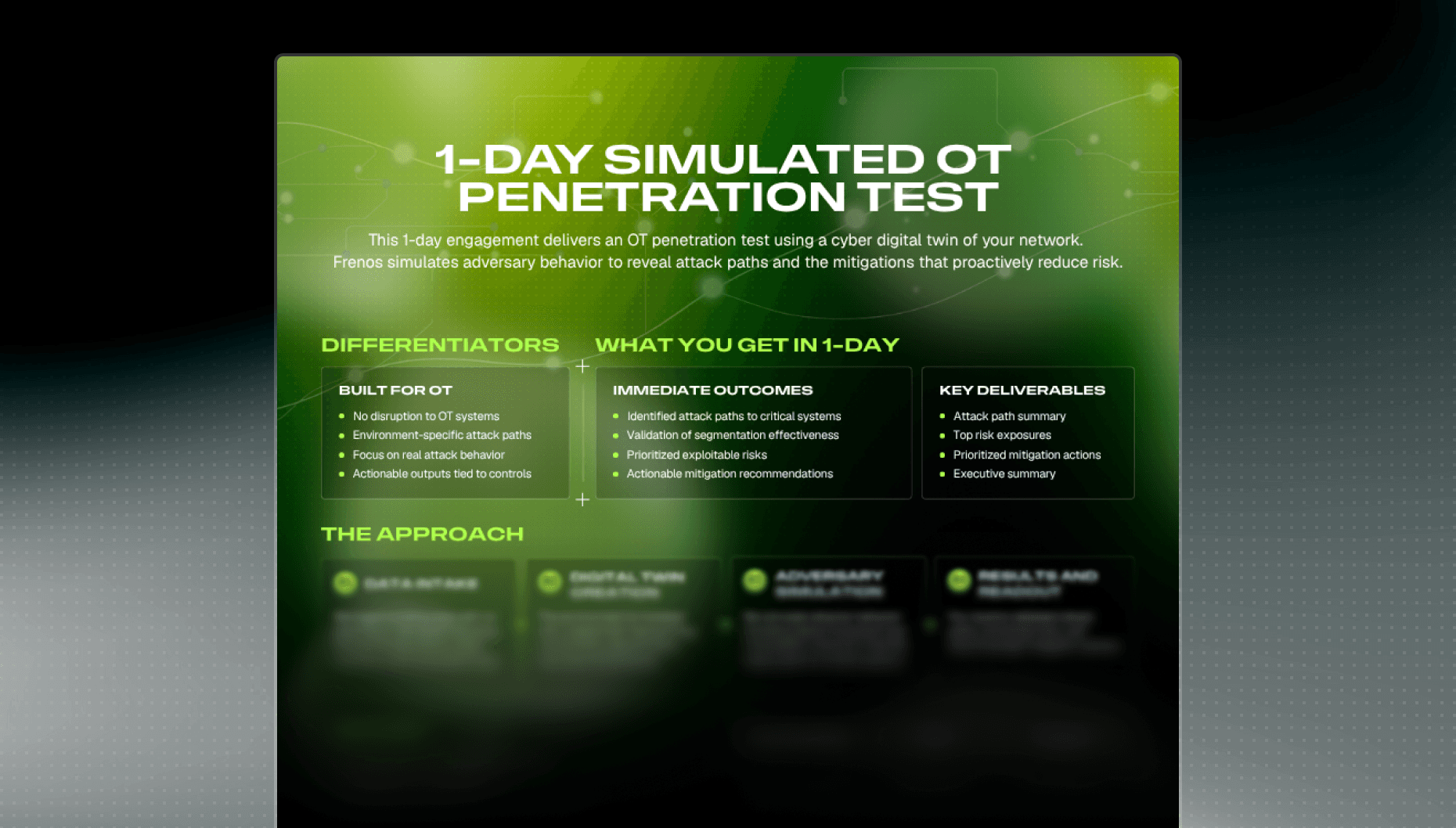

1-Day Simulated OT Pentest
Take a deep dive into understanding how Frenos' simulated OT penetration testing platform allows you to understand and improve your OT security posture at scale.
Read more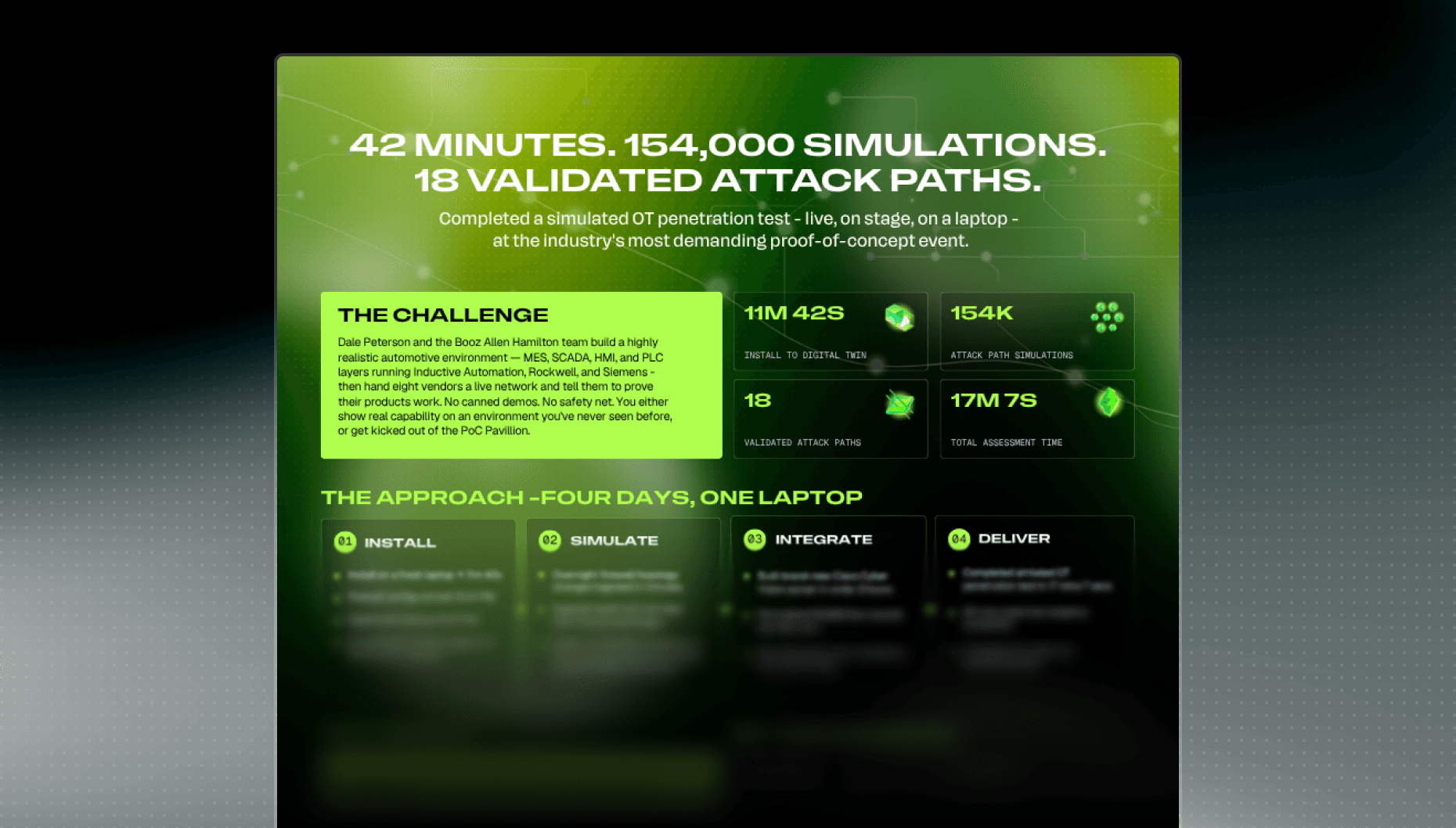
S4x26 Case Study
At the S4x26 POC Pavilion, Frenos completed 154,000 OT attack path simulations in 17 minutes and 7 seconds in a documented engagement. From three assumed-breach starting points (iDMZ, Plant Operations, Enterprise), the platform validated 18 attack paths into the critical Rockwell and Siemens zone. Those paths are exploitable given the actual controls, firewall rules, routing, and configurations modeled in the digital twin.
Read more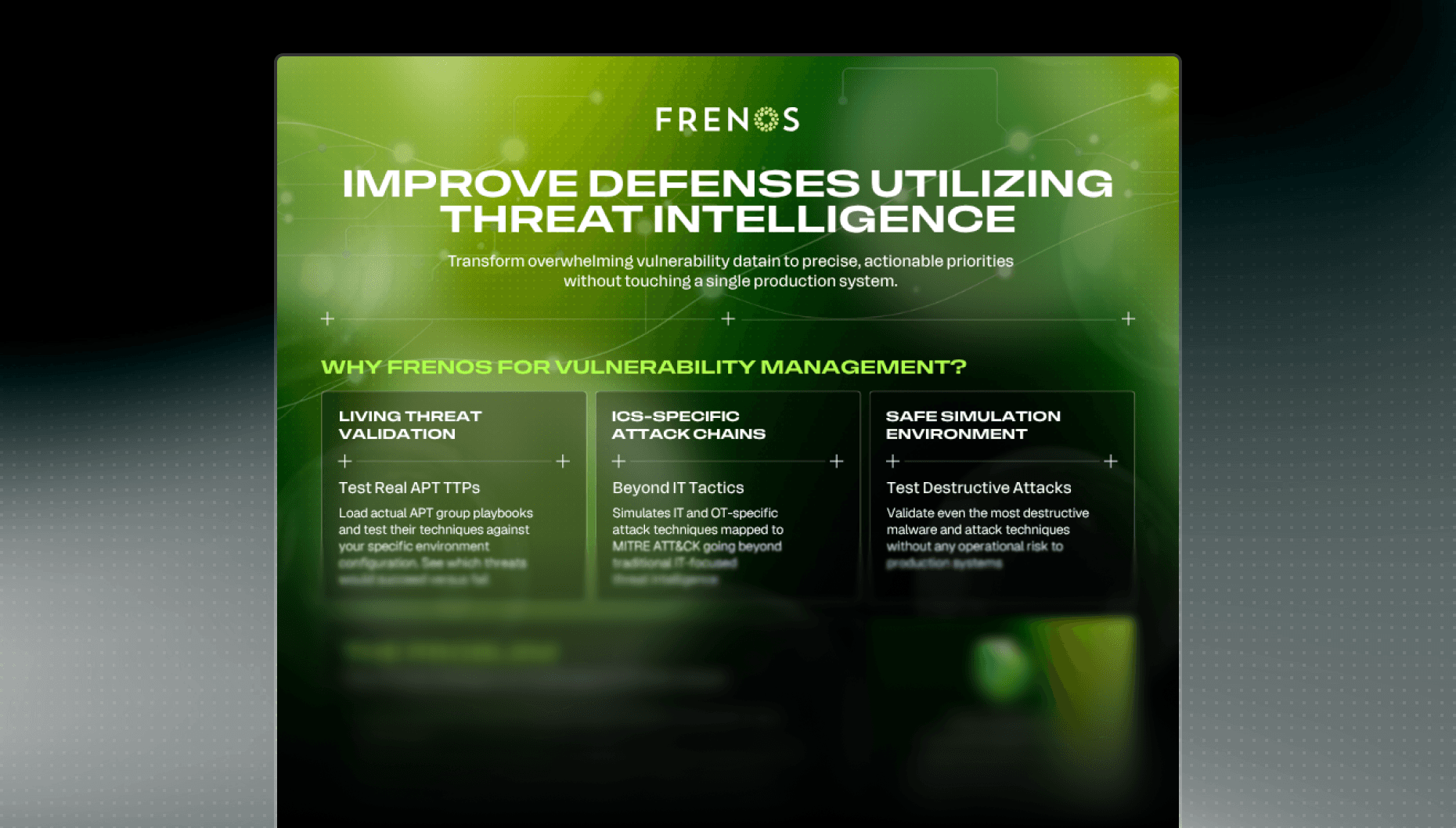
Threat Intelligence
Transform static threat intelligence into dynamic attack simulations. Reveal exactly how specific threat actors could compromise your OT environment before they try.
Read more