
OT Incident Response: A Practical Playbook for Industrial Environments



An OT incident response plan must protect more than data and endpoints. It must protect people, physical processes, product quality, equipment, the environment, and continuity of operations.
That changes how an industrial organization should investigate, contain, and recover from a cyber incident. An action considered routine in IT—isolating a host, rebooting a server, scanning a subnet, disabling an account, or pushing a patch—can interrupt visibility, stop a process, invalidate a safety assumption, or damage legacy equipment in an operational technology environment.
Effective OT incident response therefore requires coordinated decisions by cybersecurity, operations, engineering, safety, legal, communications, and executive leadership. The goal is not simply to remove malicious code as quickly as possible. It is to restore a known, safe, and defensible operating state without making the incident worse.
This playbook provides a practical framework for preparation, triage, safe containment, evidence collection, communications, recovery, and two high-priority scenarios: ransomware and unauthorized controller changes.
> Safety rule: If a cyber response action could affect a physical process, equipment state, protective function, or operator visibility, obtain authorization from the designated operations and safety authorities before proceeding. Site procedures, engineering judgment, and emergency requirements take precedence over generic cybersecurity guidance.
What Is OT Incident Response?
OT incident response is the coordinated process used to detect, analyze, contain, eradicate, and recover from a cybersecurity event affecting industrial operations. Its scope may include:
- Industrial control systems and SCADA platforms
- Programmable logic controllers (PLCs), remote terminal units, and other controllers
- Human-machine interfaces and engineering workstations
- Historians, data gateways, application servers, and industrial databases
- Safety instrumented systems and other protective functions
- Industrial network infrastructure and remote-access pathways
- Connected enterprise systems that provide a route into OT
- Vendors, integrators, and managed services with operational access
An OT incident may begin in enterprise IT and move toward industrial systems. It may also originate from a compromised vendor account, removable media, an engineering workstation, an exposed remote-access service, or an unauthorized logic or configuration change.
For that reason, OT response cannot be separated cleanly from IT response. The organization needs one coordinated command structure with different execution rules for production environments.
For broader program context, see Frenos’ complete guide to OT security.
Why OT Incident Response Requires an Operations-First Approach
Traditional IT response commonly prioritizes confidentiality, integrity, and availability. Those objectives still matter in OT, but responders must also account for safety, process stability, environmental impact, equipment protection, product quality, and recovery time.
Several characteristics make industrial response different:
- Availability may be safety-relevant. Abruptly removing a system can eliminate operator visibility or process control.
- Cyber and physical states are connected. A controller change can alter valves, motors, pressure, temperature, speed, or sequencing.
- Legacy assets may be fragile. Aggressive scanning, unsupported agents, or malformed traffic can degrade or crash devices.
- Recovery dependencies are complex. A server may be technically restored but unusable until communications, controller states, recipes, time synchronization, and process conditions are verified.
- Evidence may be volatile or incomplete. Some devices have limited logging, short retention, proprietary formats, or clocks that are not synchronized.
- Operational knowledge is distributed. Cybersecurity personnel may recognize malicious behavior, while engineers and operators understand whether a state or command is abnormal.
The practical result is straightforward: containment speed must be balanced with operational consequence. Delaying action can increase attacker dwell time, but taking an unreviewed action can create an immediate plant event.
The OT Incident Response Lifecycle at a Glance
Use the following lifecycle as the core of the OT incident response plan:
- Prepare: Define authority, dependencies, communications, evidence procedures, and safe response options.
- Detect and triage: Determine what happened, what is affected, and whether operations or safety are at risk.
- Contain: Limit adversary access and blast radius using the least disruptive effective action.
- Collect evidence: Preserve data needed for scoping, root-cause analysis, legal review, and regulatory obligations.
- Eradicate: Remove persistence and close the access path without destabilizing operations.
- Recover: Restore systems and processes in a controlled, dependency-aware sequence.
- Validate and improve: Confirm defenses, document lessons, and update architecture, controls, detections, and playbooks.
The phases may overlap. Evidence collection can begin during triage, for example, while containment may occur in stages as operations approves safer options.
1. Prepare the OT Incident Response Program
Preparation determines whether the organization will make controlled decisions or improvise under pressure.
Establish scope and incident criteria
Document which sites, systems, third parties, and physical processes the plan covers. Define criteria for declaring an OT incident, such as:
- Loss of control or operator visibility
- Unauthorized controller logic, firmware, configuration, or setpoint changes
- Malware or ransomware on an OT-connected asset
- Compromise of an engineering workstation or privileged account
- Unexpected communications across an IT/OT boundary
- Unauthorized remote access or vendor activity
- Disabled monitoring, logging, alarms, or protective functions
- Evidence of lateral movement toward critical OT zones
- Manipulation that could affect safety, quality, production, or the environment
Severity should reflect potential operational consequence, not just malware type or endpoint count.
Maintain an incident-ready architecture package
Responders need more than a flat asset inventory. Maintain an accessible, protected package containing:
- Network diagrams and approved data flows
- Zones, conduits, trust boundaries, and industrial DMZ dependencies
- Critical process and safety dependencies
- Asset owners and system custodians
- Firewall, switch, remote-access, and identity dependencies
- Controller and engineering workstation relationships
- Known vendor connections and support contacts
- Backup locations, restoration instructions, and integrity checks
- Golden configurations, logic files, recipes, and firmware versions
- Approved isolation points and alternative operating modes
If visibility is incomplete, begin with available firewall, flow, configuration, and OT visibility data. Treat unknown dependencies as operational risks rather than assuming they do not exist.
Pre-authorize containment options
Create a site-specific containment decision matrix before an incident. For each critical asset or zone, identify:
- Which network connection can be restricted or disconnected
- Who can authorize the action
- Expected production and safety effects
- Whether local or manual operation is possible
- How to reverse the change
- What evidence should be captured first, if time permits
- Which actions are prohibited while equipment is running
This matrix should distinguish between actions cybersecurity can execute independently and actions requiring operations or safety approval.
Prepare offline response capabilities
Assume normal communications or identity systems may be unavailable. Maintain protected copies of:
- Contact lists and escalation paths
- Response procedures and architecture diagrams
- Critical vendor and regulator contacts
- Forensic tools and approved collection instructions
- Backup media and restoration documentation
- Alternative communications methods
- Manual operating procedures where applicable
Test access to these materials without relying solely on the systems they are intended to recover.
Exercise realistic scenarios
Tabletop exercises are useful for authority, communications, and decision-making. Technical validation is needed to determine whether controls can actually block or detect relevant paths.
Do not introduce unsafe traffic into production simply to make an exercise realistic. Frenos explains why traditional IT testing can put OT production at risk. Where live testing is constrained, a cyber digital twin can support production-safe evaluation of IT-to-OT paths and containment assumptions.
2. Define IT, OT, Engineering, Safety, and Leadership Roles
Ambiguous authority creates dangerous delays. Define roles in advance and assign primary and alternate personnel.
Role | Primary responsibilities during an OT incident
Incident commander | Sets objectives, coordinates workstreams, records major decisions, and manages escalation
OT operations lead | Assesses process impact, approves operational actions, and coordinates operators
Control systems engineering | Evaluates controller logic, configurations, dependencies, and restoration requirements
Safety representative | Assesses potential consequences and confirms response actions align with safety procedures
IT incident response | Investigates enterprise systems, identity, email, endpoints, and IT-to-OT pathways
OT security or network lead | Analyzes industrial communications, boundaries, remote access, and OT telemetry
Forensics lead | Directs evidence collection, preservation, chain of custody, and timeline development
Site leadership | Authorizes production-impacting decisions and coordinates business continuity
Legal and compliance | Evaluates notification, contractual, regulatory, privacy, and evidence obligations
Communications lead | Coordinates internal, customer, partner, media, and public messaging
Vendor coordinator | Controls third-party engagement and validates vendor identity and access
The incident commander should not make process-safety decisions alone. Likewise, plant personnel should not remove or reimage potentially compromised systems without coordinating evidence and cybersecurity requirements, unless immediate safety demands action.
3. Detect, Triage, and Declare an OT Incident
The first objective is to establish enough reliable context to make the next safe decision.
Capture the initial facts
Record:
- Who reported the event and when
- What alert, observation, or process anomaly triggered the report
- Affected site, process, zone, asset, account, and network segment
- Current production and safety condition
- Whether the suspected activity is ongoing
- Recent maintenance, vendor access, configuration changes, or outages
- Available logs, packet data, backups, and endpoint evidence
- Actions already taken and by whom
Preserve the original alert and avoid overwriting timestamps or logs.
Separate cyber indicators from process symptoms
A process anomaly does not automatically prove a cyberattack. Likewise, the absence of a visible process anomaly does not mean the event is harmless.
Analyze both dimensions:
Cyber indicators may include unusual authentication, new remote sessions, unexpected protocols, changed firewall policy, suspicious tooling, disabled security controls, or anomalous data transfer.
Operational indicators may include unexpected setpoints, altered sequences, inconsistent HMI values, alarm floods, unexplained controller mode changes, or discrepancies between digital displays and physical measurements.
Bring cybersecurity and engineering observations into one incident timeline. Map suspicious behavior to relevant MITRE ATT&CK for ICS techniques where useful, but do not let framework mapping delay containment.
Determine severity
Ask four questions:
- Is there an actual or potential threat to people, equipment, the environment, or product integrity?
- Has control, visibility, or a protective function been affected?
- Does the adversary still have access, and can that access reach more critical assets?
- What would happen if the affected system were isolated immediately?
Declare the incident at the level justified by potential consequence. Do not wait for perfect attribution.
4. Contain an OT Incident Without Creating a Safety Event
Containment should interrupt the adversary while preserving safe operations. Use the least disruptive action that meaningfully reduces risk, then escalate if it fails.
Prefer boundary containment when possible
Potential options include:
- Disable a compromised remote-access session or account
- Require controlled credential resets from known-clean systems
- Restrict vendor access
- Block confirmed malicious destinations at managed boundaries
- Tighten IT/OT firewall rules to known-required communications
- Remove unnecessary routing between zones
- Isolate an affected workstation from peers while preserving required process connections
- Move selected functions to approved local or manual operation
- Increase monitoring around a suspected asset when immediate isolation is unsafe
Network segmentation provides predefined control points for these actions. Review OT network segmentation best practices when designing containment options.
Use a containment decision sequence
Before executing a material action, ask:
- What threat behavior will this stop?
- What required process communications will it also stop?
- Could the action affect safety, control, visibility, or equipment health?
- Who has authority to approve it?
- Can evidence be captured first without unacceptable delay?
- How will responders confirm the action worked?
- What is the rollback procedure?
Actions to treat with special caution
Do not automatically:
- Reboot controllers, HMIs, historians, or engineering workstations
- Run broad active scans against industrial devices
- Deploy untested endpoint tools or patches
- Disable accounts that support services or emergency access
- Disconnect redundant network paths without checking their function
- Restore controller logic solely because a checksum differs
- Power down equipment outside established operating procedures
- Allow an external responder or vendor to connect without verified authorization
Emergency conditions may require immediate action. Document the reason, authorization, expected effect, and actual outcome whenever circumstances permit.
5. Collect and Preserve OT Evidence
Evidence collection supports scoping, root-cause analysis, insurance, litigation, compliance, and lessons learned. In OT, collection must also avoid disrupting control processes.
Establish a collection order
Prioritize evidence according to volatility, investigative value, operational risk, and accessibility. Depending on the environment, useful sources may include:
- Identity, VPN, jump-host, and remote-access logs
- Firewall, switch, router, and industrial DMZ logs
- Passive network-monitoring data and packet captures
- Endpoint telemetry from supported systems
- Engineering workstation project files and change records
- Controller logic, configuration, mode, diagnostics, and timestamps
- HMI, historian, alarm, and event data
- Backup metadata and integrity records
- Vendor support records and maintenance tickets
- Physical access and badge records
- Operator logs and contemporaneous observations
Protect evidence integrity
For each item, record:
- Collector name
- Date and time, including time zone
- Source asset and location
- Collection method and tool version
- File name, size, and cryptographic hash where practical
- Storage location
- Every transfer or access to the evidence
Preserve originals and analyze working copies. Store evidence in a controlled repository with access logging.
Account for time discrepancies
OT environments often contain unsynchronized devices. Record the displayed time on each source and compare it with a trusted reference. Do not silently correct timestamps; document the offset and use it when building the event timeline.
Coordinate controller collection with engineering
Reading logic or diagnostic information may be routine on one platform and risky on another. Use vendor-supported, site-approved procedures. Record controller state before and after collection, and avoid writing to the device unless an authorized recovery action requires it.
6. Coordinate Incident Communications
Communication failures can cause duplicated actions, unauthorized changes, regulatory exposure, and public confusion.
Create one operational picture
Maintain an incident log containing:
- Confirmed facts
- Working hypotheses clearly labeled as unconfirmed
- Affected processes and systems
- Safety and production status
- Decisions, owners, and deadlines
- Containment and recovery actions
- Evidence locations
- External notifications
- Open risks and approval needs
Use a defined update cadence. The incident commander should ensure that cybersecurity, engineering, operations, and leadership are working from the same current information.
Control external communications
Legal and communications teams should coordinate contact with regulators, law enforcement, insurers, customers, unions, vendors, partners, and the media. Requirements vary by sector, jurisdiction, contract, and incident type.
Messages should state what is known, what remains under investigation, what operational effects exist, and what protective actions are underway. Avoid premature attribution or unsupported claims about scope.
Verify third parties before granting access
Attackers may exploit incident urgency. Validate vendor identity through an established channel, use named accounts, apply least privilege, limit access duration, record sessions where appropriate, and terminate access when the task is complete.
7. Eradicate the Threat and Recover Industrial Operations
Eradication and recovery should address the complete access path, not only the most visible infected host.
Remove attacker access and persistence
The remediation plan may need to address:
- Compromised credentials and tokens
- Exposed remote-access pathways
- Unauthorized accounts or trust relationships
- Malware, scheduled tasks, services, and startup mechanisms
- Modified firewall or switch configurations
- Altered controller logic, firmware, recipes, or setpoints
- Vulnerable internet-facing or enterprise systems used for initial access
- Weak segmentation that enabled movement toward OT
- Compromised backups, management systems, or vendor tools
If the organization restores a workstation but leaves the IT-to-OT route open, reinfection or renewed access remains possible.
Build a dependency-aware restoration sequence
Define restoration waves such as:
- Safety and protective dependencies
- Core network, identity, time, and management services
- Required controllers and communications
- Operator visibility and control systems
- Engineering and support workstations
- Historians, reporting, optimization, and business integrations
- External and vendor connections
The exact order depends on the process. Operations and engineering should own the safe startup sequence, while cybersecurity verifies trust and monitors for recurrence.
Validate backups before restoration
Confirm that backups are:
- Available and readable
- From an acceptable point in time
- Free from known malicious changes
- Compatible with the target hardware and software
- Complete enough to restore dependencies
- Protected from modification during the incident
A successful file restore does not prove a successful process recovery.
8. Validate Recovery Before Returning to Normal Operations
Recovery is complete only when the organization can demonstrate that systems and processes are operating in a known, trusted state.
Validate:
- Expected controller logic, firmware, configuration, and operating mode
- Approved HMI projects, recipes, setpoints, and alarm configurations
- Required network flows and blocked unauthorized paths
- Identity, remote-access, and privileged-access controls
- Endpoint health and security telemetry
- Time synchronization and logging
- Process values against independent or physical measurements where appropriate
- Safety and protective functions under approved test procedures
- Monitoring coverage for the behavior observed during the incident
- Absence of recurring indicators during an enhanced monitoring period
Where production testing would introduce unacceptable risk, use OT attack-path validation in a representative cyber digital twin to evaluate whether the access route remains exploitable and whether planned controls interrupt it.
OT Ransomware Response Playbook
Ransomware affecting an OT-connected environment may originate in IT, a shared service, a remote-access pathway, or an industrial workstation. Even when controllers are not encrypted, loss of HMIs, historians, engineering workstations, identity, or logistics systems can stop production.
Immediate actions
- Confirm safety and current process stability.
- Declare an incident and activate IT and OT response leads.
- Identify affected identities, sites, network zones, and services.
- Restrict confirmed malicious remote access and IT-to-OT movement at approved boundaries.
- Protect backup systems and known-good controller, HMI, and engineering files.
- Preserve ransom notes, samples, logs, volatile evidence, and relevant network data.
- Coordinate operational isolation decisions with site leadership and safety personnel.
- Move to approved local or manual operation only when procedures and staffing support it.
Investigation priorities
Determine:
- Initial access and the first known compromised identity or asset
- Whether privileged or service accounts were stolen
- Whether the threat reached OT or only disrupted OT dependencies
- Which remote-access, jump-host, file-transfer, or management paths were used
- Whether controller logic, recipes, firmware, or safety configurations changed
- Whether data was exfiltrated before encryption
- Whether backups or recovery infrastructure were accessed
Recovery priorities
Recover from known-good sources in a controlled sequence. Reset credentials from clean systems, close the original access route, and monitor restored assets before reconnecting additional zones.
Do not assume that decrypting files removes persistence or restores trust. Likewise, do not treat every unavailable industrial asset as encrypted; confirm whether loss of connectivity, identity, DNS, virtualization, storage, or another shared dependency is the actual cause.
Unauthorized Controller Change Response Playbook
An unauthorized PLC, RTU, or other controller change can directly affect a physical process. Treat it as both a cybersecurity and engineering event.
Immediate actions
- Confirm the physical process state using available independent measurements.
- Notify the control systems engineer, operations lead, safety representative, and incident commander.
- Determine whether the controller is in run, program, remote, local, faulted, or another relevant mode.
- Preserve alarms, event logs, engineering workstation records, remote-access logs, and network telemetry.
- Restrict the suspected write path when operations determines it is safe.
- Preserve the current controller logic and configuration using an approved method.
- Compare the current state with the authorized baseline.
- Do not download replacement logic until engineering understands the process impact and approves the change.
Investigation priorities
Determine:
- What logic, configuration, firmware, setpoint, or mode changed
- When the change occurred and which account or workstation initiated it
- Whether the change was authorized maintenance, operator error, failed automation, or malicious activity
- Which engineering stations, jump hosts, vendor sessions, and removable media had access
- Whether similar controllers or sites received the same change
- Whether the attacker or unauthorized user retains write capability
- Whether HMI displays or historian values were manipulated to conceal the change
Recovery priorities
Engineering should validate the intended logic against the approved baseline and current process requirements. Restore only through site-approved change control, with backups of the current state and a rollback plan.
After restoration, verify outputs, interlocks, alarms, sequencing, communications, and relevant protective functions. Monitor for renewed write attempts and investigate the full pathway that enabled the unauthorized change.
Post-Incident Review and Continuous Improvement
Conduct a review after operations stabilize. The purpose is to reduce the probability and consequence of recurrence, not to assign blame.
Document:
- Initial access and complete attack path
- Detection source and missed opportunities
- Operational and business effects
- Major decisions and their outcomes
- Containment actions that worked or failed
- Evidence gaps and time-synchronization issues
- Recovery dependencies and bottlenecks
- Control, architecture, staffing, training, and vendor-management improvements
- Owners and deadlines for corrective actions
Prioritize remediation by exploitability and potential operational impact. A long vulnerability list is less useful than knowing which combinations of access, trust, configuration, and reachability create a viable route to critical systems.
Update incident scenarios, detections, network diagrams, baselines, recovery procedures, and tabletop exercises. Then validate whether the corrective actions actually break the relevant path.
OT Incident Response Checklist
Before an incident
- [ ] Define incident authority and alternates for every site
- [ ] Identify safety, process, and cybersecurity escalation criteria
- [ ] Maintain offline contact lists and response procedures
- [ ] Map IT-to-OT pathways, zones, conduits, and remote access
- [ ] Identify critical process dependencies and isolation points
- [ ] Maintain approved logic, firmware, configuration, and HMI baselines
- [ ] Test backup access and restoration procedures
- [ ] Establish chain-of-custody and evidence-storage procedures
- [ ] Pre-authorize safe containment actions
- [ ] Exercise ransomware and controller-change scenarios
During an incident
- [ ] Confirm safety and process status first
- [ ] Activate the incident commander and OT operations lead
- [ ] Record initial facts, timestamps, and actions
- [ ] Separate confirmed facts from hypotheses
- [ ] Preserve volatile and high-value evidence
- [ ] Contain at approved boundaries where possible
- [ ] Assess operational consequences before isolating assets
- [ ] Verify third-party identities and limit access
- [ ] Maintain a common incident log and update cadence
- [ ] Protect backups and known-good engineering files
During recovery
- [ ] Close the initial access route and remove persistence
- [ ] Validate backup integrity and compatibility
- [ ] Restore according to process dependencies
- [ ] Verify logic, configurations, setpoints, and network flows
- [ ] Confirm monitoring and logging are functional
- [ ] Compare process values with trusted measurements
- [ ] Use enhanced monitoring during staged reconnection
- [ ] Obtain operations and safety approval before normal operation
After the incident
- [ ] Document root cause and the end-to-end attack path
- [ ] Identify detection, evidence, and response gaps
- [ ] Assign corrective actions, owners, and deadlines
- [ ] Update baselines, diagrams, playbooks, and training
- [ ] Validate that remediation blocks or detects the path
- [ ] Report outcomes in operational and business terms
Frequently Asked Questions
How is OT incident response different from IT incident response?
OT incident response must account for physical processes, safety, equipment, environmental effects, and production continuity. Actions such as isolation, rebooting, scanning, or patching require operational review when they could affect process control or visibility.
Who should lead an OT cyber incident?
A designated incident commander should coordinate the response, but operations and safety authorities should approve actions that can affect industrial processes. Cybersecurity, engineering, legal, communications, and site leadership need clearly defined supporting roles.
Should an affected OT asset be disconnected immediately?
Not automatically. Immediate isolation may be necessary when the threat outweighs the operational risk, but disconnection can also remove control or visibility. Use a predefined decision matrix and obtain the required operational authorization.
What evidence should responders collect from a PLC?
Potential evidence includes logic, configuration, firmware information, controller mode, diagnostics, timestamps, and change records. Collection must follow vendor-supported, site-approved procedures because interactions that are safe for one controller may not be safe for another.
How often should an OT incident response plan be tested?
Test it on a defined schedule and after significant architectural, process, vendor, or threat changes. Combine decision-oriented exercises with technical validation that does not put production assets at unnecessary risk.
Can a digital twin support OT incident response preparation?
A cyber digital twin can model network relationships and support attack-path simulation without conducting the test directly on live industrial assets. Teams can use it to explore IT-to-OT routes, evaluate containment options, test relevant adversary scenarios, and validate planned mitigations. Its value depends on the quality and freshness of the data used to represent the environment.
Strengthen OT Incident Readiness Without Testing Production
An incident response document cannot prove that segmentation, remote-access controls, detections, or containment measures will stop a real attack path.
Frenos uses cyber digital twins and adversary-driven simulation to identify exploitable IT-to-OT routes, prioritize mitigations by operational impact, and validate defenses without testing directly against production systems. The platform is designed to work with data from existing OT and security tools, while the Optica rapid visibility service can support assessments when inventory or network visibility is incomplete.
At S4x26, Frenos reports running 154,000 attack-path simulations in 17 minutes and identifying 18 validated paths into critical OT zones using live network data. Frenos also reports deploying a digital twin from raw firewall data in 11 minutes and 42 seconds during the event.
Request a demo of the Frenos simulated OT penetration testing platform to evaluate high-priority incident scenarios and validate response controls without introducing testing activity into production.
Related Resources
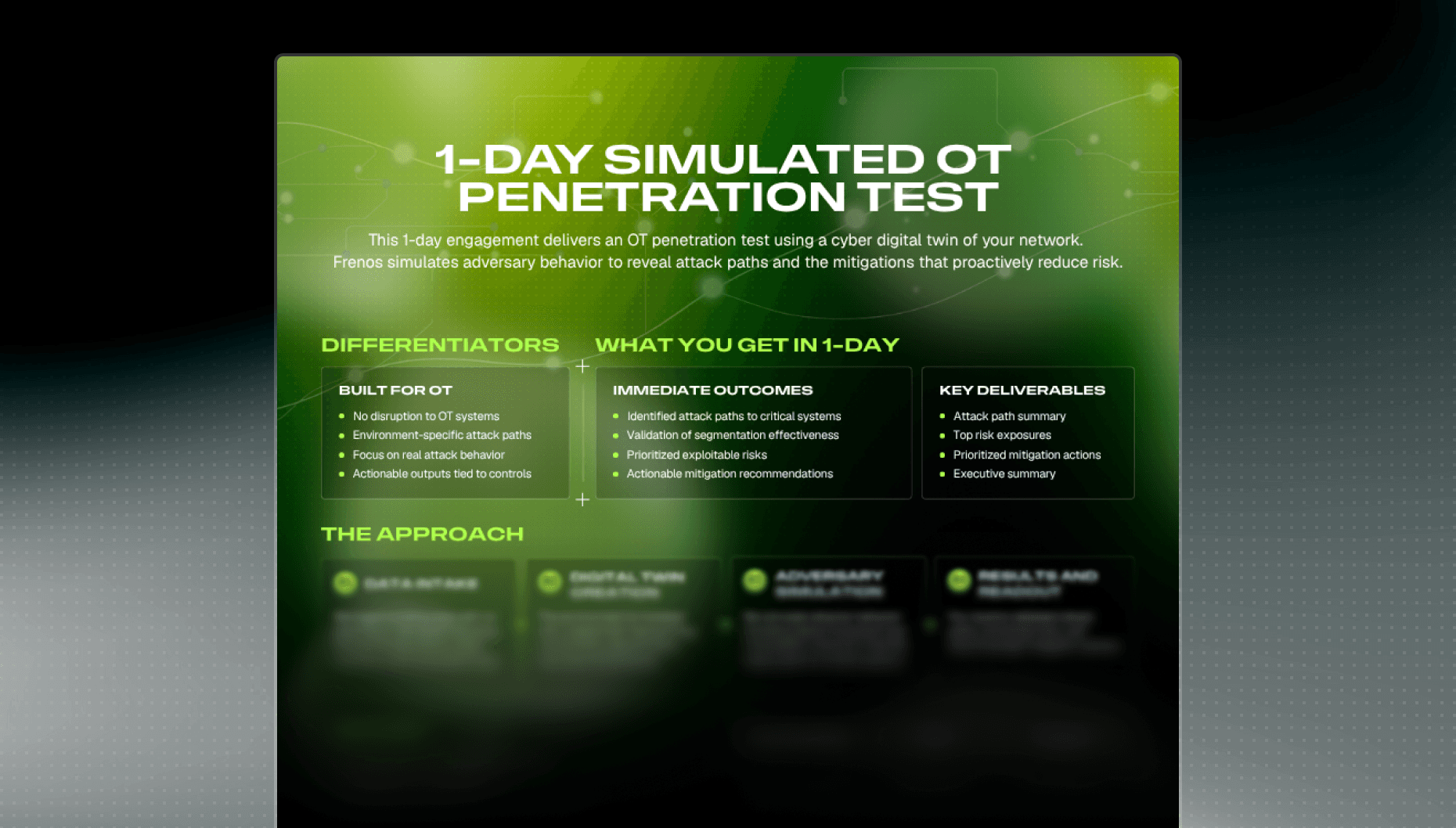

1-Day Simulated OT Pentest
Take a deep dive into understanding how Frenos' simulated OT penetration testing platform allows you to understand and improve your OT security posture at scale.
Read more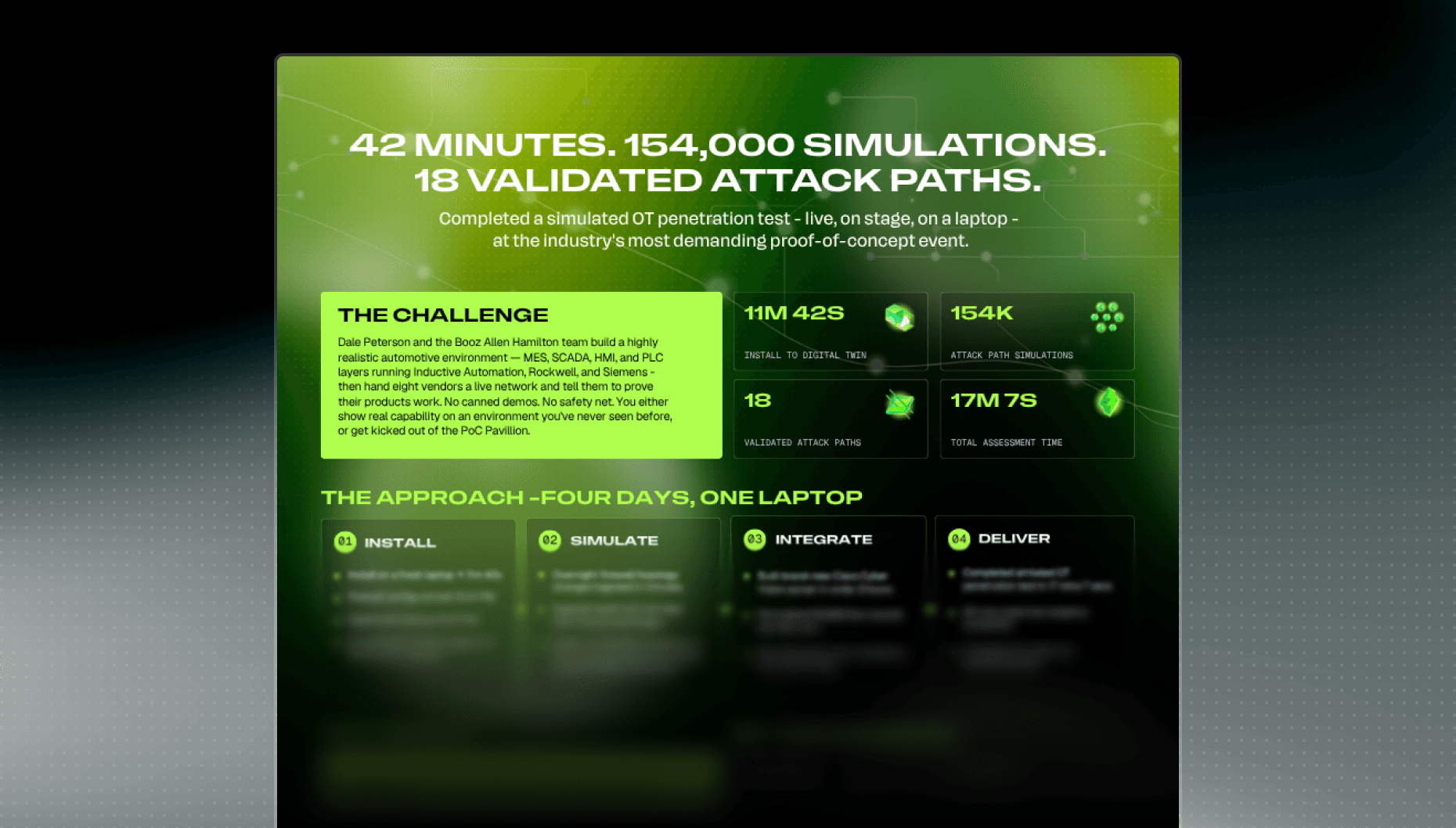
S4x26 Case Study
At the S4x26 POC Pavilion, Frenos completed 154,000 OT attack path simulations in 17 minutes and 7 seconds in a documented engagement. From three assumed-breach starting points (iDMZ, Plant Operations, Enterprise), the platform validated 18 attack paths into the critical Rockwell and Siemens zone. Those paths are exploitable given the actual controls, firewall rules, routing, and configurations modeled in the digital twin.
Read more
Threat Intelligence
Transform static threat intelligence into dynamic attack simulations. Reveal exactly how specific threat actors could compromise your OT environment before they try.
Read more