
Digital Twin vs Live Network Testing in OT Security


Digital Twin vs Live Network Testing in OT Security
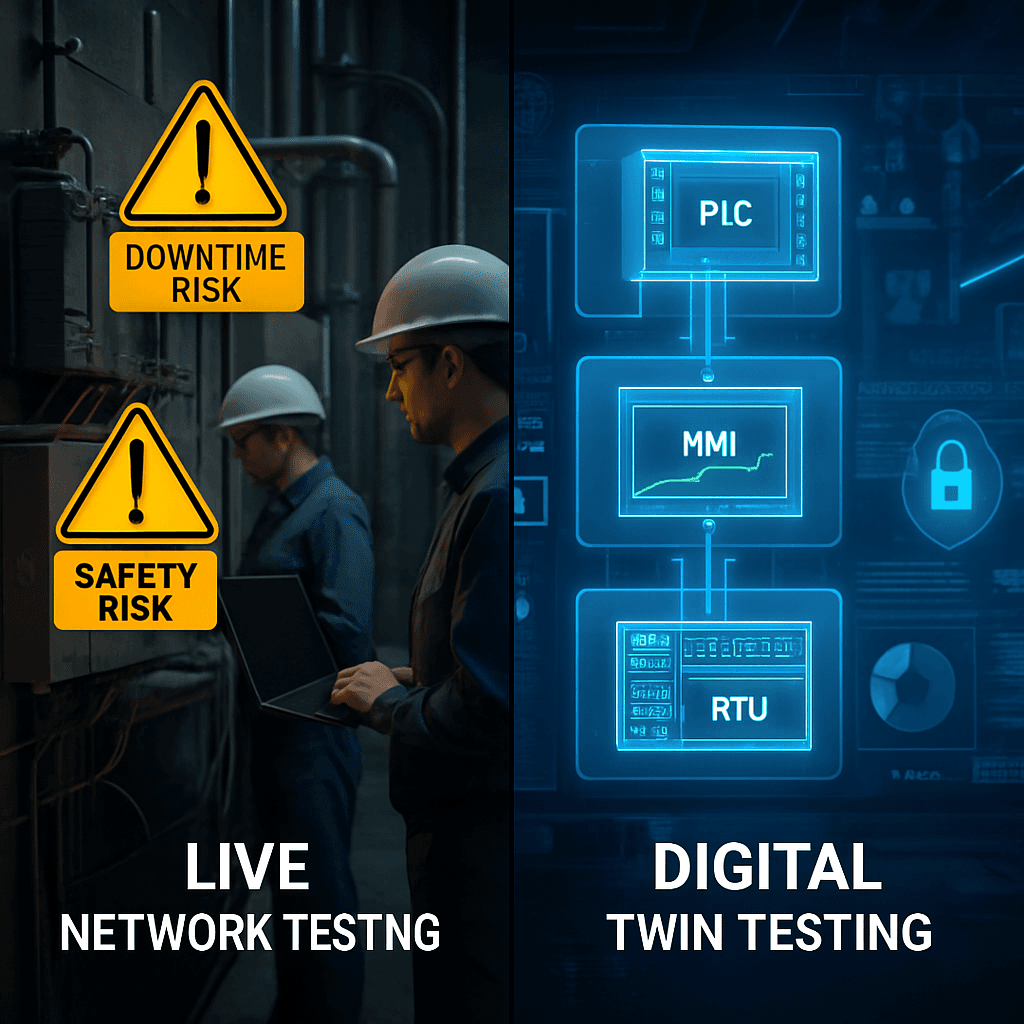
OT security teams need to validate cyber risk without disrupting industrial operations. That creates a difficult choice: test the live network directly or assess a digital twin outside production.
The short answer: Digital twin testing is generally the safer primary approach for critical OT environments. It supports repeatable, comprehensive assessment without interacting with production systems. Live testing still has value when direct validation is required and the work can be tightly controlled.
For many organizations, the most practical strategy is to use digital twin testing for ongoing assessment and reserve live testing for selected findings or specific evidence requirements.
What Is Live Network Testing in OT Security?
Live network testing evaluates security controls by interacting with production or near-production OT systems. The method comes from traditional cybersecurity testing, which was largely developed for more resilient IT infrastructure.
Typical activities include:
- Scanning PLCs, RTUs, HMIs, and other OT assets
- Testing segmentation by attempting movement between zones
- Verifying firewall rules, authentication, and access controls
- Performing limited exploitation under strict supervision
- Testing industrial protocols such as Modbus, DNP3, and OPC
Live OT testing normally operates under significant restrictions. Testing may be limited to planned maintenance windows. Critical or fragile systems may be excluded, and even passive scanning can affect some devices.
The current article cites typical live-testing coverage of 5% to 8% of the total attack surface. It also cites the SANS ICS Security Survey as reporting that 47% of organizations experienced unintended operational disruption during live OT security assessments.
These constraints can make it difficult to obtain a complete view of risk from live testing alone.
What Is Digital Twin-Based Testing in OT Security?
Digital twin-based testing uses a virtual representation of an OT environment to assess security without interacting with production systems.
A production-grade cyber digital twin can represent:
- Network topology: Architecture, segmentation, firewall rules, and access controls
- OT assets and protocols: Virtual representations of PLCs, RTUs, HMIs, historians, and industrial protocols
- Security controls: Existing tools, authentication mechanisms, and compensating controls
- Attack paths: Adversary scenarios and exploitation chains based on the modeled environment
A typical assessment follows five steps:
- Ingest data. Import asset inventories, vulnerability scan results, and network configurations.
- Build the model. Create a virtual environment that reflects production.
- Simulate adversary activity. Evaluate possible attack scenarios and paths.
- Prioritize findings. Rank issues based on exploitability within the modeled environment.
- Repeat the assessment. Update the twin as the environment changes and retest controls.
Because the assessment occurs outside production, teams can repeat testing without introducing direct operational risk. Frenos uses this approach to validate IT-to-OT and OT attack paths without testing live production systems.
Digital Twin vs Live Network Testing
Both approaches can identify vulnerabilities and evaluate security controls. The main differences are production exposure, test coverage, frequency, and the types of scenarios that can be assessed safely.
| Area | Live network testing | Digital twin testing |
|---|---|---|
| Production impact | May cause downtime or system instability | Does not interact with production |
| Safety risk | Can trigger fail-safe behavior or affect fragile devices | Isolated from physical processes |
| Test coverage | Often restricted by operational constraints | Can include the complete modeled environment |
| Frequency | Commonly annual or semiannual | Can run daily, weekly, or on demand |
| Time to results | The article cites three to five months from planning to report | The article cites hours to days |
| Cost per assessment | The article cites $50,000 to $100,000 per site | The article cites costs that may be 70% to 80% lower after initial setup |
| Destructive scenarios | Usually too dangerous for production | Can be evaluated in simulation |
| Audit evidence | Point-in-time results | Ongoing results and trends |
These figures describe the comparison presented in the current article. Actual coverage, timelines, and costs depend on the environment, scope, data quality, and testing method.
Where Live Network Testing Falls Short
Live testing must account for the operational characteristics of industrial systems.
Technical constraints
- Legacy PLCs may not tolerate modern scanning tools.
- A single device failure may interrupt production.
- Limited logging can complicate root-cause analysis.
- Recovery may take hours or days rather than minutes.
Program constraints
- The most critical systems may be excluded from testing.
- Annual findings can become outdated as the environment changes.
- Teams may not be able to validate security improvements quickly.
- Testing only the safest parts of the environment can create an incomplete view of risk.
The current article cites the Dragos World ICS/OT Cybersecurity Year in Review as reporting an average recovery time of 23 hours for unplanned OT incidents. It also cites costs ranging from $100,000 to $5 million, depending on the industry and facility.
Benefits of Digital Twin Testing
Digital twin testing aligns with OT priorities such as safety, stability, and uptime.
Production-safe assessment
Teams can assess modeled critical systems without sending test traffic to production. They can also evaluate scenarios such as ransomware, denial of service, and safety-system manipulation without executing those actions in the live environment.
Continuous security validation
Assessments can run daily, weekly, or on demand instead of only during annual testing cycles. Teams can retest controls after changes and track security posture over time.
Scenario planning
A digital twin can help teams:
- Evaluate specific adversary techniques
- Model architecture changes before implementation
- Assess compensating controls when patching is not feasible
- Validate whether vulnerabilities form exploitable attack paths
Current evidence
Repeated assessments can provide more current evidence than a point-in-time report. They can also document trends for auditors, executives, and boards.
Consistent testing across sites
A standardized simulation method can help organizations assess multiple facilities consistently. The practical level of scalability depends on available data, modeling requirements, and deployment scope.
The current article also notes that organizations may use simulation-based assessment to support programs aligned with NERC CIP, TSA Pipeline Security Directives, and IEC 62443. Applicable requirements should still be evaluated for each organization and environment.
When Live Network Testing Still Makes Sense
Live testing is not obsolete. It can be appropriate when the operational conditions and evidence requirements justify it.
Possible use cases include:
- Testing newly commissioned systems before production integration
- Assessing a fully isolated test environment that mirrors production
- Validating a specific digital twin finding
- Conducting controlled testing during an extended planned outage
- Meeting a requirement that specifically calls for live assessment evidence
Any live testing should have a clearly defined scope, operational supervision, safety controls, and recovery procedures.
For many OT programs, live testing can shift from the primary assessment method to a targeted validation method.
How to Combine Digital Twin and Live Testing
Organizations do not always need to choose only one method. A hybrid approach can combine broad simulation with carefully selected live validation.
A practical process is:
- Use the digital twin as the primary assessment environment. Model the relevant OT systems and evaluate attack paths without testing production.
- Prioritize findings through simulation. Identify vulnerabilities that contribute to credible attack paths in the modeled environment.
- Use live validation selectively. Test only specific findings when direct evidence is necessary and the operational risk is acceptable.
- Update and retest. Incorporate environmental changes into the twin and validate whether remediation reduced risk.
The current page gives an illustrative example of a manufacturing organization with 50 plants. In that example, digital twins assess all plants monthly, narrow more than 12,000 identified vulnerabilities to 450 exploitable issues, and reserve live validation for 15 high-risk findings at three representative plants.
This example illustrates the proposed method. It should not be treated as a guaranteed outcome or universal benchmark.
How Digital Twins Support OT Penetration Testing
Digital twin testing can support OT penetration testing by moving broad adversary simulation away from production.
Potential capabilities include:
- Attack-path validation: Evaluate complete attack chains without affecting live operations.
- Adversary simulation: Model threat techniques and ICS-specific malware behavior in an isolated environment.
- Remediation validation: Assess proposed fixes before production changes are made.
- Continuous testing: Move from annual assessments toward ongoing validation.
This approach changes the risk model. Comprehensive assessment occurs in simulation, while production validation is limited to cases where it is necessary and safe.
For additional context, see the existing OT Penetration Testing guide and the article titled Why Your Next OT Penetration Test Should Be Simulated. Their current CMS links should be retained when this draft is implemented.
Which Testing Approach Should You Choose?
Choose digital twin testing as the primary method when:
- Downtime could have serious operational consequences.
- The environment contains legacy or fragile systems.
- Security posture must be assessed more frequently than once a year.
- Critical systems cannot be included safely in live testing.
- Teams need repeatable metrics for leadership, audit, or remediation planning.
Maintain targeted live-testing capability when:
- A specific requirement calls for live assessment evidence.
- A fully isolated test environment accurately reflects production.
- A particular simulated finding requires direct confirmation.
- Operations can support a controlled testing window.
A hybrid strategy is often appropriate when an organization needs the breadth and frequency of simulation but still requires limited direct validation.
Final Takeaway
Live network testing provides direct evidence, but it can expose OT operations to disruption and often requires a restricted scope.
Digital twin testing provides a safer way to evaluate modeled attack paths, security controls, and remediation options without testing live production systems. It also supports more frequent assessment than traditional point-in-time testing.
For many OT environments, the practical choice is to make digital twin testing the primary assessment method and use live testing only for carefully selected validation needs.
Related Resources
- OT Penetration Testing guide
- Why Your Next OT Penetration Test Should Be Simulated
The exact URLs for these existing resources were not included in the supplied crawl evidence. Their current destinations should be restored from the live page or CMS before publication.
Related links
- Gartner's research on OT security
- OT Penetration Testing guide
- SANS ICS Security Survey
- Dragos World ICS/OT Cybersecurity Year in Review
- Sandworm
- Volt Typhoon
- regulatory requirements
- TSA Pipeline Security Directives
- IEC 62443
- OT penetration testing programs
- Why Your Next OT Penetration Test Should Be Simulated
- Solution Briefs 1-Day Simulated OT Pentest Take a deep dive into understanding how Frenos' simulated OT penetration testing platform allows you to understand and improve your OT security posture at scale. Read more
- Case Studies S4x26 Case Study At the S4x26 POC Pavilion, Frenos completed 154,000 OT attack path simulations in 17 minutes and 7 seconds in a documented engagement. From three assumed-breach starting points (iDMZ, Plant Operations, Enterprise), the platform validated 18 attack paths into the critical Rockwell and Siemens zone. Those paths are exploitable given the actual controls, firewall rules, routing, and configurations modeled in the digital twin. Read more
- Solution Briefs - Critical Infrastructure Threat Intelligence Transform static threat intelligence into dynamic attack simulations. Reveal exactly how specific threat actors could compromise your OT environment before they try. Read more
Related Resources


Why OT Cybersecurity Assessments Need to Evolve
Learn why OT cybersecurity assessments are moving from manual reviews to continuous assessment without testing live production systems.
Read more
Weaponizing Threat Intelligence Against Iranian Ransomware Enablers
See how SAIRA turns intelligence on Iranian ransomware enablers into adversarial simulations that help validate security controls.
Read more
AI Vulnerability Discovery in OT: From Findings to Safe Decisions
Learn how OT teams can validate AI-discovered vulnerabilities in digital twins, assess operational impact, and prioritize safer mitigation decisions.
Read more